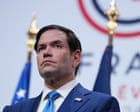
The foreign policy establishment is running a tired script in Abu Dhabi this week. Secretary of State Marco Rubio has touched down in the United Arab Emirates, with subsequent stops planned for Kuwait and Bahrain, on what the mainstream press is breathlessly calling a "high-stakes reassurance tour." The lazy consensus across global newsrooms is that Washington's 60-day ceasefire framework with Tehran has left our traditional Sunni Gulf allies panicking, vulnerable, and betrayed.
According to the conventional narrative, the Gulf Cooperation Council (GCC) monarchies are trembling over a hypothetical $300 billion reconstruction package for Iran, the absence of rigid ballistic missile caps in the preliminary text, and the reality of a revitalized Shiite powerhouse right across the water.
This analysis is fundamentally backward. It operates on a flawed premise that belongs in 2015, completely ignoring the structural transformation of the Middle East over the last four months of active conflict.
I have spent years advising energy firms and analyzing regional security architectures through active private contracts, watching the defense establishment burn billions on empty posturing. The truth that no one in the State Department or the mainstream press wants to voice is simple: the Gulf states do not need to be coddled or reassured. They won this war without firing a single shot of their own, and the current diplomatic framework is a validation of their hyper-pragmatic hedging strategy, not an existential threat to their survival.
The Illusion of Gulf Vulnerability
The core argument of the panic-mongers rests on the idea that the Gulf monarchies are helpless dependencies, horrified by any American diplomatic settlement with Iran. This completely misreads how power operates in the region.
During the intensive four-month military conflict sparked by the February 28 escalations, the GCC nations played a masterful game of calculated neutrality and selective logistical support. They allowed the US-Israeli coalition enough access to prevent a total collapse of regional shipping, yet kept their own operational profiles low enough to avoid catastrophic, regime-threatening retaliation. When Iranian missiles did hit regional infrastructure, the state apparatuses responded not with kinetic escalation, but with strict domestic media blackouts and immediate, quiet diplomatic channels to Tehran.
The UAE, Bahrain, and Kuwait are not shaking because the US signed a Memorandum of Understanding in Switzerland. They are executing a deliberate, long-term pivot. Consider the underlying mechanics of what the media mislabels as "division":
- Economic Symbiosis: The UAE remains Iran’s primary economic lung. Dubai's trading houses have spent decades laundering capital and moving goods into the Iranian domestic market. A formalized truce that lifts primary energy sanctions does not threaten the UAE; it opens a massive, immediate commercial windfall for Emirati logistics hubs.
- The Myth of the Free $300 Billion: The media is treating the proposed $300 billion reconstruction plan as a cash handout from Washington to the Islamic Revolutionary Guard Corps. In reality, it is a conditional, multi-decade framework requiring structural Iranian concessions on uranium enrichment. Vice President JD Vance already spilled the operational blueprint: any unfreezing of assets is tied directly to highly restricted, joint US-Qatari escrow accounts designed to purchase American agricultural yields and basic humanitarian goods. Iran is not getting a blank check to buy hypersonic missiles; they are getting a voucher for American corn.
The Real Chokepoint: Shipping Fees and Sovereignty
The establishment media focuses heavily on abstract geopolitical balances while missing the concrete commercial shifts taking place on the water. Five days before the ceasefire breakthrough, Tehran announced plans to implement maritime passage fees for the Strait of Hormuz.
This is where the contrarian reality of Gulf diplomacy shines. The public position of the GCC is outrage over Iranian maritime overreach. The private reality is that the Gulf monarchies have already insulated themselves from absolute dependency on the Strait. Over the last decade, Saudi Arabia and the UAE have aggressively expanded overland pipelines to the Red Sea and the Gulf of Oman, specifically bypass routes like the Habshan–Fujairah pipeline, which can move 1.5 million barrels per day directly to open water.
The true target of Iran's maritime fee theater is not the local monarchies; it is the international shipping consortia and western naval dominance. By forcing Washington into a bilateral negotiation mediated by Pakistan, Tehran has effectively acknowledged that it cannot force the GCC into submission through raw military leverage.
The Hypocrisy of "Reassurance"
When Rubio tells reporters at Al Bateen Executive Airport that he is there "to hear from them more than we are to talk," he is engaging in necessary diplomatic theater. He knows, and the host ministers know, that the regional security dynamic has permanently shifted toward a multi-aligned model.
The true risk to American interests is not that our Gulf allies will be overrun by a reconstructed Iran. The risk is that the Gulf states have realized they no longer require an exclusive, ironclad American security umbrella. While Rubio lands in Abu Dhabi, Iranian President Masoud Pezeshkian is flying to Pakistan to cement an alternative regional alignment involving Turkey, Egypt, and Saudi Arabia.
The GCC states are not victims of American diplomacy; they are the architects of a new equilibrium. They have successfully used the threat of Iranian aggression to secure advanced Western defense tech, while simultaneously normalizing ties with Tehran via Chinese and Pakistani mediation to ensure their glass towers in Riyadh and Dubai remain un-bombed.
Stop treating the Gulf states as fragile partners requiring constant psychological validation from Washington. They are cold, calculating rational actors who have successfully engineered a scenario where the United States absorbs the military costs of degrading Iran's conventional navy, while they reap the economic benefits of the subsequent peace. Rubio isn't there to save them; he is there to beg them not to replace American influence entirely with a multi-polar web of Eurasian alliances.


