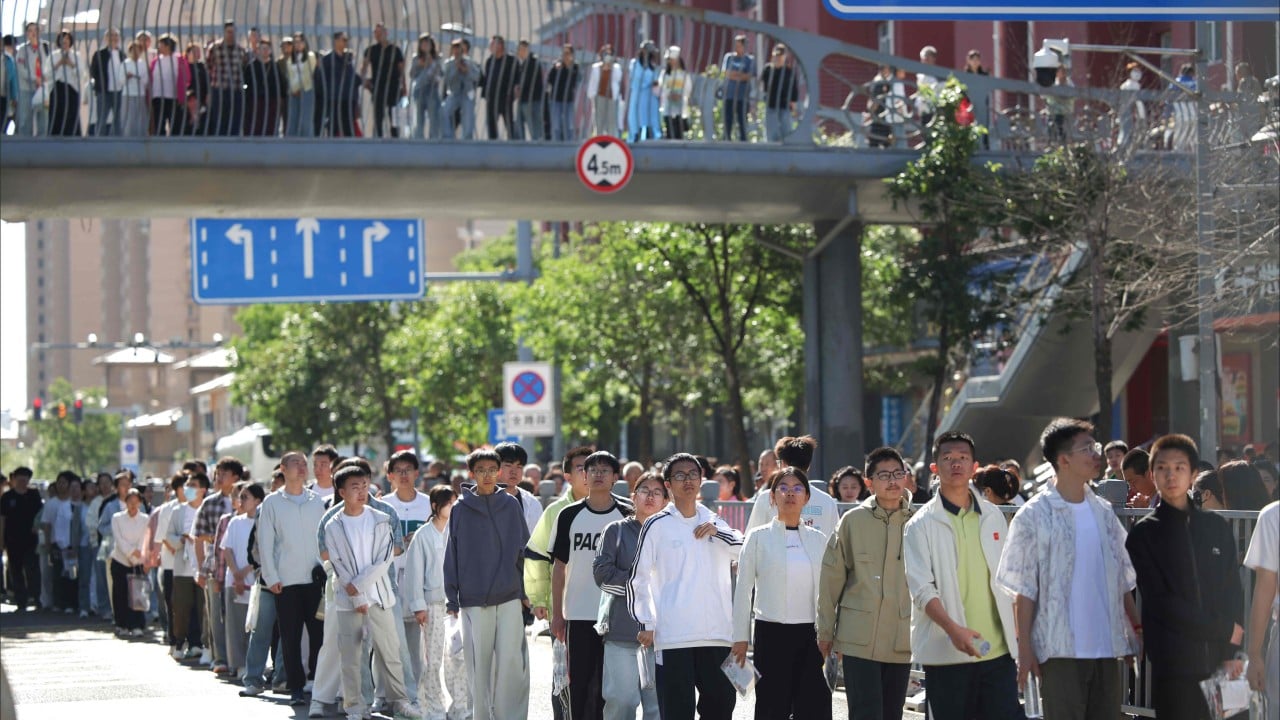
The western press loves a good decline narrative. Show them a demographic chart heading south, and they immediately write an obituary for an entire economic engine. The favorite target right now is the gaokao, China's notorious college entrance exam. Headlines weep over falling registration numbers in certain provinces, framing every dip as a sign of terminal demographic collapse, societal burnout, and the end of the Chinese century.
They have it completely backwards.
Falling numbers do not signal a broken system fading into irrelevance. They signal a ruthless, overdue correction. For decades, the gaokao functioned as an industrial-scale sorting machine, grinding millions of teenagers through memorization factories to produce an overqualified, under-experienced white-collar surplus. What we are witnessing today is not the death of Chinese education. It is the industrialization of credential inflation hitting a hard ceiling, and the smart money is celebrating the crash.
The Lazy Consensus on Demographic Panic
Every lazy analysis of China's shrinking test-taking cohort follows a predictable script. The argument goes like this: fewer babies mean fewer students, fewer students mean empty universities, and empty universities mean a stalled knowledge economy. It is linear, comforting, and entirely wrong.
Look at the ground reality. For years, China suffered from structural over-education in specific disciplines. Universities churned out millions of generic humanities and low-tier engineering graduates into a market that desperately needed skilled technicians, advanced automation operators, and vocational specialists. The obsession with four-year degrees created a bizarre paradox where factories offered six-figure wages for CNC machinists while elite university graduates fought for unpaid internships pushing paper.
When the raw volume of test-takers dips, it relieves pressure on a hyper-inflated credential market. Fewer bodies entering the academic meat grinder means the market value of actual, specialized capability can finally begin to rise. The panic over declining numbers comes from legacy bureaucrats and Western observers who mistake quantity for strength.
The Anatomy of a Forced Pivot
Let us look at what is actually happening beneath the surface data. Beijing is quietly steering capital away from bloated, low-yield academic institutions and pouring resources into high-end technical training and vocational upgrades. They are intentionally strangling the diploma mill model.
I have watched companies burn millions hiring over-credentialed graduates who could pass a multiple-choice exam on ancient poetry but lacked the basic capacity to troubleshoot an automated assembly line or write functional code for embedded systems. The gaokao rewarded obedience and rote memorization. Modern economic survival rewards problem-solving under constraints.
When a society’s youth population shrinks, the state can no longer afford to waste human capital on vanity degrees. Every single young person becomes too valuable to park in a lecture hall for four years learning obsolete theories. The drop in gaokao participation in key urban centers is a direct reflection of families and policymakers waking up to this math. They are bypassing the traditional university track because the ROI has turned negative.
A credential that costs four years of your life and guarantees nothing but debt is not an asset. It is a liability disguised as an achievement.
The Unspoken Cost of the Grind
To understand why fewer students are taking the exam, you have to talk about the psychological fatigue that broke the social contract. For generations, the promise was simple: sacrifice your youth, master the gaokao, secure an iron rice bowl corporate job, and buy an apartment.
That contract expired years ago. The apartment market stabilized downward, corporate entry-level pay flattened, and the sheer saturation of degree-holders turned a bachelor's degree into a high school diploma. Students realized they were running an ultra-marathon where the finish line kept moving further away.
Opting out is not a sign of national weakness. It is a rational economic protest. When youth unemployment metrics spike alongside falling test numbers, mainstream commentators call it a crisis. I call it market clearing. Young people are refusing to participate in a rigged auction for low-tier white-collar gigs. They are retraining, freelancing, or demanding vocational parity.
How to Play the Real Trend
If you are an investor, an educator, or a corporate strategist looking at East Asia through the lens of gaokao enrollment statistics, you are staring at the rearview mirror. Stop tracking how many kids sit for a standardized test in June. Start tracking where the vocational funding goes, which apprenticeship programs are scaling, and how automation is absorbing the labor deficit.
The winners of the next decade will not be the universities with the largest sprawling campuses filled with liberal arts majors. The winners will be the hyper-focused training institutions bridging the gap between raw talent and hard industrial execution.
The era of mass credentialism is over. The gaokao will survive, but its monopoly on ambition is broken. Good riddance.