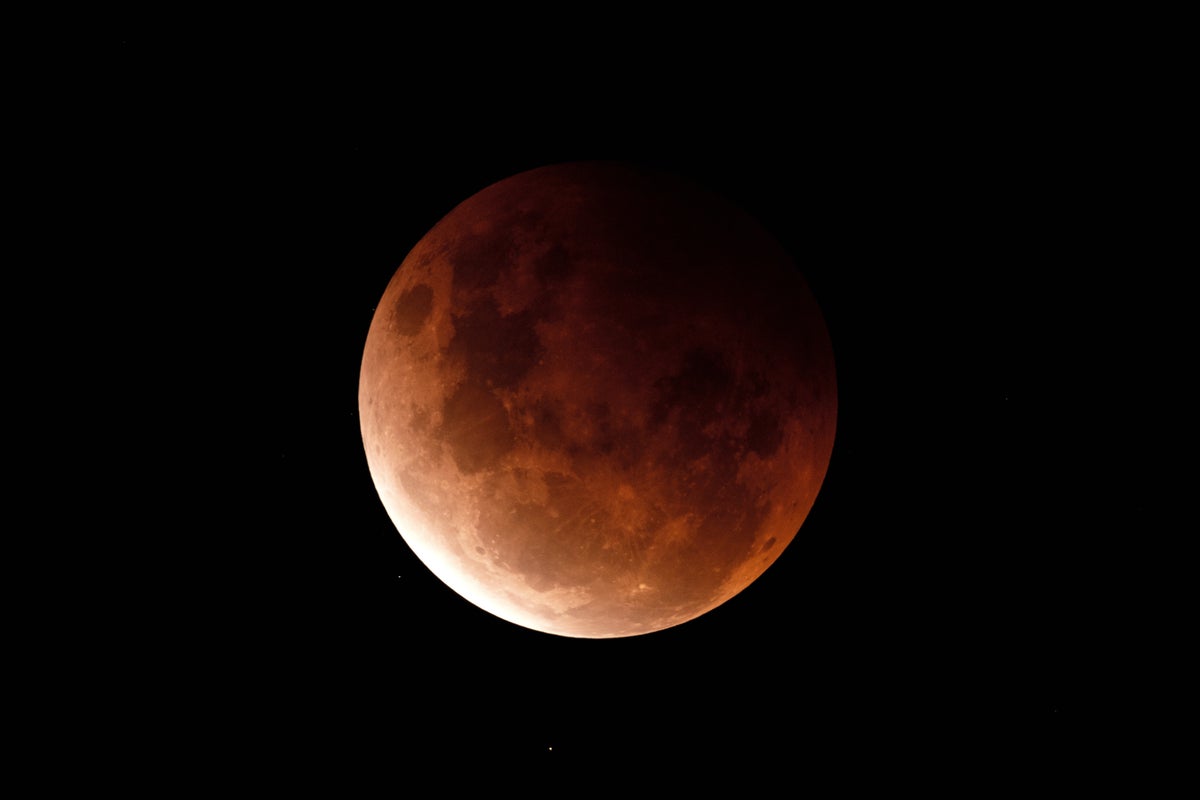
Every time the shadow of our dirt ball of a planet aligns just right to paint the moon a rusty copper, the internet loses its mind. Headlines scream about apocalyptic portents, blood red skies, and once in a lifetime celestial events that demand your immediate attention. Millions of bleary-eyed citizens set 3 AM alarms, stumble onto cold balconies, and stare at a slightly darker, reddish-grey dinner plate hanging in the smog.
Then they go back to bed feeling profoundly underwhelmed.
I have spent two decades tracking orbital mechanics and watching media outlets turn standard geometry into breathless sci-fi trailers. I have seen amateur stargazers blow thousands on motorized tracking mounts just to watch a lunar eclipse look exactly like a rusty nickel through a cheap pair of binoculars. The lazy consensus in every mainstream astronomy piece is that a total lunar eclipse is a visual masterpiece you cannot afford to miss.
They are lying to you. Or at best, they are hyping up a physics equation because fear and wonder generate clicks.
A blood moon is not a visual spectacle. It is a slow motion shadow graph. If you want actual space drama, you are looking at the wrong rock.
The Physics They Refuse to Explain
Let us clear up the basic mechanics right now because the mystic crowd loves to cloud this up with astrology and doom. A total lunar eclipse happens when the Sun, Earth, and Moon line up in exact syzygy. Earth sits right in the middle, casting a long conical shadow into space.
That shadow has two parts. The penumbra is the fuzzy outer edge where the sun is only partially blocked. The umbra is the dark, core shadow. When the moon drifts into the umbra, it should theoretically go pitch black.
It does not. Instead, it turns red. Why? Because of Earth's atmosphere acting like a giant, clumsy lens.
Sunlight passes through the ring of our atmosphere. The blue light scatters away because of Rayleigh scattering—the exact same reason our daytime sky is blue. The red light bends, or refracts, right through the edge of our air and projects onto the lunar surface. Every sunrise and sunset happening simultaneously across the entire rim of the Earth is being cast onto the moon in a collective cosmic projection.
It sounds poetic on paper. In practice? You are looking at a smudge of light filtered through industrial haze, wildfire smoke, and water vapor. If the upper atmosphere happens to be choked with volcanic ash or particulate matter during the eclipse, the moon doesn't glow a fiery crimson. It practically disappears into a charcoal void.
Yet the articles keep promising a cinematic masterpiece. They tell you it is breathtaking. They fail to mention that human night vision is absolute garbage at processing faint, low contrast red light against a pitch-black background. Your eyes take twenty minutes to adjust to the dark, only to strain at a celestial object that has the visual punch of a dying coal ember.
Why the Hype Machine Loves the Moon
Media organizations treat lunar eclipses like the Super Bowl of the cosmos for one simple reason: accessibility.
Anyone with a pair of eyes and an unobstructed eastern or western horizon can see a lunar eclipse. You do not need a telescope. You do not need dark sky reserves miles away from city light pollution. You can stand in the middle of a neon-drenched parking lot in downtown Chicago and watch the moon turn slightly muddy.
This low barrier to entry makes it the ultimate lazy journalism piece. Copy, paste, insert local times, add a stock photo of a glowing red sphere photoshopped to look like a flaming basketball, and watch the traffic roll in.
Compare this to a total solar eclipse. A solar eclipse requires precise geography. You have to travel to the narrow path of totality. The logistics are a nightmare. Traffic jams stretch for fifty miles. Hotels cost a grand a night. But when the moon covers the sun, the temperature drops, the stars pop out at noon, and the solar corona dances like silver fire around a black hole in the sky. That is a life altering event.
A blood moon is the celestial equivalent of decaf coffee. It looks like the real thing, it shares the name, but when you drink it down, there is no kick.
The Real Spectacle You Are Ignoring
While millions of people stand outside staring blankly at a copper-tinted moon, the actual dynamic universe is putting on a show overhead that puts a lunar shadow game to shame.
If you want to experience space worth losing sleep over, look at what else is happening while the astronomy nerds are obsessing over the lunar umbra.
- The Transit of Bright Satellites: Thousands of low Earth orbit commercial arrays sweep across the night sky in silent, perfectly organized military precision. Seeing a train of Starlink satellites catch the late evening sun just minutes after sunset provides a visceral reminder that humanity has actively ringed this planet in iron and silicon.
- Deep Sky Targets with Small Glass: Instead of looking at a moon washed out by direct sunlight redirection, point a basic pair of 10x50 binoculars at the constellation Orion. Find the Orion Nebula. You are photons away from a stellar nursery where massive stars are violently ripping gas clouds apart right now. That light left its source when early humans were painting caves.
- Planetary Conjunctions: Watching Jupiter and Venus creep within arcseconds of each other over a span of three clear nights offers a geometric dance of worlds that dwarfs our local satellite in scale and brightness.
These events do not get breathless headline treatment because they happen quietly. They require patience. They require a tiny bit of intellectual curiosity rather than a panic-driven calendar alert.
How to Handle the Next Eclipse
Am I telling you to pull down your window blinds and ignore the next lunar alignment? Not necessarily.
I am telling you to lower your expectations to ground level so you do not feel cheated by the hype machine.
If you decide to step outside for the next alignment, do not waste an hour freezing your fingers off waiting for a dramatic color shift. Step out for five minutes. Notice the math. Appreciate the fact that a tiny spherical rock casting a shadow millions of miles long can hit another rock with geometric precision. That is the real win here. The triumph of Newtonian physics and Keplerian orbits.
The color itself? A byproduct of dust and gas.
Stop treating astronomy like a Marvel movie premiere. The universe does not need hyperbole to be magnificent, but the internet insists on selling it that way anyway.
Go to sleep. The moon will still be there tomorrow, looking exactly like the dusty, cratered rock it has always been.