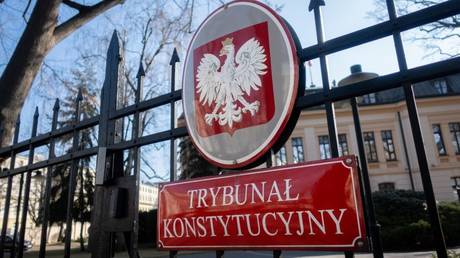
Mainstream media outlets love a good street fight in a marble hallway. When shouting matches and shoving break out inside Warsaw’s Constitutional Tribunal, legacy editors immediately slap the word "coup" into the headline, embed a few shaky smartphone videos, and call it journalism.
They are lying to you through sheer laziness.
What happened inside Poland’s top court is not a coup d'état. It is not the sudden, violent overthrow of a legitimate democratic order. It is the inevitable, loud, and deeply ugly demolition of an already broken legal cartel. If you watch the viral clips of politicians and judges screaming at one another in the corridors of the Tribunal and think you are witnessing the death of Polish democracy, you missed the actual crime scene by nearly a decade.
The Lazy Consensus of the "Coup" Narrative
Let us look at the dominant narrative pushed by the international press and opposition commentators in Warsaw. Their story is simple, digestible, and completely devoid of structural context. In their telling, the ruling coalition led by Prime Minister Donald Tusk is trampling the rule of law, ignoring judicial independence, and staging an institutional "coup" against the Constitutional Tribunal—a body stocked with judges appointed by the previous Law and Justice (PiS) government.
This framing relies on a fatal logical flaw. It assumes that the Constitutional Tribunal was functioning as a legitimate, independent court prior to the shouting matches in the hallway.
It was not.
To call the dismantling of a captured institution a "coup" is like arresting a counterfeiter and being accused of destroying the currency. You cannot overthrow a constitutional court that stopped operating under the Polish Constitution years ago. When journalists repeat the word "coup" without qualification—even tucked inside quotation marks—they act as stenographers for political theater. They validate the premise that a normal judicial body is under attack by an authoritarian mob, rather than explaining that an illegitimate political bunker is finally being cleared out.
How a Court Dies Before Anyone Starts Shoving
I have spent years watching Central European legal systems buckle under political pressure, and the pattern never changes. Institutional collapse rarely happens when cameras are rolling. It happens quietly, through procedural sabotage, years before the public ever sees a viral video.
To understand the chaos in Warsaw, you have to understand the exact mechanics of how the Constitutional Tribunal was hollowed out between 2015 and 2023.
- The "Stand-In" Judges (Sędziowie-dublerzy): Under Article 194 of the Polish Constitution, the Constitutional Tribunal consists of 15 judges chosen individually by the Sejm (the lower house of parliament). In late 2015, the incoming PiS majority refused to swear in three judges who had been legally elected by the previous parliament, instead electing their own replacements for seats that were not legally vacant. Both the European Court of Human Rights (ECtHR) and the Court of Justice of the European Union (CJEU) explicitly ruled that panels including these "stand-in" judges do not constitute a "tribunal established by law."
- The Term-Limit Manipulation: Julia Przyłębska, who presided over the Tribunal for years, remained in her post long after the statutory six-year term for the Tribunal's President had expired in December 2022. She argued that the law introducing the six-year limit did not apply to her retroactively, sparking an internal mutiny even among other PiS-appointed judges who refused to recognize her authority or attend full-bench hearings.
- Selective Docket Engineering: Instead of acting as a neutral arbiter of constitutionality, the Tribunal became a legislative veto weapon. Whenever the new government passed a law to reform state media, the judiciary, or public prosecution, PiS lawmakers immediately referred it to the Tribunal, which routinely issued rapid "interim measures" to freeze the reforms before they could even take effect.
When an institution violates its own founding charter, ignores the rulings of binding European courts, and operates as a partisan branch office, it ceases to be a court. It becomes a squatters' camp with gavels.
The Question Nobody in the Media Is Asking
When viewers search for news about the chaos in Poland’s top court, they usually ask: "Is Donald Tusk’s government breaking the law to restore the rule of law?"
That is the wrong question. It traps you in a false binary where either the old guard is right or the new government is authoritarian.
The real question—the one constitutional scholars like Marcin Matczak and Wojciech Sadurski have wrestled with for years—is much harder: How do you restore a constitutional order using purely constitutional tools when the guardian of the constitution has been hijacked by the opposition?
Think about the mechanics of that trap. Imagine a scenario where a referee in a championship game takes a bribe from Team A, rewrites the rulebook at halftime, and declares that any attempt to remove him from the field is a violation of league rules. If Team B walks off the field, they lose. If Team B physically removes the corrupt referee, the announcers scream that Team B is attacking the integrity of the game.
That is Warsaw right now.
If the Tusk administration obeys every ruling issued by panels containing unlawfully appointed stand-in judges, they permanently legitimize an illegal court and surrender their democratic mandate to govern. If they ignore those rulings and pass resolutions declaring the Tribunal defective, they invite accusations of "legal dualism" and authoritarian overreach.
There is no clean, polite, bloodless exit from a captured state. Anyone selling you a neat procedural fix is either naive or lying.
Why "Coup" Claims Are Political Weapons, Not Legal Definitions
Let us define our terms with surgical precision, because sloppy language ruins public discourse.
A coup d'état is the sudden, extra-constitutional seizure of executive state power, typically involving the military, police, or armed factions, to depose an existing government.
Nothing remotely resembling that occurred in Warsaw. The government in power won a free and fair parliamentary election with a record 74% voter turnout. They hold the executive mandate. The disputes inside the Tribunal building involve competing interpretations of parliamentary resolutions, the validity of judicial mandates, and physical access to hearing rooms and administrative offices.
Why, then, do PiS politicians and their media allies scream "coup" (zamach stanu) into every microphone?
Because victimhood is the ultimate currency in modern populist politics. When you lose the parliament, lose the public broadcaster, and watch your judicial shield crumble, you cannot win an argument on dry administrative law. Nobody marches in the streets over Article 190 of the Polish Constitution. People do get angry when they are told a violent coup is underway. The word is engineered for domestic mobilization and international confusion—specifically designed to trick foreign correspondents who do not read Polish legal journals into writing "both sides" headlines.
The Uncomfortable Truth About the Current Government’s Strategy
Being a contrarian does not mean giving the current Polish government a free pass. If you want an honest assessment, you have to admit the massive downsides to the aggressive path Tusk’s coalition has chosen.
To bypass a hostile President (Andrzej Duda, who vetoes almost every judicial reform bill) and a captured Constitutional Tribunal, the government has relied heavily on parliamentary resolutions (uchwały) rather than formal statutes (ustawy), and has refused to publish certain Tribunal rulings in the official Journal of Laws (Dziennik Ustaw).
Here is the brutal reality: That is a dangerous precedent.
In a healthy democracy, the executive branch does not get to pick and choose which court rulings it prints in the official gazette. Even when a ruling comes from a tainted bench, withholding publication sets a trap for the future. If PiS returns to power in four years, they will point directly to the 2024–2026 playbook and say, "You governed by parliamentary resolution and ignored our courts; now we will govern by resolution and ignore yours."
By fighting fire with fire, the current coalition risks burning down the very concept of binding judicial review. They are trading long-term institutional stability for short-term governance survival. It is a calculated gamble, and it carries the very real risk of institutionalizing permanent legal chaos in Central Europe.
How to Actually Read Political Chaos Without Getting Played
If you want to stop falling for sensationalist headlines every time a constitutional crisis erupts in Europe, stop watching the hallway shoving matches and start tracking the actual levers of power.
- Ignore the hallways; read the Journal of Laws. Video of politicians yelling at security guards is pure theater. What matters is whether a ruling is officially promulgated and whether lower-court judges in district and appellate courts actually cite it in their decisions. In Poland, the vast majority of ordinary judges have already stopped recognizing the legitimacy of the Tribunal’s tainted panels. The system has quietly routed around the blockage.
- Follow the European Court of Human Rights, not local partisans. When two factions in a country accuse each other of violating the constitution, look to the binding supranational treaty obligations both sides signed. The ECtHR rulings (such as Xero Flor w Polsce sp. z o.o. v. Poland) established clear, objective legal facts about the composition of the Polish court long before the current shouting matches began.
- Separate "illegal" from "extra-constitutional." Learn to distinguish between a government breaking an ordinary statute and a government attempting to dismantle a parallel legal structure created in violation of the constitution. They look identical on a 15-second news clip, yet they represent opposite legal realities.
The next time a headline tells you that a "coup" has erupted inside a European courthouse, turn off the sound on the video. Look at who appointed the judges, check whether their terms expired years ago, and ask yourself who benefits from you believing that a captured bunker is a real court.
You are not watching the overthrow of a democracy—you are watching the noisy, overdue eviction of squatters who locked themselves inside the courthouse years ago.