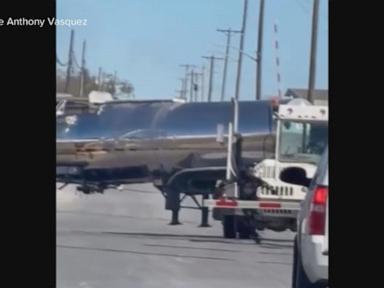
Viral dashcam footage out of Fort Worth shows a tanker truck clearing railroad tracks just seconds before a freight train screams through the crossing. Within minutes, the internet's armchair safety experts arrived with their favorite lazy take. They called the driver reckless. They demanded his commercial license. They treated a near-catastrophe like a simple case of individual stupidity.
That consensus is not just wrong. It is dangerous.
When you reduce a near-miss between an eighty-thousand-pound hazardous materials rig and a multi-thousand-ton locomotive to "bad driving," you let the real culprits off the hook. You ignore decades of fractured municipal planning, outdated rail preemption engineering, and the brutal economic pressure baked into modern freight logistics.
If you want to understand why tanker trucks keep getting trapped on tracks in sprawling metroplexes like Dallas-Fort Worth, stop staring at the cab. Start looking at the pavement beneath the tires and the traffic signals fifty feet ahead.
The Physics of a Trap You Cannot See
Most people judge commercial truck drivers using passenger car intuition. In a sedan, you see a crossing, you check left and right, and you cross in two seconds. If traffic backs up, you stop cleanly behind the white line.
A fully loaded tanker truck operates in a completely different physical reality.
First, consider the vehicle's geometry and mass. A standard hazardous materials tractor-trailer stretches roughly seventy feet long and weighs up to eighty thousand pounds when loaded. Under Federal Motor Carrier Safety Administration regulations, drivers hauling placarded hazardous materials must come to a complete stop fifteen to fifty feet before every railroad grade crossing, open their window or door to listen, check both directions, and then accelerate from a dead stop across the rails.
Think about what happens next.
- Zero momentum: Starting an eighty-thousand-pound vehicle from zero on a slight incline takes agonizing seconds. A driver cannot simply tap the gas to clear the tracks if conditions change mid-crossing.
- The dynamic envelope: A train does not stay strictly between the steel rails. Locomotives and railcars overhang the track bed by several feet on each side, creating a strike zone much wider than the tracks themselves.
- The surge effect: Tankers carry liquid. Even with internal baffles designed to dampen movement, liquid cargo shifts forward and backward during braking and acceleration, fighting the driver's inputs at the exact moment precision matters most.
Now add urban traffic congestion into that equation.
In high-growth freight hubs like Fort Worth, industrial corridors sit right next to booming suburban commuter routes. A driver stops legally at the crossing. The tracks ahead look clear. The driver initiates the slow, heavy pull across the rails. Five seconds later, a traffic light thirty yards past the crossing turns red, or a commuter car cuts into the truck's braking cushion, shrinking the landing zone on the far side of the tracks.
Suddenly, seventy feet of steel and flammable liquid is straddling an active mainline with nowhere to go.
Why Railroad Crossing Design Fails Heavy Freight
I have spent years dissecting supply chain failures and watching transportation agencies throw millions of dollars at public awareness campaigns while ignoring glaring infrastructure defects. Telling drivers to "Look, Listen, and Live" does nothing when the intersection itself is engineered like a snare.
The core technical failure at urban crossings is almost always signal preemption—or the lack of it.
At a properly engineered crossing near a signalized intersection, the railroad's track circuit communicates directly with the municipal traffic light controller. When an approaching train trips the circuit—typically twenty to thirty seconds before arrival—the traffic light immediately switches to green for vehicles clearing the tracks, flushing traffic out of the danger zone before the crossing gates descend.
In older industrial zones across Texas and the rest of the country, that synchronization is frequently broken, outdated, or missing entirely.
When preemption fails or runs on an insufficient timer, the traffic light stays red while the crossing bells start ringing. Cars stack up bumper-to-bumper on the far side of the rails. A truck driver who entered the crossing when space appeared open—or who misjudged the stack-up by ten feet—gets pinned between a wall of commuter cars and a descending wooden gate arm.
Then there is the problem of hump crossings.
Over decades, road crews repave asphalt approaches to railroad tracks layer by layer, while the tracks themselves stay fixed on their ballast bed. This creates a steep vertical crown—a hump—right at the rail line. Low-clearance trailers and heavy tankers have to crawl over these humps to avoid bottoming out or rupturing undercarriage components. Crawling across a track eats up the exact twenty-second warning window federal regulations require for crossing signals.
The Gate Arm Myth
Watch the comments on any viral train-versus-truck video and you will see the same question repeated endlessly: "Why didn't the driver just drive through the crossing gate?"
It is a fair question with an infuriating answer.
Crossing gate arms are designed with shear bolts so a trapped vehicle can snap them off without disabling the truck. In theory, a driver trapped on the tracks should floor it, break the wooden or fiberglass arm, and escape.
In practice, drivers freeze because the trucking industry has conditioned them to fear minor property damage almost as much as a crash.
Breaking a crossing gate triggers an automatic federal incident report, an immediate drug and alcohol test, a police citation, and a permanent mark on the driver's Compliance, Safety, Accountability score. For an owner-operator or a company driver working under strict safety bonuses, snapping a two-hundred-dollar piece of wood feels like career suicide. By the time the driver's brain overrides that conditioning and realizes a locomotive is bearing down at fifty miles per hour, ten precious seconds have evaporated.
What Everyone Gets Wrong About Freight Safety
When viral footage surfaces, news outlets and safety boards default to predictable talking points. Let's dismantle the three biggest misconceptions driving the public conversation.
Misconception 1: "We need stricter penalties for reckless truckers."
Strict liability already exists. Commercial drivers face federal disqualification, massive fines, and criminal negligence charges for crossing violations. Adding harsher penalties does not change the laws of physics or fix a poorly timed traffic light. Punishing the last person in a broken chain of decisions creates the illusion of action while leaving the trap intact for the next truck.
Misconception 2: "Automated cameras at crossings will stop near-misses."
Enforcement cameras generate municipal revenue and mail tickets two weeks after an incident. A camera cannot clear a backed-up intersection, lengthen a twenty-second signal cycle, or give a tanker driver an escape lane. Real prevention requires physical grade separation—bridges and underpasses—or interconnected intelligent traffic systems that hold cross-traffic back before a heavy vehicle ever commits to the tracks.
Misconception 3: "Drivers ignore warning lights to save time."
Nobody hauling flammable liquids plays chicken with a freight train to shave two minutes off a delivery schedule. Tanker drivers are among the most vetted, experienced professionals on the road; carriers rarely hire anyone with less than two years of clean commercial experience just to insure the cargo. When a tanker ends up on the tracks with a train approaching, it is almost never bravado. It is an entrapment scenario caused by sightline obstructions, queuing traffic, or signal timing failures.
The Brutal Math of Grade Crossings
To understand why these near-misses keep happening in places like Fort Worth, look at the sheer scale of the friction point. The United States has more than two hundred thousand public and private highway-rail grade crossings. Texas alone leads the nation with roughly nine thousand public crossings—more than any other state by a wide margin.
Every single at-grade crossing is an architectural compromise.
Building an overpass or underpass to separate road traffic from rail traffic costs anywhere from fifteen million to over fifty million dollars per intersection, depending on utility relocation and right-of-way acquisition. Cities and freight railroads routinely fight over who pays that bill. Because neither side wants to absorb the capital expense, dangerous at-grade crossings remain open in the middle of dense freight corridors for decades after traffic volumes have outgrown them.
Instead of spending concrete-and-steel money to eliminate the hazard, agencies spend pennies on paint, signs, and public service announcements.
Meanwhile, freight trains have grown dramatically longer under Precision Scheduled Railroading. Two-mile-long trains are now standard across major Class I rail networks. Longer trains mean crossings stay blocked for ten or fifteen minutes at a time, creating massive traffic bottlenecks on adjacent roads. When the gates finally rise, pent-up commuter traffic surges forward erratically, creating the exact stop-and-go chaos that traps heavy commercial trucks mid-crossing.
The Uncomfortable Truth About My Contrarian View
Blaming infrastructure and systemic design has a real downside: it risks excusing genuine driver negligence when it actually happens.
There are drivers who roll through stop lines without looking. There are drivers distracted by dispatch tablets, fatigued from pushing Hours of Service limits, or unfamiliar with local routes who blindly follow GPS directions onto narrow industrial crossings never meant for fifty-three-foot trailers. No amount of signal engineering can save a driver who ignores flashing red lights and tries to beat a descending gate.
Accountability has to run in both directions. Drivers must treat every grade crossing like a loaded weapon, refusing to enter the track bed unless there is guaranteed, unobstructed space for the entire length of their rig on the far side—regardless of how many impatient commuters honk behind them.
How to Actually Stop the Next Tanker Crash
If transportation officials, fleet operators, and city planners want to prevent the next Fort Worth near-miss from turning into a hazardous materials fireball, they need to stop lecturing drivers and start fixing the environment.
- Audit every hazmat route crossing for queue spillback. Municipal traffic engineers must measure the exact distance between railroad tracks and downstream traffic lights. Anywhere that distance is less than one hundred feet, traffic signals must be hardwired into the rail preemption circuit to flush queues early.
- Eliminate the penalty for emergency gate strikes. Federal regulators and carriers should explicitly indemnify drivers who snap a crossing gate to escape an active track entrapment. Make it standard training: if the lights flash while your trailer is over the rails, you do not stop, you do not hesitate, and you do not worry about the gate arm.
- Deploy commercial-specific routing enforcement. Consumer GPS apps routinely route heavy trucks across steep, low-clearance, or short-storage crossings. Fleet dispatchers and municipal authorities need mandatory geofenced routing that keeps placarded tankers strictly on grade-separated corridors or fully preempted arterial crossings.
- Close redundant at-grade crossings. In older industrial districts, towns often have three or four rail crossings within a single mile. Closing half of them and funneling the money into one properly engineered overpass eliminates multiple points of failure permanently.
Watching a tanker truck barely escape a locomotive in Fort Worth should not make you angry at one driver. It should make you furious at a transportation system that keeps building hundred-million-dollar logistics hubs around nineteenth-century intersections—and then acts shocked when eighty thousand pounds of fuel gets caught in the middle.