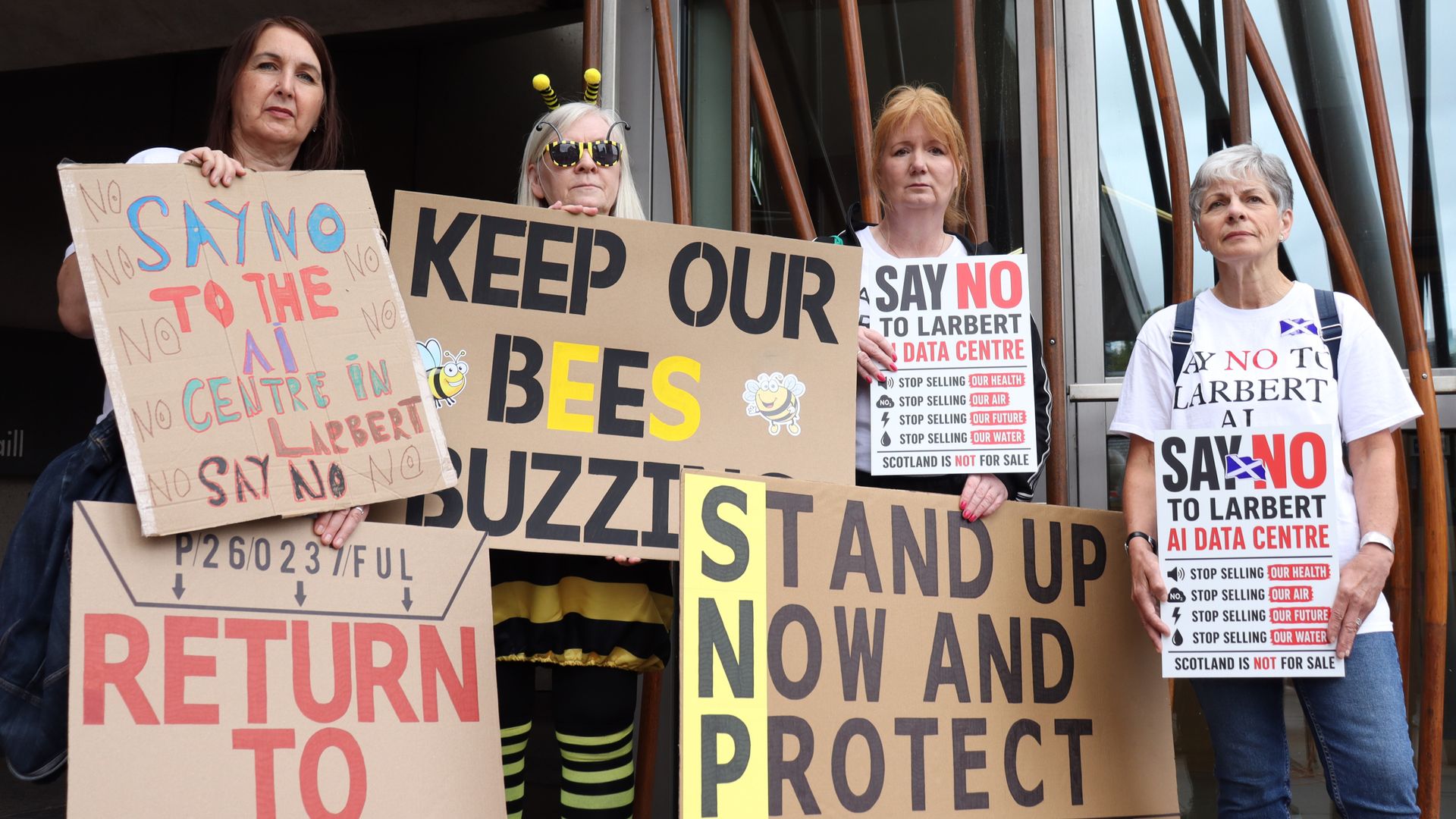
Every few weeks, a new headline declares war on the concrete boxes powering artificial intelligence. The script is always the same. Local residents complain about the hum. Environmentalists point to water consumption. Utility executives wring their hands over aging transformers and warn of impending blackouts.
It is a neat, tidy villain story. It is also completely backwards.
The lazy consensus in tech journalism right now treats AI data centres like parasitic vampires draining a pristine, well-oiled electrical grid. That narrative gives a free pass to the real culprits behind our energy bottlenecks—decades of utility underinvestment, broken permitting laws, and a transmission network held together by duct tape and 1970s engineering.
I have sat in site-selection war rooms where hyperscalers tried to hand utilities hundreds of millions of dollars upfront to upgrade regional substations, only to be told the permitting queue would take seven years. The data centres aren't breaking the grid. They are exposing how broken the grid already was, and they happen to be the only entities with the balance sheets big enough to fix it.
The Myth of the Parasitic Server Farm
When a reporter writes that a single hyperscale campus consumes as much electricity as a mid-sized city, the framing is designed to trigger panic. We picture millions of suburban homes going dark so a chatbot can generate marketing copy.
Here is what that framing leaves out. Residential demand is erratic, peaking violently between 5:00 PM and 9:00 PM when everyone turns on their air conditioning, ovens, and televisions at the exact same moment. Utilities have to build massive, expensive "peaker" plants that sit idle 90% of the year just to survive those four-hour surges.
AI training clusters are the exact opposite. They are flat, predictable, 24/7 baseload consumers. For a power generator, a customer that buys a guaranteed 500 megawatts every single hour of every single day is a dream scenario. It underwrites the financing for new power generation that would otherwise never get built.
The Transmission Bottleneck Nobody Mentions
If you want to know why power grids are straining in Northern Virginia, Dublin, or Frankfurt, stop looking at the GPUs and start looking at high-voltage transmission lines.
In the United States, the average age of a large power transformer is over 40 years—well past its intended design life. According to data from the Lawrence Berkeley National Laboratory, more than 2,600 gigawatts of generation and storage capacity are currently stuck in interconnection queues across the country. That is more than double the total generating capacity of the entire existing U.S. power fleet.
The electricity exists. The solar farms, wind turbines, and natural gas plants are waiting to connect. They are blocked because regional grid operators lack the transmission infrastructure to move electrons from where they are generated to where they are needed. Blaming AI data centres for grid instability is like blaming a fleet of delivery trucks for traffic jams on a highway that hasn't been repaved since the Carter administration.
The Water Consumption Shell Game
Right behind the electricity panic comes the water outrage. Critics love to cite eye-popping figures about millions of gallons evaporating into thin air to cool racks of Nvidia H100s and Blackwell chips.
On the surface, the optics look terrible. Dig into the thermodynamics, and the outrage falls apart.
First, you have to separate closed-loop cooling from evaporative cooling. Older facilities built a decade ago relied heavily on evaporative cooling towers because water was cheap and the hardware ran cooler. Modern AI clusters generate heat densities that make traditional air-and-water evaporation obsolete. When you pack 100 kilowatts into a single server rack, air simply cannot carry the thermal load away fast enough.
The industry is rapidly shifting to direct-to-chip liquid cooling and immersion systems. In a closed-loop liquid system, coolant circulates through cold plates attached directly to the processors, absorbs the heat, and transfers it to an external heat exchanger. Once the loop is filled, water loss is virtually zero. Microsoft, Meta, and Google have all deployed zero-water-evaporation designs for their newest AI-ready facilities.
Second, look at the relative scale. In drought-stricken regions like Arizona or Spain, data centres routinely catch heat for water use while golf courses, alfalfa farms, and leaky municipal pipes waste orders of magnitude more. A single 18-hole golf course in the American Southwest can consume upwards of 300,000 to 500,000 gallons of water per day. Yet nobody chains themselves to the gates of a country club to protest turfgrass irrigation.
To be fair, the industry earned some of this skepticism. In the early days of the cloud boom, developers routinely hid behind non-disclosure agreements and shell companies, concealing water projections from local water boards until the concrete was already poured. That secrecy bred justifiable distrust. Transparency is non-negotiable now, and facilities built in water-stressed basins have zero excuse for using open-loop evaporative systems.
Why Utilities Secretly Love the AI Boom
If you listen to public utility commission hearings, you would think power companies are drowning under the weight of tech requests. Look at their investor earnings calls, and you hear a completely different tune.
For nearly twenty years—from roughly 2002 to 2022—U.S. electricity demand was effectively flat. LED lighting, Energy Star appliances, and offshored manufacturing offset population growth. Regulated utilities make money by deploying capital into infrastructure and earning a guaranteed rate of return approved by state regulators. Flat demand meant limited excuses to build new infrastructure, which meant stagnant growth.
AI shattered that stagnation overnight.
- Capital expenditure: Utilities are projecting tens of billions of dollars in new grid investments over the next five years, largely justified by data centre load growth.
- Cost socialization vs. ring-fencing: The real fight isn't whether the grid can handle the load; it's who pays for the upgrades.
When utilities do it wrong, they spread the cost of new substations and transmission lines across all ratepayers, effectively forcing a retired schoolteacher to subsidize a trillion-dollar tech giant's power hookup. That is where the public backlash is 100% justified.
When regulators force hyperscalers to sign special purpose tariffs—requiring them to pay upfront for dedicated transmission upgrades and commit to minimum monthly power purchases regardless of whether they use the electricity—everybody wins. The utility gets a guaranteed return, the data centre gets its megawatts, and residential ratepayers get a modernized, more resilient grid without seeing their monthly bills spike.
The Nuclear and Behind-the-Meter Reality
The smartest operators in this space aren't waiting around for regional grid operators to untangle their bureaucratic knots. They are bypassing the public grid entirely.
Look at what happened when Talen Energy struck a deal to co-locate an Amazon Web Services data centre directly next to the Susquehanna nuclear power plant in Pennsylvania, or Microsoft's power purchase agreement to restart Unit 1 at Three Mile Island. Even though the Federal Energy Regulatory Commission pushed back on the Susquehanna interconnection terms—highlighting the genuine regulatory friction over grid maintenance fees—the strategic direction is unmistakable.
This is called behind-the-meter generation. By plugging directly into a power plant before the electricity ever touches the public transmission network, data centres eliminate transmission losses, bypass seven-year interconnection queues, and secure carbon-free baseload power.
Imagine a scenario where a tech company wants to build a 1-gigawatt training cluster. Under the traditional model, it submits an application to the regional grid operator, waits half a decade for environmental reviews and transmission studies, and fights local zoning boards every step of the way. Under a behind-the-meter model, it pairs directly with an existing nuclear facility, a dedicated geothermal plant like Fervo Energy's projects in Nevada, or an on-site natural gas microgrid equipped with carbon capture.
The public grid doesn't lose a single watt. In fact, in cases like Three Mile Island, the nuclear plant was previously shuttered because it couldn't compete economically in wholesale power markets. AI demand literally resurrected gigawatts of clean, zero-carbon baseload capacity that would have otherwise been demolished.
What Everyone Gets Wrong About AI Energy Efficiency
Another glaring flaw in the backlash narrative is the assumption that AI compute demand will scale linearly forever using today's brute-force hardware.
Critics take the power consumption of training a frontier model in 2024, multiply it by ten, and extrapolate a doomsday scenario where data centres consume half the planet's electricity by 2030. That assumes engineering stands completely still. It never does.
Look at the hardware trajectory:
- Silicon specialization: General-purpose GPUs are already giving way to custom ASICs—like Google's TPUs, AWS Trainium, and Groq's LPUs—designed specifically for matrix multiplication and inference workloads at a fraction of the watt-per-token cost.
- Model architecture: The industry is moving rapidly away from monolithic, dense models toward Mixture-of-Experts (MoE) architectures, where only a small fraction of the neural network's parameters are activated for any given query.
- Quantization and distillation: Running models at 4-bit or even 1-bit precision instead of 16-bit floating-point slashes memory bandwidth and power draw dramatically with negligible loss in reasoning capability.
We have seen this exact movie before. In 2010, analysts predicted that the rise of cloud computing and video streaming would cause data centre electricity use to spiral out of control. Between 2010 and 2018, global data centre compute instances increased more than sixfold, while total energy consumption rose by only 6%, according to research published in Science. Gains in server virtualization, Power Usage Effectiveness (PUE), and chip efficiency completely outpaced the volume growth.
AI will test that curve harder than cloud computing ever did, and there is a genuine risk of a short-term energy crunch between now and 2028 while new generation comes online. pretending that efficiency gains won't bend the curve is historical amnesia.
The Real Fight Is Local Zoning, Not Global Physics
If you strip away the apocalyptic climate rhetoric and the fearmongering about blackouts, most data centre backlash boils down to something far simpler and much more human: NIMBYism (Not In My Backyard).
And frankly, communities have a right to be picky about what gets built next to their neighborhoods.
A massive data centre does not bring the permanent job boom that politicians promise during ribbon-cutting ceremonies. Construction requires thousands of tradespeople for two years, which is great for local contractors. Once the doors close and the servers spin up, a $1 billion facility might employ fewer than 50 full-time technicians and security guards.
Meanwhile, residents are left looking at a windowless, windowless concrete fortress surrounded by chain-link fences and rows of diesel backup generators. When those generators undergo monthly testing, the low-frequency diesel rumble can rattle windows half a mile away.
Developers who ignore these local realities deserve the pushback they get. You cannot drop an industrial monolith next to an elementary school, offer a handful of permanent jobs, and expect the town council to throw you a parade.
The operators who are winning approvals right now have abandoned the arrogant "take it or leave it" playbook:
- District heating integration: In Nordic countries like Sweden, Finland, and Denmark, data centres pipe their waste heat directly into municipal heating networks, warming tens of thousands of homes during winter. Instead of fighting the facility, towns actively recruit them to lower municipal heating bills.
- Acoustic engineering and battery backups: Replacing diesel backup generators with grid-scale lithium-iron-phosphate (LFP) battery banks eliminates both the noise pollution and the local particulate emissions during testing and outages.
- Brownfield redevelopment: Building on abandoned industrial sites, shuttered coal plants, or former steel mills repurposes existing heavy-duty electrical substations while cleaning up blighted land—zero forests cleared, zero farmland paved over.
Stop Defending the Status Quo
The energy transition was always going to require a massive, painful, expensive overhaul of how we generate and move electricity. Electrifying transportation, heating, and heavy industry was already pushing our twentieth-century grid toward its breaking point long before generative AI entered the chat.
AI data centres didn't create this crisis. They simply pulled the future forward by a decade and dropped a multi-trillion-dollar check on the table to pay for the upgrades.
Communities should absolutely hold tech giants' feet to the fire. Force them to pay 100% of their transmission infrastructure costs. Ban open-loop evaporative cooling in drought-prone regions. Mandate battery backups instead of diesel, and require waste-heat recovery wherever viable.
Just stop pretending that halting data centre construction will save the power grid. If you pull the plug on AI infrastructure tomorrow, you won't get a clean, resilient, affordable energy system. You will just get the same crumbling, underfunded grid we had five years ago—only without the one customer rich enough to rebuild it.