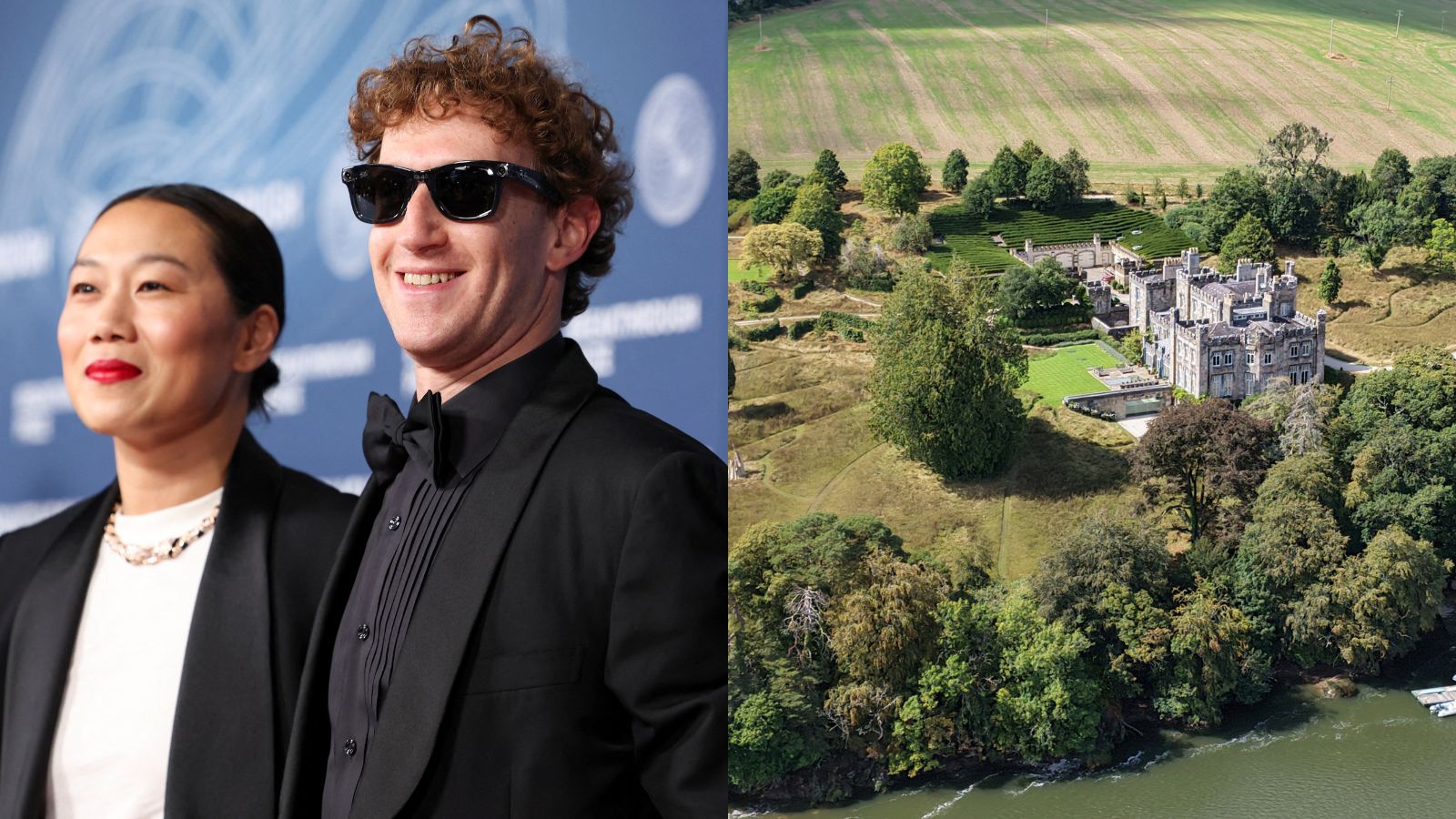
The mist over the River Blackwater does not care about market capitalization. It rises slowly, clinging to the ancient limestone ashlar of Strancally Castle, blurring the boundary where the 19th-century gothic architecture meets the quiet, damp air of County Waterford. For two centuries, this fortress has stood as a monument to isolation and permanence. Now, it belongs to the man who built an empire out of frictionless digital connection.
Mark Zuckerberg and Priscilla Chan have quietly added a 440-acre Irish estate to their portfolio, completing an off-market transaction valued between twenty and thirty million euros.
Consider the sheer scale of the space. Architectural records note that the rambling hallways and grand wings of the 1830 structure are so vast that a walk from the kitchen to the dining room takes nearly five minutes. It is a physical footprint designed to swallow time. In a life spent optimizing every microsecond of human attention through algorithms, Zuckerberg has purchased a sanctuary where minutes are entirely wasted just trying to find lunch.
The purchase places him neatly into a modern landed gentry. Technology billionaires are quietly colonizing the Irish countryside. Stripe co-founder John Collison secured the historic Abbey Leix estate, while vacuum tycoon James Dyson took over Ballynatray House just a few miles down the very same river valley. Ireland is no longer just a tax jurisdiction or a data center location housing Meta's massive infrastructure. It has become a physical retreat for the architects of the modern world.
Strancally was originally built for a conservative Member of Parliament, designed by the Pain brothers to project an unyielding, muscular authority over the landscape. For the past twenty-five years, it was lovingly rescued from decay by financier Michael Alen-Buckley and his family, who poured decades into restoring its battlements, pointed windows, and sprawling gardens. Now, the keys pass from old finance to new code.
There is a striking irony to the location. Strancally Castle sits roughly two hundred kilometers southwest of Dublin, where Meta coordinates its vast European operations and faces the unyielding scrutiny of regional regulators. The juxtaposition is poetic. Down the road, corporate compliance officers and data watchdogs scrutinize every digital footprint of the tech giant. Up the river, behind thick stone walls and a private river quay, the architect of that empire can watch the river run past green hills that have ignored empires for a thousand years.
The estate features modern luxuries hidden beneath its historical facade—including a sleek, subterranean swimming pool flanked by raw stone—yet its true value lies in its heavy, impenetrable silence. It offers a refuge from a world that never logs off.
The heavy oak doors close against the Irish damp. Outside, the rain falls on four hundred and forty acres of emerald grass, indifferent to algorithms, unbothered by updates, and timelessly secure.


_1617603374686.jpg)