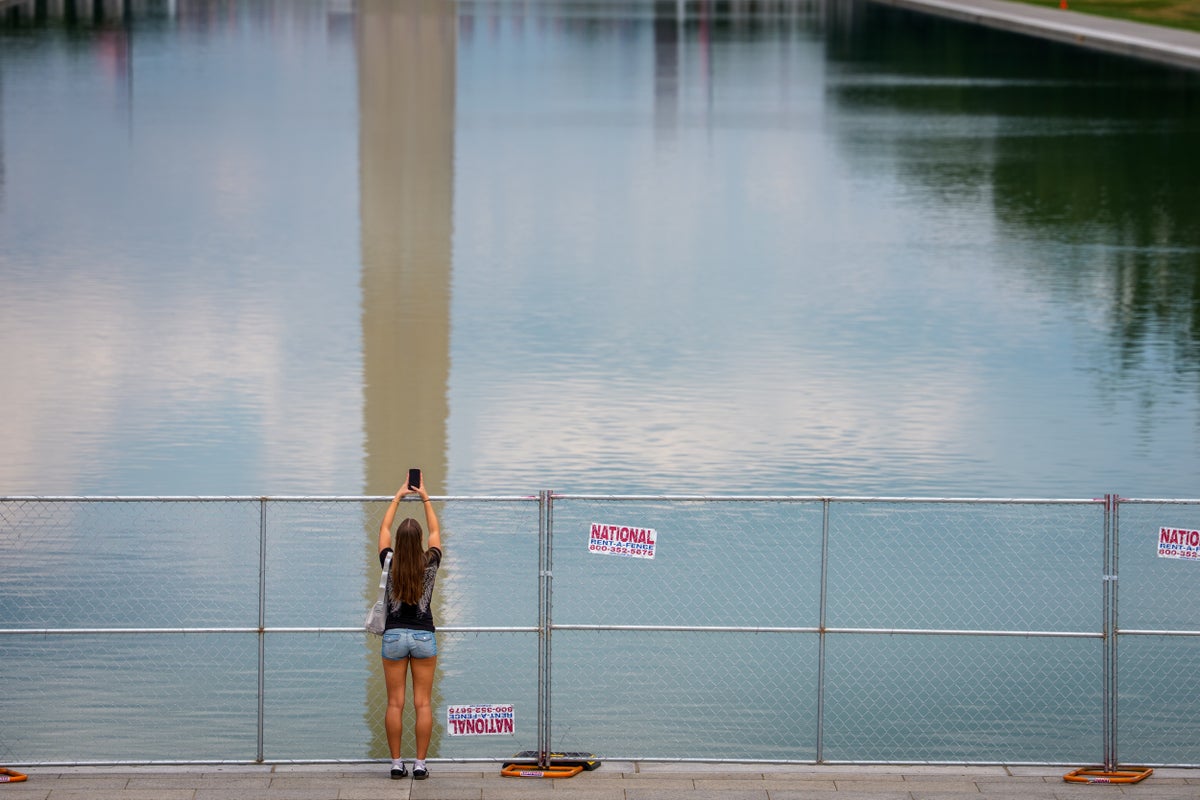
The gravel of the National Mall used to have a distinct sound under a shoe. It was a loose, satisfying crunch, the soundtrack to millions of quiet Sunday morning walks, high school field trips, and slow strolls between the giants of American history. For generations, you could stand at the base of the Lincoln Memorial, look out toward the Washington Monument, and see the sky perfectly inverted in the dark, still water of the Reflecting Pool.
Now, you hear something else. A dull, rhythmic rattle.
It is the sound of wind hitting chain-link fence.
If you walk down Constitution Avenue today, the view is fractured. A heavy, industrial barrier hugs the perimeter of one of the world’s most iconic public spaces. It is not temporary construction netting. It is a fortified perimeter, a grid of interlocking steel that stands between the public and the water. According to official procurement documents and security timelines, this metal scar is scheduled to remain in place until January 2027.
Think about that timeline. A child born when the first posts went up will be running around, talking, and entering preschool before an ordinary citizen can stand at the water's edge unimpeded.
This is no longer a temporary security measure. It is a long-term alteration of the American landscape. And it forces us to confront a uncomfortable question: When we lock away our most sacred public spaces to protect them, what are we accidentally locking out?
The Day the Geometry Changed
To understand what has been lost, you have to understand the specific magic of the Reflecting Pool. Henry Bacon, the architect who designed the Lincoln Memorial, did not view the pool as a separate feature. He viewed it as a mirror meant to double the grandeur of the monument, visually tying the legacy of Abraham Lincoln to the rest of the nation's capital. It was designed to be open. It was designed to be touched.
Consider a hypothetical traveler named Elena. She saved for three years to bring her teenage children to Washington from Ohio. She wanted them to stand where Martin Luther King Jr. delivered his "I Have a Dream" speech. She wanted them to feel the weight of that expansive, unbroken view.
Instead, Elena and her family found themselves peering through two-inch steel diamonds. To get a clean photograph, her son had to thrust his smartphone camera through a gap in the mesh, his knuckles scraping against the cold metal. The grand illusion of unity and openness was replaced by the aesthetic of a construction site or a high-security facility.
The official justification for the barrier centers on the high-profile nature of the modern political climate, specifically surrounding the events and transitions linked to the Trump presidency and the broader security apparatus of the National Capital Region. The National Park Service and cooperating federal security agencies face an impossible mandate: protect the symbols of democracy from any conceivable threat, at any cost.
But security is a ravenous beast. It is never satisfied.
Once a perimeter is established, removing it requires a bureaucratic bravery that is rare in Washington. No official wants to be the one who authorized the removal of a fence right before an unforeseen incident. So, the fence stays. Month after month. Year after year. The temporary becomes the permanent.
The Friction of Everyday Citizenship
The creeping militarization of public space does not happen all at once. It happens in increments. A concrete planter here. A checkpoint there. A temporary fence that quietly gets its lease extended through another fiscal year.
For the people who live in the District, the Reflecting Pool was not just a tourist destination; it was a sanctuary. Marathon runners used it to pace their long miles. Government workers spent their lunch breaks sitting on the stone coping, watching the ducks slice through the reflection of the sky.
Now, the logistics of a simple walk require navigation. The fence dictates where you can walk, where you can turn, and what you can see. It introduces a subtle, persistent friction into the act of being an American citizen in the nation's capital.
The numbers tell a story of containment. The procurement records detailing the maintenance and leasing of these security barriers run into hundreds of thousands of dollars of taxpayer money. We are actively paying to keep ourselves at arm's length from our own history. The contract extensions stretch out toward that January 2027 horizon, a date that feels abstract until you realize how many seasons of life will pass before the steel comes down.
The Invisible Stakes
There is a psychological cost to living behind barriers. When we surround our monuments with steel fencing, we send a subconscious message to every visitor who approaches them. We tell them that the environment is hostile. We tell them that they are suspects until proven otherwise. We imply that the grand experiments of democracy are so fragile that they must be kept in a cage.
The irony is thick. The Lincoln Memorial and the Reflecting Pool were built to celebrate union, healing, and the erasure of boundaries. To wrap them in chain link is to create a visual paradox that no amount of official security jargon can justify.
The tourists still come, of course. They crowd along the designated pathways, their faces pressed against the wire. They take their pictures, but the pictures are compromised. The memory is compromised.
On a recent evening, as the sun dipped below the Potomac, the sky turned a deep, bruised violet. The Washington Monument caught the last rays of golden light, glowing like a beacon. In the past, that light would have stretched across the water in a flawless, shimmering line.
Instead, the light hit the fence. The golden reflection was shattered into a thousand jagged pieces by the steel mesh, casting a checkered shadow across the dark water. The monument was still there. The history was still there. But it was trapped behind the grid, waiting for a January that feels a long, long way away.


