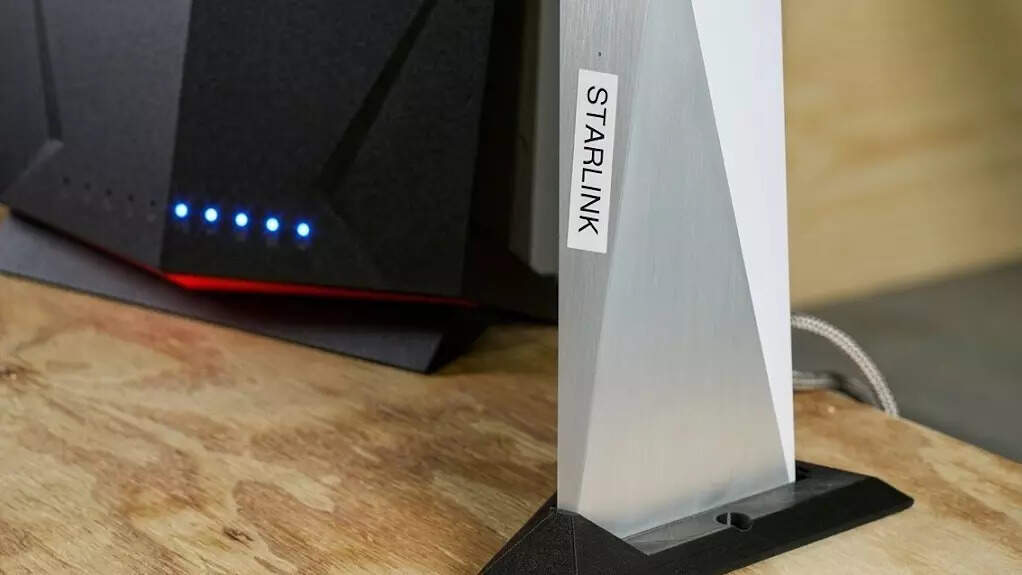
Elon Musk’s Starlink has officially activated its satellite internet service across the United Arab Emirates, ending years of regulatory speculation and providing a third way for a market long defined by a rigid duopoly. Starting today, residents and businesses from the high-rises of Dubai to the deep sands of the Empty Quarter can bypass terrestrial fibre and 5G networks entirely.
The primary entry point for users is the Residential Lite plan, priced at AED 230 per month. For those requiring unrestricted peak-hour performance, the standard Residential tier sits at AED 300 per month. Both plans require a significant upfront capital expenditure: AED 1,465 for the Standard Kit or AED 1,099 for the ultra-portable Starlink Mini. Unlike local telco contracts that often bake hardware costs into long-term commitments, Starlink demands the cash upfront for the hardware, offering in return a month-to-month service that can be paused or cancelled without the usual bureaucratic friction.
The End of the Dead Zone
For decades, the UAE’s connectivity story was a tale of two cities—literally. If you lived in a master-planned development in Dubai or Abu Dhabi, you enjoyed world-class fibre. If you ventured into the northern farms, offshore oil rigs, or remote desert camps, you were at the mercy of patchy 4G or prohibitively expensive legacy satellite providers.
Starlink changes this by removing the "where" from the equation. Because the system relies on a constellation of over 6,000 satellites in Low Earth Orbit (LEO) at roughly 550km, it avoids the massive latency spikes associated with traditional geostationary satellites parked 35,000km away. We are looking at a transition from 600ms pings—rendering video calls impossible—to a range of 20ms to 45ms. This is responsive enough for competitive gaming and seamless remote work from a moving yacht or a desert dunes safari camp.
The timing of this rollout isn't accidental. It follows a 10-year maritime license granted by the Telecommunications and Digital Government Regulatory Authority (TDRA) in 2024, which acted as a Trojan horse for the full consumer launch. By securing the maritime and aviation sectors first—including high-profile deals with Emirates and flydubai—SpaceX proved the reliability of its beam-forming technology in the UAE’s challenging atmospheric conditions, where extreme heat and humidity can often degrade high-frequency signals.
Business Economics of the LEO Constellation
The Business tier, starting at AED 248 per month, is perhaps the most disruptive element for the local SME sector. Historically, a "business grade" connection in the UAE came with a "business grade" price tag, often triple the cost of residential lines for similar speeds. Starlink’s pricing structure essentially flattens this hierarchy.
- SME Backup: For a warehouse in Jebel Ali or a boutique office in Al Quoz, Starlink serves as a low-cost redundant line. If a construction crew accidentally cuts a fibre optic cable—a common occurrence in rapidly developing zones—the business stays online.
- Offshore Operations: The maritime sector is the biggest winner. Ships and offshore rigs that previously paid thousands of dollars for narrow-band satellite links now have access to 200Mbps+ speeds for the cost of a high-end gym membership.
- Rapid Deployment: You can set up a Starlink dish in five minutes. For temporary events, pop-up retail, or remote construction sites, the "time to internet" has dropped from weeks of trenching and cabling to the time it takes to unbox a pizza.
However, it is a mistake to view Starlink as a "fibre killer" in the urban core. Local providers still offer 1Gbps+ speeds that a satellite dish, limited by the physics of shared spectral bandwidth, simply cannot match in high-density areas. In a crowded Dubai Marina, if a thousand people suddenly pointed dishes at the same satellite, speeds would inevitably throttle. Starlink is a relief valve for the underserved, not a replacement for the urban backbone.
The Hardware Gamble
The hardware itself is a marvel of engineering, but it carries risks. The Standard Kit is designed to withstand temperatures up to 60°C, which is essential for UAE summers. It features an "auto-heat" function to melt snow—useless here—but more importantly, its lack of moving parts in the newer V4 models makes it resilient against the fine silica dust of the Arabian Peninsula.
The Starlink Mini is the real sleeper hit of this launch. About the size of a thick laptop, it fits in a backpack and draws minimal power. It is the definitive tool for the "digital nomad" or the weekend desert camper. But potential buyers should note that the AED 1,099 price tag is only part of the story. Unlike fibre routers, which sit safely indoors, your Starlink dish is exposed to the elements. A freak hailstorm or a severe sandstorm could turn your AED 1,500 investment into a plastic paperweight, and SpaceX’s support, while improving, lacks the physical retail presence and "technician at your door" service that Etisalat or du provide.
Geopolitical Resilience and Data Sovereignty
The launch also carries a layer of strategic importance that goes beyond cat videos and emails. By diversifying the country's connectivity stack, the UAE is insulating itself against terrestrial infrastructure failures. In an era where subsea cables—the arteries of the global internet—are increasingly viewed as targets for sabotage or accidental damage, having a space-based backup is a matter of national security.
This rollout also signals a subtle shift in how the UAE manages its digital borders. While Starlink operates via a US-based company, its official entry means it operates within the TDRA’s regulatory framework. This is a sanctioned, controlled expansion. It provides the freedom of satellite tech with the stability of local legal standing, ensuring that users aren't operating in a legal grey area as they might with "grey market" kits imported from elsewhere.
If you are currently tethered to a reliable 500Mbps fibre line in a downtown apartment, Starlink is a novelty you don't need. But if your work takes you beyond the reach of the nearest cell tower, or if your business cannot afford a single hour of downtime, the satellite dish is no longer a luxury. It is an essential piece of the modern kit.
Check the Starlink availability map for your specific "cell" before purchasing, as some high-density areas may have waitlists to preserve signal quality.