The heat in Bikoro does not just sit on your skin; it presses into your lungs like a damp rag. In the quiet hours before dawn, when the heavy mist hangs motionless over the dense green canopy of the Equateur province, the silence feels complete. But microscopic silent threats move faster than human feet can run.
When an invisible virus takes root in the remote villages scattered along the Congo River, speed becomes everything. Not the abstract speed of data traveling across fiber-optic cables, but the terrifying velocity of fever, hemorrhage, and contact.
In past epidemics, news moved slow. A person fell ill in an isolated settlement miles from any paved road. Days passed before a local nurse suspected something beyond ordinary malaria. Weeks drifted by before sample tubes reached a laboratory capable of genetic sequencing in Kinshasa or Atlanta. By then, the chain of transmission was already five links deep.
This time, the timeline broke.
The Fire in the Forest
Consider a village healthcare worker named Jean—a composite of the real local health responders who stand on the frontline. Jean wakes at four in the morning to the sound of torrential rain hammering corrugated tin roofs. He carries a simple solar battery, a basic digital thermometer, and a binder worn thin at the edges.
He does not have a state-of-the-art facility. He has a room with two wooden benches, a box of latex gloves, and an instinct forged through years of survival.
When three members of the same household develop sudden high fever, joint pain, and uncontrollable vomiting within forty-eight hours, Jean knows the signs. He does not wait for a formal proclamation. He logs the symptoms, calls a regional health supervisor using the one spot on the hill where mobile coverage flickers into existence, and isolates the family.
Yet the virus moves on invisible currents.
Ebola is notorious for its cruelty, but its primary superpower is simple: it exploits human tenderness. It spreads when a mother wipes sweat from her child's forehead. It spreads when neighbors gather to wash the body of a respected elder before burial. Love and duty become the primary vehicles for biological destruction.
In the record-setting outbreak across the Democratic Republic of Congo, the curve of infection did not climb gradually. It spiked straight up. The sheer rate of new cases surpassed every previous baseline, catching global monitoring networks off guard.
Why the Math Changed
Why did this outbreak outpace every precedent? The answer lies at the intersection of ecology, geography, and human movement.
First, the geography of the Congo basin has altered dramatically over the last decade. Loggers and miners push deeper into pristine rainforest, cutting roads through habitats once completely isolated from dense human settlements. Fruit bats and wild primates, natural reservoirs for the virus, find their territories shrinking and overlapping with human encampments.
Second, mobility is no longer what it was twenty years ago. What used to be a three-day trek through dense mud track can now be covered in hours on the back of a cheap motorcycle taxi. A patient incubating the virus can board a wooden barge on the Congo River, travel dozens of miles downstream, and enter a town of a hundred thousand people before the first symptom appears.
A virus does not think, plan, or hate. It relies entirely on our connections to carry it forward.
When transmission chains hit urban centers, the math transforms exponentially. In a sparse forest settlement, one sick person might come into contact with five people. In a bustling river port market, that same individual touches surfaces, trades paper currency, and interacts with dozens of individuals in an afternoon.
The health authorities faced a terrifying reality: the virus was outpacing the logistics of response.
Fighting an Unseen Target in the Dark
The technical response to Ebola has advanced remarkably. Scientists developed effective ring vaccination protocols, where every contact of a confirmed case—and every contact of those contacts—receives a protective dose. Highly targeted monoclonal antibody treatments can save lives if administered early.
Yet tools are useless if you cannot reach the target in time.
The Eastern provinces of the DRC have endured decades of violent conflict, armed militia activity, and deep-seated institutional distrust. Imagine trying to conduct contact tracing in a zone where gunfire interrupts nightfall, where health workers must travel with armed escorts, and where communities have seen decades of promises vanish into thin air.
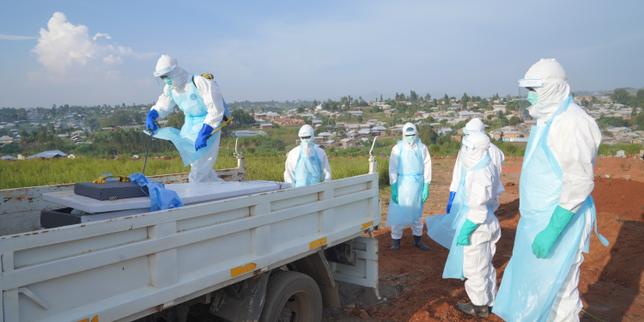
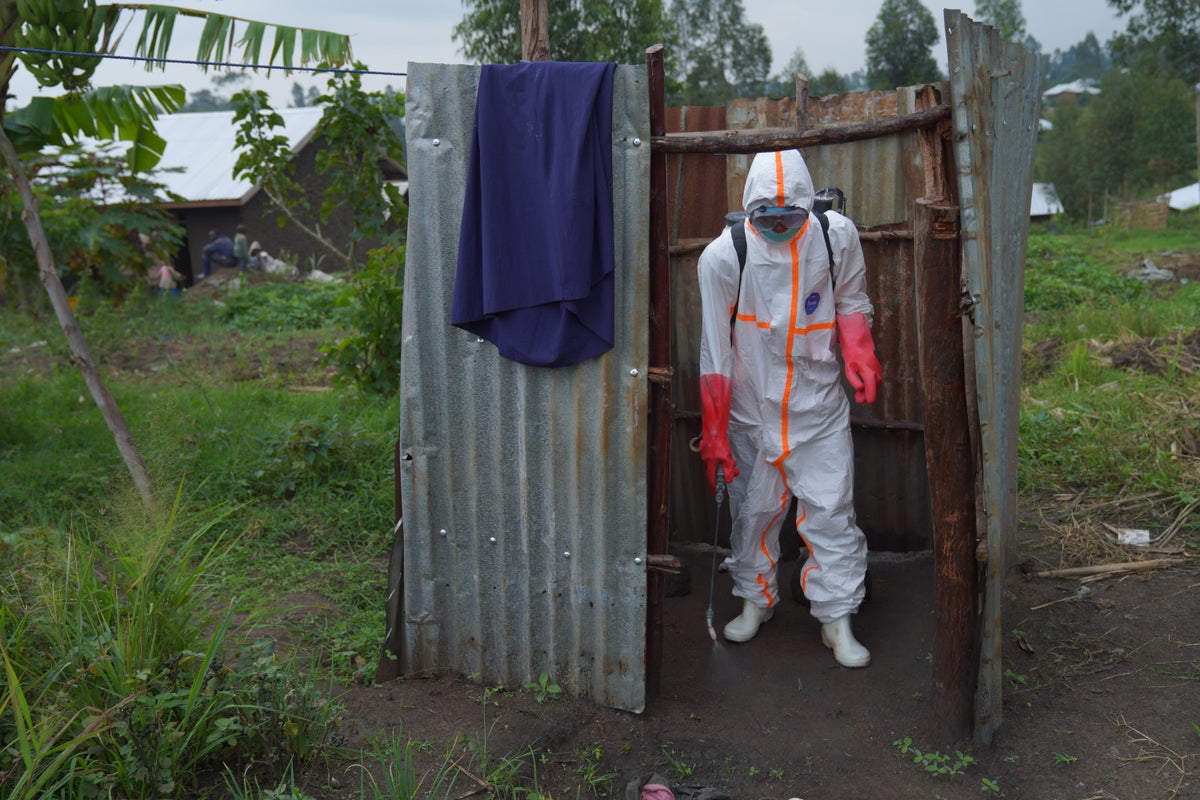
When medical teams arrive wearing white protective hazmat suits, looking like creatures from another planet, fear spreads as fast as the fever. Rumors multiply in the vacuum of clear communication. People hide their sick relatives. They flee into the forest to avoid isolation centers, unknowingly carrying the virus into untouched communities.
To understand the crisis is to understand this fundamental truth: you cannot stop an outbreak with medicine alone. You stop it with trust.
The Human Wall
Back in the field, response teams learned that high-tech interventions failed whenever they ignored human dignity.
Progress began not when extra diagnostic machinery arrived, but when epidemiologists sat down under mango trees with local village chiefs, traditional healers, and religious leaders. They listened first. They adjusted protocols to allow families to observe safe, dignified burial rituals from a safe distance rather than forcing anonymous, hurried interments.
Health workers recruited local survivors—people who possessed natural immunity following recovery—to work inside the treatment centers. Seeing a neighbor walk out of an isolation unit alive shattered the myth that the facilities were death traps.
Bit by bit, the velocity of the virus met an equally powerful force: the collective resolve of informed communities.
The outbreak proved that speed in public health is not merely about rapid diagnostics or fast transport. It is about the speed of empathy. The moment a community feels heard, the chain of secret transmissions breaks. People step forward. They report symptoms early. They accept the vaccine.
The forest remains quiet again in Bikoro, but the lessons carved into the dirt roads of the Congo basin remain urgent. Pathogens will continue to leap from the wild into human populations, and increased global connectivity guarantees that the next outbreak will move even faster than the last.
The true test of human survival is whether our capacity for cooperation can match the ruthless speed of the microscopic world.
A single motorcycle engine fades into the distance down a red-dirt road, carrying a cooler of cold-chain vaccines toward the tree line, racing the setting sun.