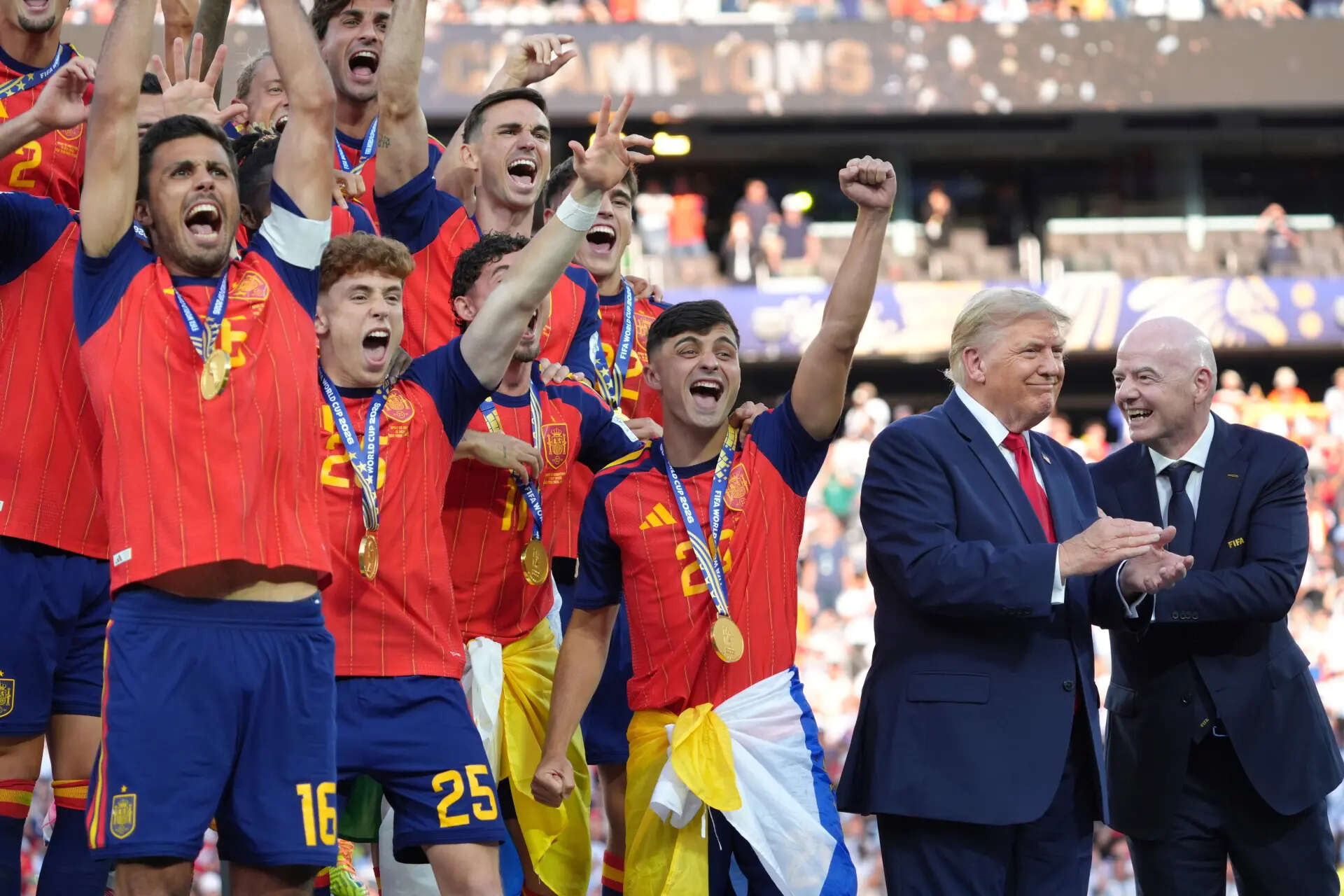
When Ferran Torres swept the ball past Emiliano Martínez in the 106th minute at MetLife Stadium, he didn't just win a trophy for Spain. He shattered a carefully scripted political photo op.
Donald Trump had every reason to want a different ending to the 2026 World Cup. The tournament, held across North America, was supposed to serve as a massive stage for American spectacle. Standing alongside Gianni Infantino on the podium in New Jersey, Trump expected to bask in global goodwill while handing over the trophy.
Instead, he got booed by tens of thousands of fans inside the stadium.
Then came the awkward trophy presentation itself. Trump tried to linger on stage alongside the celebrating Spanish squad, refusing to move out of the frame until Infantino quietly guided him toward the exit. Mikel Merino was already breaking into the YMCA dance nearby. To make matters even more surreal, Ferran Torres later celebrated back in Madrid wearing a red cap stamped with "Make Spain Great Again."
The awkwardness went way deeper than a photobomb. Spain's victory delivered a sharp cultural and political statement that collided directly with everything Trumpism stands for.
The Geopolitical Clash Behind the MetLife Final
Spain did not arrive in New Jersey as just another European football power. They arrived as the national team of a government that had been openly sparring with Washington for months.
Under Prime Minister Pedro Sánchez, Spain has consistently pushed back against American foreign policy demands. When Washington pressured European NATO members to hike defense spending to 5% of GDP, Sánchez flatly refused. Trump responded by labeling Spain a "terrible partner" and calling the country a "wasted cause." He even threatened to cut off trade deals.
The friction didn't stop at defense budgets. Madrid actively denied the United States access to Spanish military bases and airspace for operations during conflicts in the Middle East. When Spain officially recognized Palestinian statehood and put restrictions on military supply shipments, Washington issued stern warnings that Spain was risking its alliance with the US.
When Spanish forward Borja Iglesias was asked before the final how he felt about the prospect of shaking Trump's hand on stage, his answer was direct: "I will shake hands with Trump, but I hope it's quick. I don't want to go to jail."
Iglesias was joking, of course. But the comment reflected a team that felt completely disconnected from the political circus hovering over the final.
A Multicultural Squad That Shatters the MAGA Narrative
Trump's political rhetoric relies heavily on strict borders, deep-seated nationalism, and hostility toward globalism.
Spain's World Cup roster offered a completely opposite reality.
This championship team wasn't built on rigid cultural isolation. It was powered by a dynamic, multicultural generation shaped by immigration and regional diversity. Lamine Yamal and Nico Williams drove Spain's attack with breathtaking pace and flair. Alongside core talents like Rodri, Pau Cubarsí, and Ferran Torres, they formed a collective unit that proved unstoppable.
They played fluid, joyful, unselfish football.
When Ferran put on that red "Make Spain Great Again" cap during the victory parade in Madrid, it was a tongue-in-cheek nod that completely flipped the original slogan's intent. Spain's version of greatness was inclusive, modern, and undeniably global. It showed millions of viewers that true national success often comes from welcoming outside influences, not shutting them out.
Football Rules Beat White House Pressure
If anyone doubted Trump's desire to influence the tournament, the administration's intervention in the group stage proved it.
Earlier in the World Cup, American striker Folarin Balogun received a red card against Bosnia and Herzegovina, which carried an automatic suspension. Trump publicly pressed FIFA to review the decision. Surprisingly, FIFA deferred Balogun's one-match ban, clearing him to play in the knockout round against Belgium.
It was a striking moment where administrative pressure altered an official disciplinary process.
Yet political influence has clear boundaries once players step onto the grass. The US team was soundly beaten 4-1 by Belgium anyway.
Spain then systematically dispatched Europe's heaviest hitters. They blew past France in the semi-finals before tackling defending champion Argentina in a brutal, physical final. They didn't win through political maneuvering or administrative favors. They won because they were simply the best team on the planet.
Why Palestinian Flags Flew for Spain
The resonance of Spain's triumph stretched well beyond Madrid and Barcelona. Across Gaza and the West Bank, fans openly cheered for Spain throughout the knockout rounds.
That support wasn't purely about football tactics.
For months, Sánchez's government had been one of the few Western nations to take a firm diplomatic stance on the crisis in the Middle East. Spain enforced arms embargoes and consistently advocated for Palestinian statehood. For millions watching in the Middle East, seeing Spain lift the trophy on American soil felt like a symbolic victory.
While Trump envisioned a photo of himself handing the World Cup to a team that aligned with his worldview, he ended up handing it to a squad representing a nation that had repeatedly challenged his administration's foreign policy.
The Trophy Left New Jersey but the Parallels Remain
Football tournaments are often marketed as purely sporting events, detached from culture and policy. The 2026 World Cup final proved that idea completely wrong.
When you look at how Spain conquered this tournament, the lessons extend far beyond the pitch.
First, look at squad building. Spain abandoned old dogmas about physical size and defensive conservatism. They trusted teenage talents like Yamal and Cubarsí on the biggest stage possible, pairing them with elite tactical anchors like Rodri. They proved that flexibility and modern talent development beat rigid tradition every single time.
Second, understand that soft power in sports is shifting. A nation's public image isn't defined solely by the political leaders who host ceremonies or stand near trophies. It is defined by the values, diversity, and style of the athletes who perform under the lights.
Trump got his camera time in New Jersey, but Spain walked away with the title, the global admiration, and the ultimate last laugh.