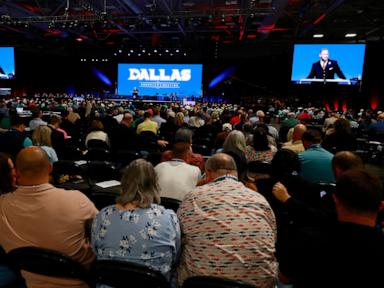
The Southern Baptist Convention (SBC) is currently navigating a mathematical paradox: a significant contraction in the absolute membership base occurring simultaneously with a resurgence in localized engagement metrics. While headline figures focus on the loss of roughly 241,000 members in the most recent reporting cycle—marking the 17th consecutive year of decline—this figure serves as a lagging indicator that obscures a more complex internal shift. The critical tension lies in the delta between formal affiliation and active participation.
The Dual Metric Divergence
To understand the health of the SBC, one must isolate the three distinct vectors of institutional movement. The convention is not experiencing a uniform decline; instead, it is undergoing a structural re-composition.
1. The Membership Contraction
The drop to 13.2 million members represents a continued correction of "ghost rosters." For decades, Baptist polity allowed for the accumulation of inactive members on local church rolls. The current decline is driven by two primary forces:
- Administrative Sanitization: Modernized database management at the local level has led to the purging of non-attending members.
- Cultural Disaffiliation: The decreasing social utility of religious labeling means individuals who do not attend are less likely to maintain formal ties.
2. The Attendance Surge
In contrast to membership loss, average weekly in-person attendance rose by over 5% in the last year, reaching 4.02 million. This indicates that while the "outer ring" of nominal members is evaporating, the "inner core" of active participants is intensifying. The attendance-to-membership ratio is the most accurate barometer for institutional vitality. A rising ratio suggests that the remaining organization is more concentrated, committed, and operationally viable than the larger, diluted base of the early 2000s.
3. The Baptismal Recovery
Baptisms—the primary metric for new customer acquisition in a religious context—surpassed 226,000, representing a 26% year-over-year increase. This is the highest level recorded in several years. From a strategic perspective, this suggests that the SBC’s "top-of-funnel" activities are regaining efficiency even as the "retention" of legacy members fails.
The Structural Bottleneck of Church Plants
The total number of SBC congregations fell slightly to 46,906. This stagnation reveals a bottleneck in the church planting ecosystem. While the North American Mission Board (NAMB) has prioritized the creation of new "units," the rate of church closures (attrition) is currently neutralizing the gains from new startups.
The institutional strategy relies on the Church Planting Life Cycle:
- Seed Funding: Heavy capital injection into high-density urban areas.
- Growth Phase: Reliance on young, bi-vocational leadership.
- Sustainability Gap: The point at which a plant must transition from denominational subsidies to local tithing.
The current data suggests a high failure rate or a slower-than-expected maturation process for these plants. If the SBC cannot accelerate the "New Unit" birth rate to exceed the "Legacy Unit" closure rate, the geographic footprint of the convention will continue to shrink, regardless of how well individual large churches perform.
Financial Efficiency and Resource Allocation
Total giving reported by SBC churches exceeded $10 billion. On a per-capita basis, giving among active attendees is at an all-time high. This creates a strategic buffer. The SBC is not facing an immediate liquidity crisis; it is facing a scale crisis.
The allocation of these funds follows a specific hierarchy known as the Cooperative Program (CP). Under this framework:
- Local Retention: Churches keep the majority of funds for local operations and staff.
- State Conventions: A percentage is sent to state-level entities for regional missions.
- National Distribution: The remaining funds support international missions (IMB), domestic planting (NAMB), and six seminaries.
The "yield" on these dollars is currently under scrutiny. The cost-per-baptism and cost-per-new-member are rising. This is due to the increased overhead of operating in post-Christian urban environments compared to the legacy "Bible Belt" strongholds. The SBC is essentially moving from a "low-cost acquisition" environment to a "high-cost acquisition" environment.
Demographic Realities and the Replacement Rate
The SBC faces a significant demographic headwind. The "Silent Generation" and "Baby Boomers" constitute a disproportionate share of the formal membership. As these cohorts age out, the convention requires a replacement rate that it is currently failing to meet through biological growth (children of members) or proselytization.
The Replacement Index for a religious organization can be modeled as:
$$R = \frac{B + T}{D + A}$$
Where:
- $B$ = Baptisms (New entrants)
- $T$ = Transfers in (Affiliation shifts)
- $D$ = Deaths (Actuarial loss)
- $A$ = Attrition (Voluntary departures)
When $R < 1$, the organization is in a state of terminal decline. The current data suggests that while $B$ (Baptisms) is increasing, it is not yet large enough to offset the combined weight of $D$ and $A$. The 26% jump in baptisms is a positive trend, but it must be sustained for a decade to stabilize the $R$ value.
The Strategic Pivot to Engagement Metrics
The convention’s leadership is signaling a shift in priority from Gross Membership to Active Attendance. This is a pragmatic recognition of reality. In a data-driven environment, an inactive member is a liability—they skew per-capita data and create a false sense of scale that complicates resource planning.
Moving forward, the SBC’s viability depends on three specific tactical shifts:
Hyper-Localization of Assets
The convention must decentralize its resource hubs. Large, centralized bureaucracies are becoming too expensive to maintain relative to the shrinking membership base. Expect a push toward "Micro-Networks" where churches share back-office costs (HR, accounting, insurance) without relying on national denominational structures.
The Bi-Vocational Leadership Model
The traditional model of a full-time, seminary-educated pastor is becoming financially unsustainable for the average-sized SBC church (which typically sees fewer than 70 people on a Sunday). The "Masterclass" strategy here involves training a new class of leaders who maintain secular employment, effectively lowering the fixed-cost base of the local church and allowing more capital to flow toward community engagement and "top-of-funnel" activities.
Digital-to-Physical Funnels
The 5% increase in attendance is partly attributed to "re-entry" after the pandemic disruptions, but it also reflects a more sophisticated use of digital platforms to drive physical attendance. The SBC is learning that digital "engagement" is a vanity metric unless it converts to physical "presence." The churches showing the most growth are those using digital tools not as a replacement for the Sunday service, but as a lead-generation engine for small-group discipleship.
The Operational Forecast
The SBC will likely reach a membership floor between 10 million and 11 million within the next five to seven years. This "right-sizing" is necessary. The organization that emerges will be smaller in absolute numbers but higher in "density"—meaning a higher percentage of the members will be financial contributors and active volunteers.
The risk to this forecast is the ongoing internal friction regarding policy and theology. Institutional instability creates a "perception tax" that hinders the recruitment of younger, high-capacity leaders. If the convention can stabilize its internal governance, the increase in baptismal efficiency suggests a path toward long-term equilibrium. The focus must remain on the Conversion Ratio (Baptisms per 100 members), which currently sits at approximately 1.7. To achieve true growth, this ratio must move toward 3.0 to overcome the actuarial realities of an aging population.
Strategic focus should immediately move away from membership reclamation—which has a low ROI—and toward the aggressive scaling of the church planting model in high-growth corridors. The convention's future is not in the pews of the 1990s, but in the efficiency of the baptismal funnel in the 2030s.