The midnight sun in Alaska does not bring warmth; it brings a strange, suspended reality. At 2:00 AM, the sky hangs in a permanent twilight, a bruised purple that tricks the mind into thinking time has stopped. For residents living on the fringes of Anchorage or the Kenai Peninsula, this perpetual daylight creates a false sense of security. You believe you can see everything coming.
You cannot.
Living in Alaska means accepting a unspoken contract with the wilderness. The terms are simple: we build our houses, plant our gardens, and walk our dogs, but we do so on borrowed ground. Most days, the boundaries hold. But every summer, as the salmon runs begin and the berries ripen on the hillsides, those boundaries blur. The wilderness steps onto the porch.
Consider the ordinary routine of stepping outside to check the mail or let a pet into the yard. In the Lower 48, the biggest threat is a stray dog or a sudden downpour. In Alaska, that mundane transition from the safety of drywall to the vulnerability of the gravel driveway is where the quietest, most violent collisions occur.
It happens in a heartbeat.
A woman steps through her back door. The air smells of damp pine and cold earth. She is thinking about her grocery list, or a text message she forgot to send, or the way the morning light looks against the mountains. She takes three steps toward her car.
Then, the world changes shape.
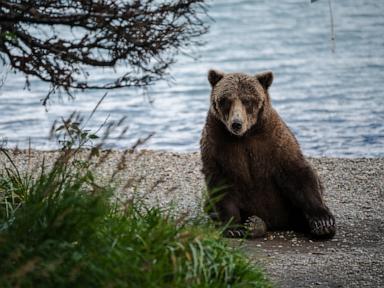
Wildlife biologists often talk about the "buffer zone"—the invisible psychological distance an animal requires to feel safe. When a human unknowingly breaches that zone, logic evaporates. It is a terrifyingly simple equation: surprise plus proximity equals aggression. A brown bear does not attack out of malice. It attacks out of a profound, sudden terror that mirrors our own.
The sound is what stays with people who survive. It is not the cinematic roar Hollywood uses to sell movie tickets. It is a low, guttural huffing, like a massive steam engine clearing its valves, followed by the heavy, thudding slaps of five-hundred pounds of muscle hitting the dirt at thirty miles per hour.
You do not have time to reach for bear spray if it is tucked away in a drawer by the kitchen sink. You do not have time to run. Evolution did not design humans to outrun an animal that can sprint up a mountain face faster than a thoroughbred horse.
In those critical seconds, the human mind fractures. One part witnesses the event with cold, detached clarity—noticing the smell of wet fur, the yellow tint of the teeth, the dirt caked under the claws. The other part is screaming.
The defense is instinctual and brutal. Cover the neck. Interlock the fingers behind the head. Lie flat on your stomach so they cannot flip you over to expose your vital organs. Use your elbows and legs to anchor yourself to the earth.
And then, you wait.
The attack itself is usually brief, though it stretches into an eternity for the person on the ground. A bear defending its space or its cubs wants to neutralize the threat. Once the human stops moving, stops screaming, and becomes a silent, inanimate object on the forest floor, the bear often stops. It looks around, its sides heaving, and then it vanishes back into the thick brush as quickly as it arrived.
The silence that follows is heavier than the twilight.
When neighbors hear the cries for help and the sirens finally cut through the quiet Alaskan air, the immediate focus shifts to medical survival. Deep lacerations, broken bones, and puncture wounds require urgent care. Emergency rooms in these regions are uniquely equipped for the trauma, staffed by doctors who know exactly what a bear claw does to human tissue.
But the physical wounds heal much faster than the psychological ones.
The real casualty of a backyard bear attack is the loss of sanctuary. How do you step outside your own front door when your brain now associates the rustle of a birch tree with a fight for your life? The home, which once felt like a fortress against the elements, suddenly feels like a cage surrounded by hidden threats. Every shadow looks like a hunching shoulder. Every snapped twig is a warning.
Statistically, bear attacks remain rare. Millions of people live, work, and recreate in bear country every year without ever seeing more than a track in the mud. You are far more likely to be struck by lightning or injured in a mundane car accident on your way to the trailhead.
Yet, numbers offer cold comfort when the statistic is bleeding on your driveway.
The state responds with a standard, necessary protocol. Fish and Game biologists deploy to track the animal, assessing whether it was a defensive reaction or a predatory behavior. If a bear associates a residential porch with an easy meal—pet food left outside, uncleaned barbecue grills, or unsecured garbage—it becomes a recurring hazard. In the grim calculus of wildlife management, a habituated bear is a dead bear.
We blame the animal, or we blame the victim, because blaming something gives us a illusion of control. If we can point to a mistake—"she shouldn't have been out so late," or "he should have carried spray"—we convince ourselves that we are safe because we would have acted differently.
The truth is much more unsettling. Sometimes, you do everything right, and the wilderness just reaches out and touches you anyway.
Preventing these encounters requires a constant, exhausting vigilance that newcomers often find overwhelming. It means shouting into the empty air when walking to the garage, just to let the shadows know you are there. It means using heavy, steel bear-proof trash cans that require two hands and a specific sequence of finger movements to open. It means accepting that your birdfeeder might attract something much larger than a chickadee.
As the midnight sun finally begins its slow, circular dip toward the horizon, the neighborhood settles back into its uneasy peace. The blue lights of the police cruisers fade. The yellow caution tape flutters slightly in the morning breeze.
The wilderness watches, waits, and reclaims its silence.