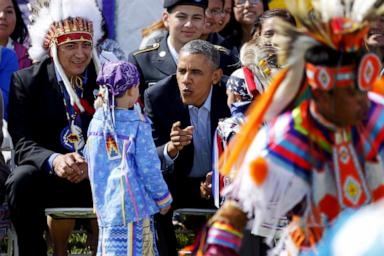
Dust does not settle easily on red dirt. It hangs in the air long after the last Ford F-150 has rattled down the county road, coating the leaves of post oaks and settling into the creases of weathered hands.
On a Tuesday afternoon in southeastern Oklahoma, the air tastes of sulfur, dry grass, and anticipation.
This is the Choctaw Nation. It is a sovereign expanse of pine forests, rolling hills, and rolling pastures where history is not something read in a textbook; it is a physical weight carried by every family whose ancestors survived the Trail of Tears. Today, that weight mixes with something entirely modern, loud, and blindingly bright: the circus of American presidential politics.
A campaign rally is coming. Not to a steel-and-glass arena in a coastal metropolis, but to the heart of Indian Country.
Consider what happens when a political machine rolls into a community that has spent centuries being treated as an afterthought. Helicopters chop the sky above Durant. Secret Service agents in mirrored sunglasses scan the treeline where wild turkeys usually roam unbothered. Giant video screens rise over parking lots like monoliths fallen from another planet, projecting the oversized face of a billionaire populist who knows exactly how to work a crowd that feels forgotten by the rest of the map.
For decades, political campaigns treated Native American reservations like blank spaces on a cartographer's parchment. Candidates flew over them between Dallas and Tulsa, assuming the votes were too sparse, the turnout too low, or the political loyalty too entrenched to matter. They chased suburban moms in Ohio and factory workers in Michigan while millions of Indigenous citizens stood silently at the edge of the American experiment, watching their treaties broken by successive administrations regardless of party color.
Then the calculus shifted.
Politics is arithmetic, but it is also theater. When a candidate touches down on tribal land, it sends a signal that reverberates far beyond the immediate county line. It says: You exist. Your geography matters.
To understand why this rally is happening, you have to look past the red hats and the protest signs. You have to look at the map.
Oklahoma is a state where tribal sovereignty has undergone a seismic legal earthquake. Following the landmark McGirt ruling, the Supreme Court affirmed that much of eastern Oklahoma remains historic reservation land. Overnight, the legal landscape transformed. Jurisdiction shifted. Tribal governments like the Choctaw Nation, the Cherokee, and the Chickasaw stopped being mere cultural entities and reclaimed their full status as sovereign governments managing healthcare, policing, economic development, and infrastructure on a massive scale.
They are economic powerhouses now. They employ tens of thousands of people. They build hospitals, casinos, and community colleges. They pave roads.
And politicians noticed.
When a campaign schedules a stop in Choctaw territory, it is courting more than just individual voters casting ballots in a November election. It is acknowledging a distinct political power center. It is a calculated gambit to capture the imagination of rural voters—both Native and non-Native—who feel alienated by urban centers that dictate cultural norms from thousands of miles away.
Step inside the tribal complex before the gates open. The mood is not monolithic. Do not mistake a reservation for a single-minded block.
Meet a hypothetical voter named Silas. He is a fifty-two-year-old Choctaw ironworker who spent thirty years building skyscrapers in Houston before moving back home to care for his aging mother. Silas wears a worn leather vest, drives a truck with a dented tailgate, and holds a deep, bone-weary skepticism of anyone wearing a suit in Washington.
"They come out here every four years," Silas says, leaning against his pickup while the soundcheck thumps in the distance. "They talk about respect. They talk about tradition. But when the dust settles, our roads are still washed out after a spring storm, and our kids are still driving an hour to see a specialist."
Silas is not easily impressed. Yet, he plans to attend the rally. Why? Because for most of his life, politicians did not even bother to drive down his highway. They didn't know his nation existed, let alone care about its treaty rights. Even if the visit is transactional, even if it is pure political theater designed for evening cable news, it acknowledges his existence. And in a country where millions feel invisible, visibility is a powerful narcotic.
Beside him stands his niece, Chloe. She is twenty-four, studying tribal governance at Southeastern Oklahoma State University, and her worldview is entirely different from her uncle's. Chloe sees the rally through the lens of leverage.
"It's about pressure," she explains, adjusting her turquoise earrings. "If we show up in numbers, if we pack this arena, we force both parties to reckon with us. We aren't just a photo op. We are a voting bloc that can swing a close election in Oklahoma and across the West."
Chloe is right. From Arizona to Alaska, Indigenous voters have proven time and again that they can tilt razor-thin margins in statewide races. Turnout campaigns organized by native grassroots groups have unlocked thousands of votes that political consultants used to write off as unreachable.
The national parties are waking up to this reality. They realize that ignoring rural and indigenous communities is no longer a viable strategy in a polarized nation where every single vote functions like gold dust.
The sun begins to dip below the horizon, painting the Oklahoma sky in streaks of bruised purple and burning orange. The temperature drops rapidly, the way it always does on the plains when autumn is creeping in.
Inside the perimeter, the crowd swells. Families carry folding chairs. Vendors sell roasted nuts, cotton candy, and campaign merchandise stamped with aggressive slogans. The air is thick with the scent of funnel cake and diesel exhaust.
A speaker takes the microphone. The bass rattles the chest cavities of everyone within a hundred yards. The rhetoric is familiar: grievance, promise, strength, division, unity, all tangled together in a breathless performance designed to bypass the analytical brain and strike directly at the gut.
The crowd roars. It is a primal, communal sound—the sound of people shouting into the wind, demanding to be heard by a system that has ignored them for generations.
Outside the gates, standing in the shadows of the parking lot, an elder named Joseph watches the spectacle unfold. He has lived through the administrations of ten presidents. He remembers when native children were punished for speaking their language in government-run boarding schools. He remembers when his people were treated as wards of the state rather than citizens of sovereign nations.
He crosses his arms over his chest, his face carved from the same stone as the hills around him.
"They shout about freedom," Joseph says softly, his voice barely audible over the roar of the loudspeakers. "They shout about the Constitution. But our treaties were signed before most of their grandfathers crossed the ocean. You cannot build a future by forgetting the foundation."
He is not angry. He is simply observant. He knows that when the klieg lights are turned off and the Secret Service convoys head back to the airport, the dust will settle once more on the red dirt. The politicians will fly away to the next state, the next arena, the next camera angle.
The work will remain.
The roads will still need paving. The healthcare systems will still need funding. The sovereignty of the Nation will still need defending in federal courtrooms against state politicians who want to chip away at tribal authority bit by bit.
Yet, something has shifted in the air tonight.
The Choctaw Nation did not go looking for this spotlight; the spotlight came looking for them. And as long as politicians need every single vote they can scrape together from the margins of the map, Indian Country will no longer be a quiet whisper in the wilderness.
It will be a roar.
The music swells. The candidate takes the stage, arms raised, stepping into the glare of the blinding lights while the crowd surges forward to touch the hem of power. Out in the dark, beyond the perimeter fence, the crickets keep up their steady, ancient rhythm, indifferent to the noise, waiting for the night to reclaim its silence.


