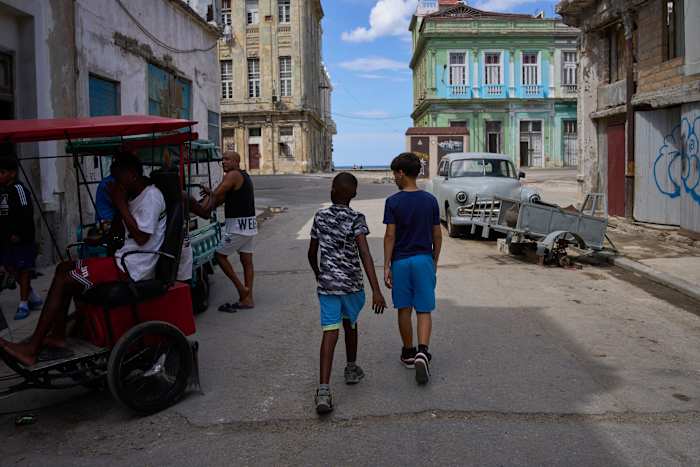
The silence is what hits you first. In Havana, a city usually defined by the rhythmic clatter of 1950s Buicks and the persistent pulse of reggaeton, the absence of sound is physical. It has a weight. When the grid fails, the fans stop their rhythmic slicing of the humid air. The refrigerators give a final, shuddering gasp before going cold. Then, the darkness rushes in, not as a gradual evening fade, but as a total, suffocating blanket.
Ten million people suddenly find themselves living in a world where the 21st century has been revoked.
Cuba’s energy crisis is often described in Western headlines through the sterile language of megawatts and fuel shipments. Analysts talk about "decrepit infrastructure" and "thermoelectric inefficiency." But to understand the true cost of an islandwide blackout, you have to look at the hands of a mother trying to charcoal-grill a week’s worth of thawing meat before it rots. You have to hear the frustrated click-click-click of a lighter in a kitchen where the electric stove has become a useless hunk of metal.
The Ghost in the Machine
At the heart of this collapse sits the Antonio Guiteras power plant. It is the titan of the Cuban grid, a massive facility in Matanzas that acts as the island’s primary heartbeat. When Guiteras "trips"—a technical term that sounds far too polite for a systemic catastrophe—the entire country feels the shockwave.
Think of the national grid like a massive, aging bicycle. To keep it moving, everyone has to pedal at exactly the same speed. If one person tires, the others have to pedal harder to compensate. But in Cuba, the bikes are rusted. The tires are bald. The chain is held together by scavenged wire and hope. When the Antonio Guiteras plant stops pedaling, the sudden drag is so violent that it pulls everyone else off their seats. The system doesn't just slow down; it seizes.
This isn't a freak accident. It is the predictable result of a "perfect storm" that has been brewing for decades. The infrastructure is ancient, with many plants operating well past their intended forty-year lifespan. Maintenance is deferred because parts are unavailable or unaffordable. Imagine trying to keep a fleet of steam engines running using only the contents of a kitchen junk drawer.
The Invisible Currency of Light
When the lights stay off for twenty-four, forty-eight, or seventy-two hours, the societal contract begins to fray. In the modern world, electricity is the invisible substrate upon which everything else is built. Without it, the water pumps stop. High-rise apartment buildings become concrete traps where the elderly are stranded on the tenth floor, unable to descend stairs in the pitch black and unable to flush toilets because the tanks are dry.
Consider a hypothetical shopkeeper named Alejandro in Old Havana. His small "mipyme"—a private business—represents his life savings. He sells frozen chicken and dairy. In a blackout, his business isn't just paused; it is being actively destroyed. Every hour the power is out, the temperature in his freezers climbs. He watches his capital melt into a puddle on the floor. For Alejandro, the energy crisis isn't a political talking point. It is a slow-motion bankruptcy.
The government blames the U.S. embargo, citing the difficulty of procuring fuel and spare parts. Critics point to internal mismanagement and a failure to pivot to renewables when the oil subsidies from allies began to dry up. The truth, as it often does, lives in the messy middle. The "blockade" makes everything harder, but the systemic rigidity of the state makes adaptation nearly impossible.
The Arithmetic of Despair
The numbers are staggering, yet they fail to capture the exhaustion. During peak hours, the deficit in generation often exceeds 1,000 megawatts. To put that in perspective, that is roughly a third of the island's total demand simply vanishing.
To manage this, the authorities employ "programed blackouts." They are supposed to be orderly. They are supposed to be fair. But the grid is too fragile for order. A planned four-hour outage stretches into twelve. A brief flicker of hope—the lights coming on for twenty minutes—is snatched away by another "system failure."
- Fuel Shortages: Ships carrying crude oil are often diverted or delayed because the cash-strapped government cannot provide immediate payment or letters of credit.
- Weather Extremes: Rising temperatures increase the demand for cooling, while hurricanes batter the already weakened transmission lines.
- Brain Drain: The technicians who know how to patch these Frankenstein machines together are among the hundreds of thousands of Cubans who have emigrated in recent years.
When the experts leave, they take the "tribal knowledge" of the plants with them. You cannot replace thirty years of knowing exactly which valve needs a rhythmic tap to stay open with a manual written in 1970s Russian.
The Kitchen Table Revolution
In the dark, the conversation changes. When there is no television to watch and the phone batteries are dead, people sit on their doorsteps. They talk. They vent. The frustration that is usually whispered starts to find its volume.
The energy crisis has become the primary catalyst for social unrest. It’s hard to stay quiet when you haven't slept because the heat is unbearable and the mosquitoes are feasting in the stagnant air. The pot-banging protests, known as "cacerolazos," are the soundtrack of the blackout. It is a primal noise—the sound of hunger and heat and a profound sense of being forgotten by the future.
The government has scrambled to lease floating power plants—massive Turkish barges anchored offshore that pump electricity into the grid. They are a literal lifeline, but they are also a Band-Aid on a severed artery. They are expensive, they require constant fuel, and they don't fix the crumbling wires that distribute the power they generate.
The Long Road to the Switch
The irony of Cuba’s situation is that the island is bathed in sunlight. Theoretically, it should be a solar powerhouse. Yet, renewable energy accounts for a tiny fraction of the national matrix. Transitioning to a decentralized solar grid would require billions in investment and a total overhaul of the country's economic model. It would mean moving away from a centralized "command and control" system to one where power is generated on every rooftop.
Until that happens, the people of Cuba live in a state of permanent suspense. They have developed a sixth sense for the grid. They listen for the specific hum of a transformer. They watch the streetlights of a neighboring district with the intensity of sailors looking for a lighthouse.
A blackout in a wealthy nation is an inconvenience, a story to tell over dinner once the lights return. A blackout in Cuba is a test of endurance. It is the realization that the modern world is a fragile gift, and for millions of people, that gift has been revoked indefinitely.
As the sun sets over the Malecón, the orange glow reflects off the water, beautiful and indifferent. The city prepares for another night of shadows. Somewhere in a darkened apartment, a child asks when the fan will start spinning again. The parents don't answer. They don't want to lie, and the truth is a shadow they can no longer push away.
The grid isn't just wires and turbines. It is the heartbeat of a civilization. And right now, Cuba is flatlining.