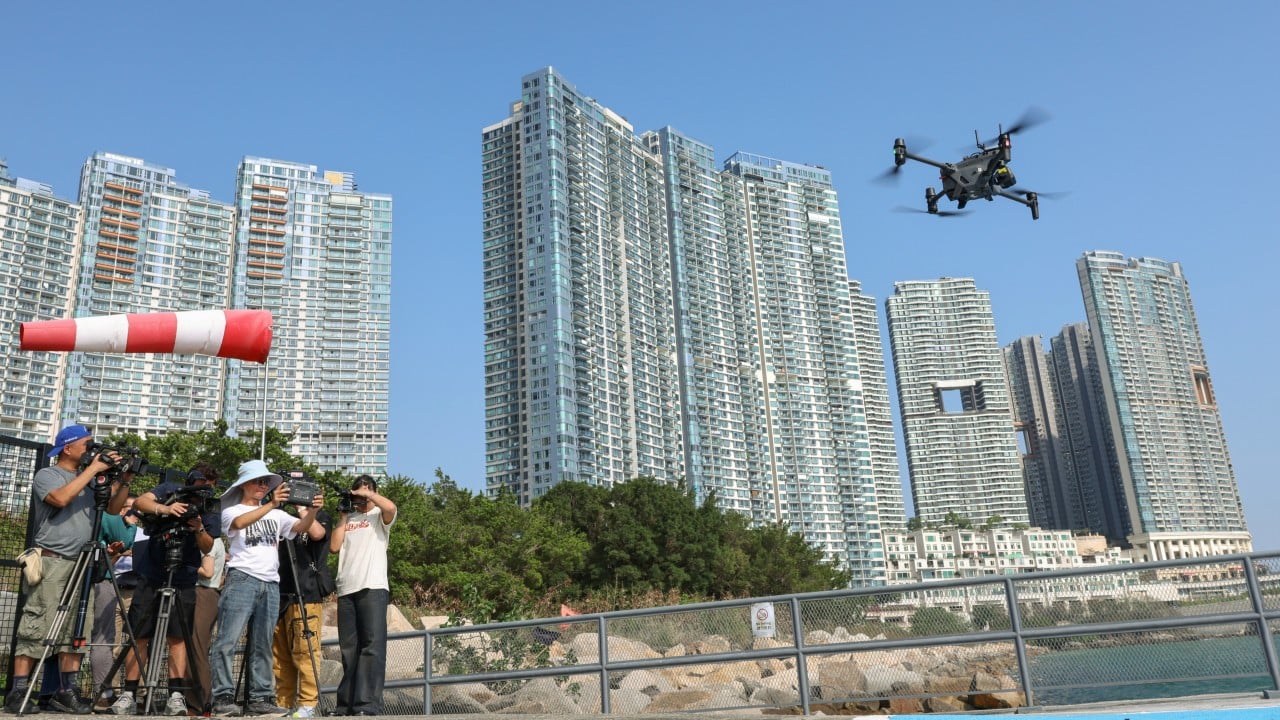
The air in the city used to belong to the birds and the occasional, distant roar of a 747. It was an empty volume, a vast, wasted void between the tops of our heads and the clouds. But look up lately. Something is changing in the silence.
We are witnessing the birth of a new geography. It isn't happening on the ground, where we’ve spent centuries fighting over inches of asphalt. It’s happening in the "low-altitude economy," a dry, bureaucratic term for a revolution that feels more like science fiction than a municipal policy update. Recently, over 100 drone projects were proposed in a single surge of ambition, signaling that the gold rush has moved from the dirt to the sky.
To understand why this matters, you have to stop thinking about drones as toys for hobbyists or cameras for wedding photographers. Think of them as the new capillaries of a living city.
The Midnight Delivery
Consider a woman named Elena. She lives on the 14th floor of a high-rise in a dense urban center. It is 2:00 AM, and her toddler has a spiking fever. In the old world—the world of 2024—Elena has two bad options. She can bundle a sick, screaming child into a car, fight for parking at a 24-hour pharmacy, and risk a late-night fender bender. Or she can wait for a courier who is currently stuck behind a garbage truck three miles away.
In the world these 100 new projects are building, Elena hits a button.
Four minutes later, a soft hum vibrates outside her window. A carbon-fiber octocopter, guided by a mesh of satellite data and local sensors, hovers at her balcony. A small, climate-controlled compartment opens. The medicine is there. The drone departs, slipping back into a pre-defined "sky corridor" that functions like an invisible interstate. No traffic. No CO2 emissions from an idling van. No human error at the steering wheel.
This isn't just about convenience. It’s about the reclamation of time. We have reached the physical limit of our streets. We can't widen the roads anymore without tearing down the neighborhoods we love. The only way out is up.
The Invisible Infrastructure
The sudden influx of these 100 projects isn't a coincidence. It’s a coordinated land grab for the air. Governments and private equity firms are finally realizing that the space between 100 and 1,000 feet is the most valuable undeveloped real estate on the planet.
But the stakes are invisible. When a company proposes a "low-altitude logistics hub," they aren't just building a warehouse. They are designing the software that will prevent thousands of autonomous machines from colliding over your backyard. They are solving the "three-dimensional Tetris" of urban flight.
The technical hurdles are immense. To make this work, we need more than just better batteries. We need a "Digital Twin" of the entire city—a 3D map updated in real-time that accounts for every construction crane, every new flagpole, and every gust of wind whipping between skyscrapers.
I’ve spoken with engineers who stay up late worrying about "acoustic pollution." They know that if the sky becomes a hornet’s nest of buzzing motors, the public will revolt. The 100 projects currently on the table aren't just competing on speed; they are competing on silence. They are testing blade shapes that mimic the serrated wings of an owl, designed to shear through the air without a sound.
The Human Cost of Efficiency
It is easy to get swept up in the magic of it. Yet, there is a lingering shadow. What happens to the millions of people who make their living on the ground?
The delivery driver is a fixture of our modern economy. They are the people who know which gate code actually works and which dogs are friendly. A drone doesn't know those things. It doesn't care. As we automate the "last mile," we risk severing one of the last remaining physical threads between commerce and community.
We must be honest: this transition will be painful for some. The "low-altitude economy" is expected to be worth trillions, but that wealth doesn't naturally trickle down to the person whose van is being replaced by a flight path. The challenge for policymakers isn't just approving 100 drone projects; it’s ensuring that the people grounded by this technology have a way to climb with it.
A New Way to See
Beyond logistics, these projects are changing how we protect one another.
Imagine a forest fire in a remote canyon. In the past, we sent pilots in heavy tankers, flying low in treacherous smoke, risking lives to drop retardant. Today, a swarm of twenty drones can be deployed in minutes. They operate with a hive mind, circling the blaze, identifying heat signatures through the smoke, and dropping their payload with surgical precision. They don't need to see through the haze; they "see" through thermal data and LIDAR.
Or consider the bridge you drive over every morning. Infrastructure is failing across the globe because inspecting it is dangerous and expensive. Men and women hang from ropes under rusted girders, squinting at cracks. Now, a specialized drone can fly inches from the steel, using high-resolution sensors to detect microscopic stress fractures long before they become catastrophic.
The sky is becoming a tool for preservation.
The Architecture of Tomorrow
If you look at the blueprints of the newest buildings in Shenzhen, Dubai, or North Texas, you’ll notice something strange. The rooftops aren't just flat slabs for HVAC units anymore. They are being designed as "vertiports."
These are the bus stations of the future. They feature induction charging pads where drones can land, swap batteries, and take off again in sixty seconds. They have automated sorting systems that move packages directly from the sky into the building’s internal mail chutes.
The 100 projects currently being proposed are the first bricks in this invisible city. They represent a shift in human habit. We are moving from a 2D civilization to a 3D one. We are learning to inhabit the vertical.
It is a messy, complicated, and occasionally frightening transition. There will be accidents. There will be legal battles over "air rights" and privacy. Does a homeowner own the air 200 feet above their pool? The courts are about to find out.
Yet, despite the friction, the momentum is irreversible. The efficiency of the sky is too great to ignore. We are trading the friction of the tires for the freedom of the blade.
The next time you’re walking down a crowded street, frustrated by the gridlock and the exhaust, take a second to look up. The space is there. It’s waiting. And very soon, it will be humming with the sound of a thousand errands being run on the wind.
The birds might have to share their kingdom, but for the rest of us, the world is about to get a lot wider.
One day, you will tell your grandchildren about the time when the sky was empty, and they will find it as hard to believe as a world without the internet. They will look up at a perfectly choreographed dance of lights and cargo, a silent ballet of supply and demand, and they will wonder how we ever managed to stay so stuck to the ground.
The first hundred steps have been taken. The rest of the journey is straight up.