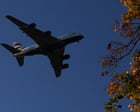
Stand on a damp rooftop in West London, and the world vibrates. It is a low, continuous shudder that rattles loose tiles and travels straight up through the soles of your shoes. Every ninety seconds, a silver tube packed with two hundred sleeping strangers lifts off from Heathrow Airport, slicing into the stubborn British overcast. From the ground, it looks effortless. It looks like magic. It looks like absolute freedom.
Yet gravity and chemistry do not care about magic. Jet fuel does not vanish when the engines roar silent; it transforms into carbon dioxide, water vapor, and nitrogen oxides, hitching a ride straight into the upper troposphere where it lingers for centuries. For decades, modern society built its entire concept of globalized civilization on the promise of the four-hour flight to anywhere, treating the sky as an infinite, bottomless sink. Now, the bottom is starting to show. Meanwhile, you can find related events here: When the Story Chases the Tragedy The Reality of Aerial News Gathering.
Enter the climate advisers. In cold, fluorescent-lit rooms in Westminster, calculators hummed, spreadsheets glowed, and a blunt truth was laid bare before the government. You cannot expand Europe’s busiest aviation hub while pretending the atmosphere has an elastic limit. The recommendation was stark, unvarnished, and deeply uncomfortable for an industry built on perpetual, unobstructed growth: if Heathrow gets its long-coveted third runway, airlines must pay for carbon dioxide removal. Not cheap paper offsets. Not vague promises to plant seedlings in a distant valley that might burn down next summer. Real, permanent, engineered carbon removal.
To understand why this proposal is a watershed moment, you have to look past the political theater and confront the brute physics of flight. Imagine a Boeing 777 loaded for a trans-Atlantic crossing. It burns roughly thirty gallons of fuel every single minute. Right now, there is no battery pack on earth light enough or dense enough to lift that airplane across the ocean. Hydrogen remains a distant promise, years away from commercial viability at scale. Sustainable aviation fuels are currently produced in quantities so small they are essentially statistical rounding errors. When politicians talk about net-zero aviation by mid-century, they are leaning heavily on a technological fairy tale. To see the complete picture, check out the excellent report by The Guardian.
This is where the climate committee stepped in with a dose of sober reality. If aviation cannot eliminate its emissions at the source right now, it must pull them out of the air afterward. This is the domain of Direct Air Capture.
Picture giant industrial fans humming in the windy expanses of Iceland or the American Southwest. These machines pull ambient air through liquid solvents or solid sorbents, trapping the carbon molecules, and then—through immense heat and pressure—injecting that carbon deep underground into basalt rock, where it mineralizes into stone over a couple of years. It works. It is real. But it is unimaginably expensive. Pulling a ton of carbon out of the sky costs hundreds of dollars, and doing it at industrial scale requires staggering amounts of energy.
Now connect the dots. If Heathrow expands, adding hundreds of thousands of additional flights each year, millions of tons of new carbon will pour into the upper atmosphere. Under the advisers' blueprint, airlines would no longer get a free pass to treat the sky as a public dumpster. They would be forced to foot the bill for capturing and burying an equivalent amount of carbon dioxide.
Consider what happens to the ticket price. An economy seat to New York or Singapore suddenly carries a hidden surcharge—not a government tax born out of spite, but the actual, physical cost of cleaning up the mess. A flight ceases to be artificially cheap. It reflects its true planetary cost.
For the people living in the shadow of the proposed third runway, this debate is not new. In villages like Harmondsworth and Longford, residents have spent decades watching their homes threatened by expansion plans, only to see them stalled by court battles, changing administrations, and economic crashes. They know what it is like to live with double-glazed windows rattling every minute, breathing jet exhaust while planners argue over GDP forecasts. To them, the aviation debate is measured in decibels, demolished heritage homes, and the quiet erosion of community life.
Naturally, the aviation lobby reacted to the climate advisers' proposal with immediate, predictable horror. Airlines argued that slapping heavy carbon removal mandates on a single hub would price British carriers out of the global market, driving traffic to rival hubs in Frankfurt, Paris, or Dubai where environmental rules might be more lenient. They point to the fragile recovery of global travel, the razor-thin profit margins, the jobs lost, the economic engine stalling. They argue that growth and green transitions must happen in harmony, which usually translates to: let us grow now, and we will clean up later when someone else is in charge.
But the advisers' logic cuts deeper than quarterly earnings reports. For decades, society has operated on a moral hazard: the traveler pays for the ticket, but the future pays for the burn. We have externalized the cost of our wanderlust onto generations who will never step foot on those planes. Every vacation booked, every corporate conference flown to, every cargo haul of overnight packages has left an invisible, accumulating IOU in the air above our heads.
To walk through the departure lounge at Heathrow's Terminal 5 is to witness human connection at its finest. Families reuniting after years apart, students heading out to study in strange cities, lovers bridging continents with a boarding pass. It is impossible not to feel the pull of that wanderlust. Nobody wants to lock the world down. Nobody wants to return to an era where international travel was the exclusive playground of the ultra-wealthy.
Yet, pretending there is no bill is no longer an option. If we want the privilege of crossing oceans in hours, we must reckon with the architecture of that privilege. The debate over Heathrow's third runway is not merely a local planning dispute over noise pollution, property values, or concrete pouring. It is a stress test for our collective honesty. Can a modern industrial economy expand its carbon footprint while honoring a planetary deadline?
The answer offered by the climate advisers is a conditional yes, but with a terrifying price tag. Yes, you can expand, but only if you pay to clean up every single extra molecule of filth you put into the air. It forces the airline industry to internalize a cost it has successfully dodged since the Wright brothers first sputtered across the sand at Kitty Hawk.
As you sit in your living room and hear that distant, subterranean rumble shake the windowpanes, the sound takes on a different texture. It is no longer just the noise of progress. It is the sound of an economy running on borrowed time, writing checks that the atmosphere is increasingly reluctant to cash.
The path forward is narrow and unforgiving. If governments adopt these recommendations, flying will become more expensive. Corporate travel budgets will tighten. Weekend city breaks to distant capitals will require a harder look at the bank account. But something essential will also shift. We will stop treating the sky as an infinite expanse and start treating it as what it truly is: a finite, fragile ceiling.
The planes will keep taking off. The silver tubes will slice through the clouds, carrying human hopes and business deals across oceans. But every time the wheels leave the tarmac, the invisible ledger will demand balancing. The era of cheap, consequence-free flight is drawing to a close, replaced by a sobering realization. In the end, we always have to pay for the journey.