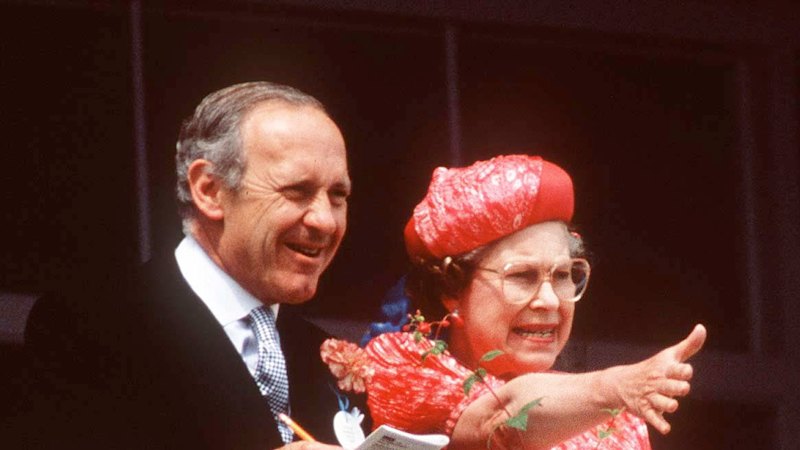
Most people think royal palaces are stuck in the Middle Ages. They assume courtiers want nothing to do with modern media or public scrutiny. But that view completely ignores figures like Sir William Heseltine, the Australian-born courtier who fundamentally reshaped how the world viewed Queen Elizabeth II.
When Heseltine passed away at 96, he left behind a legacy that defined modern royal public relations. Affectionately known as "My Bill" by the Queen herself, he wasn't just another background bureaucrat. He was the strategist who realized that if the House of Windsor wanted to survive the late 20th century, it had to let the cameras inside.
Breaking the Mold from Fremantle to Buckingham Palace
Born in Fremantle, Western Australia, in 1930, Heseltine didn't come from the traditional British aristocracy. Before entering royal service, he worked as a private secretary to Australian Prime Minister Sir Robert Menzies. That political grounding gave him a sharp instinct for public perception that many lifelong courtiers simply lacked.
When he joined the Buckingham Palace press office in 1960, the royal communications playbook was essentially locked in the Victorian era. Press interactions were formal, distant, and fiercely defensive. Heseltine knew that approach wouldn't work in an era where television was rapidly becoming the dominant cultural force.
He famously observed that while the monarchy shouldn't be too avant-garde, it could not afford to stay too far behind the times either. That philosophy guided every major media shift the royal family made over the next three decades.
The Gamble Behind the 1969 Royal Documentary
The defining moment of Heseltine's early career came with the 1969 BBC television documentary, Royal Family. Today, reality TV is everywhere, but back then, inviting cameras to film the Queen eating breakfast, walking in the countryside, and interacting casually was an unprecedented gamble.
Traditionalists inside the palace panicked. They worried it would cheapen the mystique of the crown. Heseltine argued the exact opposite. He believed that showing the human side of the family would protect the institution from growing irrelevance.
The gamble paid off massively. Over 350 million viewers worldwide watched the documentary, instantly transforming public perception. It brought warmth and accessibility to an institution that had previously felt cold and unapproachable.
Navigating the Stormy Years as Private Secretary
By 1986, Heseltine reached the pinnacle of his career when he was appointed Private Secretary to the Sovereign—the first Australian ever to hold the post. This put him right in the engine room of royal administration during a turbulent era marked by intense tabloid scrutiny, particularly surrounding the marriages of the younger royals.
Dealing with Fleet Street during the height of the 1980s tabloid obsession was relentless. Heseltine had to balance protecting the Queen's privacy with acknowledging the public's appetite for news. He introduced a more open, pragmatic style of walkabout during royal tours, encouraging the Queen to step off the official path, shake hands, and talk directly to everyday crowds. That simple shift became the gold standard for global state visits ever since.
What Modern Public Figures Can Learn from His Approach
Heseltine’s career offers a masterclass in modern reputation management. He didn't chase viral moments or try to manipulate the narrative through spin. Instead, he relied on calculated transparency.
He understood a fundamental truth about public life: you can't hide from the public in an open society, but you can choose how to engage on your own terms. By letting people see the human elements behind the crown, he built a reservoir of goodwill that sustained the monarchy through decades of cultural upheaval.
When he retired in 1990 and eventually returned to Western Australia, he left behind an institution that was vastly more adaptable than the one he entered thirty years prior. The modern public perception of the British monarchy bears his fingerprints from top to bottom.