When the thermometer hits 45°C in the shade, most of us scramble for the nearest air conditioning remote. We don't think about the carbon footprint or the grid strain. We just want to stop sweating. But in the heart of Burkina Faso, a country where the sun feels like a physical weight, a massive residential project is proving that our reliance on buzzing, energy-hungry metal boxes might be a massive architectural mistake.
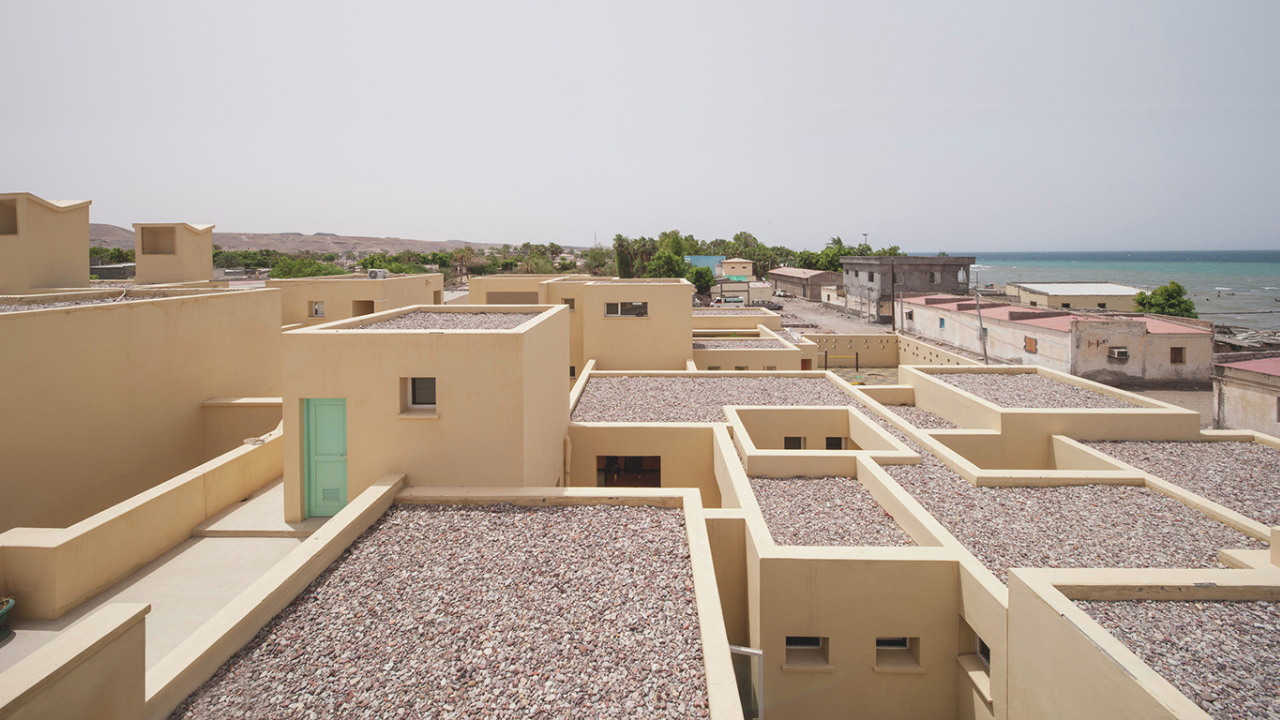
The SOS Children’s Village in Tadjourah isn't just a shelter. It's a masterclass in thermal mass and passive cooling. This isn't experimental tech from a Silicon Valley lab. It's the revival of techniques that people used for centuries before we got lazy and started plugging everything into a wall. If you want to know why your house feels like an oven in the summer, look no further than the way we’ve abandoned local materials for "modern" concrete and glass.
Why Modern Building Materials Are Actually Terrible
Most people assume concrete is the gold standard for durability. It's cheap, it's fast, and it’s everywhere. But concrete is a thermal disaster in hot climates. It absorbs heat all day and radiates it back at you all night. You're living inside a slow-cooker. In Djibouti and Burkina Faso, sticking to Western-style cinder blocks is basically a heat-stroke waiting to happen.
The Tadjourah village, designed by Urko Sanchez Architects, rejects this. They looked at the environment first. They saw a region where the heat is relentless and the wind is a double-edged sword. To fix this, they didn't look for a bigger generator. They looked at the dirt under their feet.
By using local materials with high thermal inertia, the buildings act as a buffer. They don't just block the sun. They manage it. Think of it like a heavy wool coat in the winter—it keeps your body heat in. In a hot climate, high-mass walls do the opposite by keeping the external heat out long enough for the sun to go down. By the time the heat finally penetrates the wall, the air outside has cooled off, and the cycle resets. It’s physics, not magic.
Traditional Wind Towers and the Science of Natural Ventilation
If you walk through the village, you'll notice these tall, chimney-like structures rising from the roofs. They aren't for smoke. These are modern interpretations of "badgirs," or wind catchers, a Persian invention that’s been around for millennia.
The concept is simple. Hot air rises. Cool air stays low. These towers are positioned to catch even the slightest breeze high above the ground where the air is moving faster. This air is then funneled down into the living spaces. As the cool air enters, it pushes the stagnant, warm air out through openings on the opposite side.
- Natural Pressure: The height of the towers creates a pressure differential.
- Airflow: It’s a constant, silent exchange of air that requires zero electricity.
- Venturi Effect: Narrowing the passages actually speeds up the air, creating a "breeze" even on still days.
This isn't just about moving air. It’s about psychological cooling too. Moving air helps sweat evaporate faster, which is your body's built-in AC. When you combine this with the shaded courtyards found throughout the village, you get a microclimate that’s significantly cooler than the surrounding desert. Honestly, walking into one of these homes feels like stepping into a cellar.
The Architecture of Shadows
Most modern suburbs are laid out in a grid. It’s easy for cars, but it’s terrible for shade. In the Tadjourah village, the houses are packed together in a way that looks almost random, but it’s deeply calculated. They mimic the narrow alleys of traditional Medinas.
The buildings shade each other. By keeping the houses close, the amount of wall surface exposed to the direct midday sun is minimized. You end up with a network of narrow, "canyon-like" streets where the ground never gets a chance to bake.
We’ve forgotten that shade is a resource. We treat it as an afterthought, something we get from an umbrella or a lone tree in the yard. In this village, the architecture is the shade. The roofs are often double-layered or ventilated, allowing hot air to escape from the "attic" space before it can heat the ceiling of the room below. It’s a layering strategy. You don't just have one barrier between you and the sun; you have three or four.
Why We Don't Build Like This Anymore
You might wonder why, if this works so well, we aren't doing it in Arizona, Nevada, or Spain. The answer is usually "efficiency," or at least the corporate version of it. It’s easier to ship standardized steel and glass than it is to train a workforce in traditional masonry or earth-building.
There's also a status issue. For decades, "modern" meant Western. If a building didn't look like a glass box from New York or London, it was seen as "underdeveloped." This mindset has caused a massive loss of indigenous knowledge. We're now seeing the consequences. As global temperatures rise, those glass boxes are becoming uninhabitable without massive amounts of power.
The SOS Children’s Village is a middle finger to that trend. It proves that "primitive" techniques are actually more sophisticated than our current tech because they work in harmony with the environment instead of trying to fight it with a power cord.
Lessons You Can Actually Use
You probably can’t go out and rebuild your house with three-foot-thick earth walls tomorrow. But the principles used in this village are universal.
Stop opening your windows the second it gets hot. If the air outside is 35°C and the air inside is 25°C, you’re just letting the heat in. Close everything up during the day. Use heavy, light-colored curtains to create your own "thermal mass" barrier.
Think about "night flushing." This is what the village does naturally. At night, when the temperature drops, open every window and use a fan to pull the cool air in and push the warm air out. Then, seal the house at sunrise. You’re essentially "charging" your home with cold air to last through the day.
Planting trees on the west side of your home can reduce your cooling costs by nearly 25%. It’s the same "architecture of shadows" principle. If the sun never hits your wall, the wall never gets hot.
We need to stop thinking about cooling as something we "buy" from the electric company. It's something we should design for. The kids in Tadjourah are living in one of the hottest places on Earth, and they're doing it comfortably without a single humming compressor. That should make us all rethink how we live.