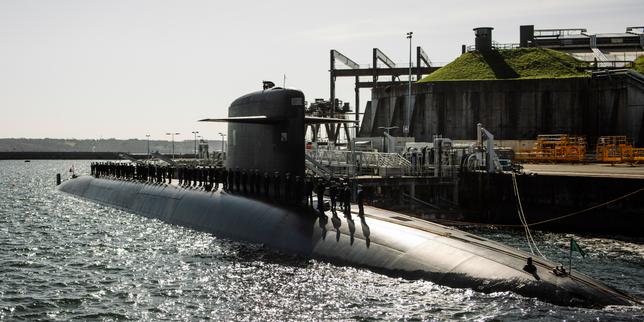
The rain in Brittany doesn't fall; it occupies. It clings to the granite cliffs of the Crozon Peninsula, blurring the line between the gray Atlantic and the gray sky. Deep beneath the surface of the harbor, tucked away in the belly of a submarine named Le Terrible, a young officer stares at a screen that shows him nothing but the status of a promise.
He is twenty-four. He has a fiancé in Rennes and a fondness for jazz. He is also one of the few humans on earth currently holding the keys to the end of the world.
For decades, this young man’s mission was simple, if terrifying. He was the guardian of a "Sanctuary." If an enemy crossed a specific line on a map of France, his boat would receive a signal. The logic was cold, binary, and strictly national. But the map is changing. The lines are blurring. The rain falling on the Ile Longue is the same rain falling on the streets of Berlin, Warsaw, and Vilnius.
We are witnessing the quietest, most consequential shift in European history: the day the French nuclear umbrella began to stretch.
The Ghost of the Cold Peace
Nuclear doctrine is usually discussed in windowless rooms by men in charcoal suits who use words like "strategic ambiguity" to mask the scent of scorched earth. It feels academic until you realize that every brick in every cafe in Paris or Prague exists because of a collective agreement to remain terrified.
For sixty years, France maintained a solitary stance. Charles de Gaulle viewed the "Force de Frappe" as a strictly hexagonal affair. It was about l'indépendance. If the world went to hell, France would at least be the master of its own ashes. This was the era of the "Sanctuary."
But a sanctuary with a burning backyard is no sanctuary at all.
Consider the reality of a modern ballistic missile. It does not recognize the customs booths at Strasbourg. If a tactical strike hits a frontline state in the East, the fallout—political, economic, and literal—doesn't stop for a passport check. The "vital interests" of France, once defined by the physical borders of the Rhine and the Alps, have bled outward.
The shift isn't just about hardware. It’s about the soul of the continent. While the United States debates its own commitment to old alliances, a heavy silence has fallen over Europe. In that silence, the hum of French nuclear reactors and the muffled engines of the Triomphant-class submarines have become the most important sounds in the world.
The Warning Shot That Never Fires
There is a specific, Gallic quirk to this strategy called the ultime avertissement.
In the American or British playbook, you generally have a ladder of escalation. You start small. You hope they stop. France, however, prefers a different kind of theater. The "final warning" is a single, non-strategic nuclear strike intended not to start a war, but to scream "Stop" so loudly that the air vibrates. It is the tactical equivalent of a slap across the face with a gauntlet.
For years, the rest of Europe looked at this with a mix of confusion and disdain. They preferred the American "Extended Deterrence," a warm, fuzzy blanket provided by Washington.
Then came February 2022.
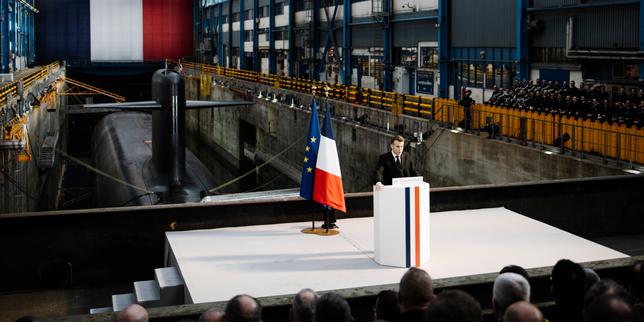
The blanket was pulled back. Suddenly, the "European dimension" of French doctrine stopped being a rhetorical flourish in a Macron speech and became a structural necessity. When French officials now say that their nuclear forces "by their very existence, contribute to the security of the Atlantic Alliance and of Europe," they aren't just being polite. They are acknowledging a terrifying truth: France is now the only nuclear power in the European Union.
This puts the young officer in the submarine in a strange position. He is no longer just defending a country; he is the silent pulse-check for an entire civilization.
The Invisible Stakes of the "Europeanization"
Imagine a cabinet meeting in a Baltic capital. The threat is no longer theoretical. It is moving. In the old world, the eyes in that room would look toward the sunset, hoping for help from across the ocean. Today, they also look toward the south.
The adaptation of the doctrine is a dance of shadows. France cannot—and will not—offer a "nuclear sharing" agreement like the Americans do. You won't see French warheads stationed on German soil. That would break the spell of independence that gives the deterrent its teeth. Instead, the shift is psychological.
It is an invitation.
France is asking its neighbors to join the conversation about what constitutes a "vital interest." If a power-grid failure in Poland caused by a foreign actor leads to a total collapse of European stability, is that a "vital interest" for France? Ten years ago, the answer was a shrug. Today, the answer is a low, vibrating "Yes."
This isn't about creating a "Euro-Bomb." It is about a shared recognition of vulnerability. We are learning that you cannot have a common market and a common currency without eventually sharing a common fate.
The Burden of the Unseen
The complexity of this move lies in its fragility. Deterrence only works if the other side believes you are crazy enough to do it, but sane enough to know when. By expanding the umbrella to cover Europe, France is increasing its surface area for mistakes.
Critics argue this is a dangerous overreach. They say it invites a Russian or Chinese counter-move that puts Paris in the crosshairs for a conflict that started in a border town three thousand kilometers away. And they are right. That is the cost of the seat at the table.
But the alternative is a continent of "nuclear nakedness."
Without the French pivot, Europe remains a collection of wealthy, technologically advanced states that are, at their core, protectorates. To be a protectorate is to live at the mercy of a distant voter in Iowa or Arizona. By "Europeanizing" the doctrine, France is attempting to turn a collection of states into a sovereign entity.
It is a heavy lift for a nation that once prided itself on being the "splendid exception."
The Quiet Reality of the Watch
Back on the Le Terrible, the air is recycled and smells faintly of ozone and machine oil. The crew lives in a world of artificial light where time is measured by shifts and sonar pings. They do not see the debates in Brussels. They do not read the white papers about "strategic autonomy."
They simply exist as a mathematical variable.
Their presence ensures that any aggressor must solve an impossible equation. The aggressor has to wonder: Will the French risk it all for a city that doesn't speak their language? The genius of the new doctrine is that the answer doesn't have to be a "Yes." It only has to be a "Maybe." That "maybe" is the thin, invisible wire that keeps the peace.
We often think of power as something active—an explosion, a speech, a law. But the most profound power in Europe today is passive. It is the power of a boat that stays hidden, carrying a message that it hopes never to deliver.
The rain continues to lash the coast of Brittany. The granite stays firm. And deep in the dark water, the young officer waits, a silent witness to a Europe that is finally realizing it must protect its own.
The umbrella is open. It is heavy, it is expensive, and it is terrifying. But for the first time in a generation, the whole continent is standing under it.
Would you like me to look into the specific technical capabilities of the new M51.3 missile slated to enhance this deterrent strategy?