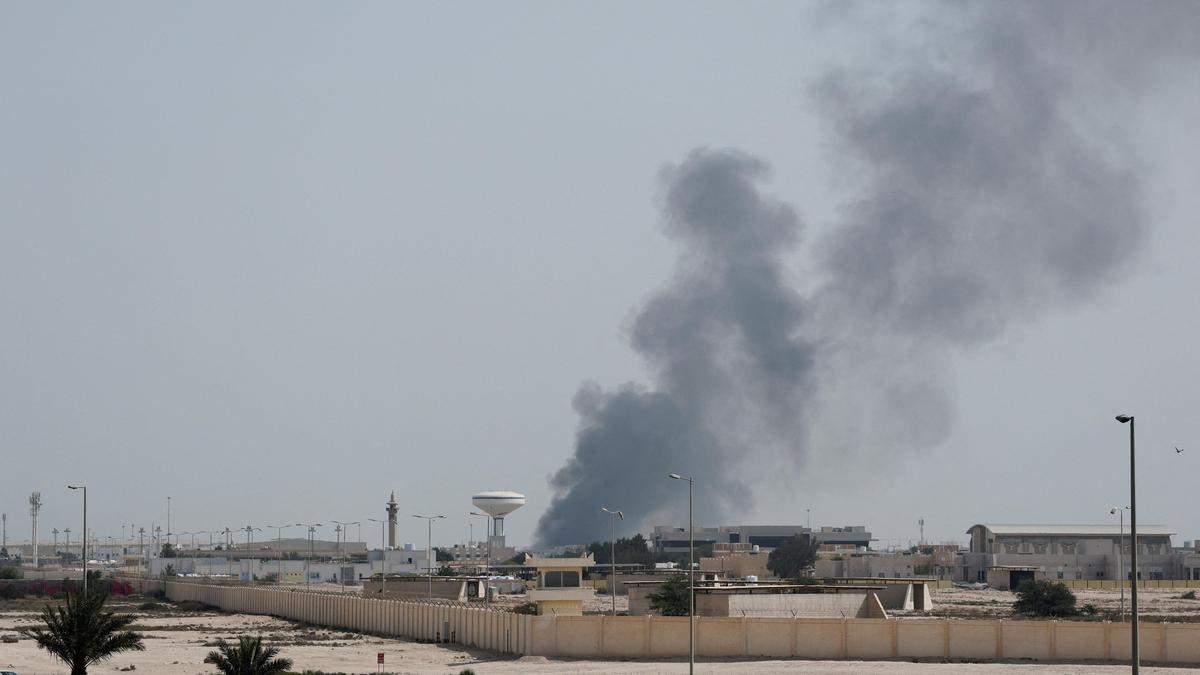
The shadow war between Iran and Israel has spilled out of the intelligence corridors and onto the vital shipping lanes of the Arabian Sea. While initial reports focus on the immediate rescue of fifteen Indian crew members from a tanker hit off the coast of Oman, the tactical shift seen in the strike on Duqm port suggests a far more dangerous escalation in maritime warfare. This wasn't a random act of piracy. It was a calibrated demonstration of long-range precision.
For years, the "war between wars" was fought in the dark. Now, it is fought with low-cost, high-impact suicide drones that bypass traditional naval defenses. By targeting the Duqm port area—a strategic hub that serves as a critical maintenance and logistics base for Western navies—the attackers are signaling that no corner of the Indian Ocean remains a safe harbor. This hit represents a fundamental breakdown in regional maritime security protocols.
The Duqm Gateway and the New Geography of Conflict
Duqm is not just another port. It is the linchpin of Oman’s economic future and a vital strategic asset for the US and UK navies, providing a deep-water berth outside the volatile Strait of Hormuz. When drones strike this specific geography, they aren't just hitting a tanker; they are threatening the viability of the "Hormuz Bypass."
The logistics of this specific operation reveal a sophisticated level of intelligence gathering. To strike a moving target like an oil tanker after hitting a fixed port installation requires real-time telemetry and a command-and-control structure that exceeds the capabilities of most non-state actors. The use of "loitering munitions"—drones that can hang in the air until a target is identified—has turned the Arabian Sea into a shooting gallery where the predator has all the advantages.
The evacuation of the fifteen Indian nationals underscores the human cost and the international pressure building on New Delhi. India, which has historically maintained a delicate balancing act between Tehran and Tel Aviv, now finds its citizens in the direct line of fire. This puts the Modi administration in an impossible position, forced to protect its workforce while navigating a proxy war that shows no signs of cooling.
The Math of Asymmetric Maritime Attrition
The economics of these strikes are skewed heavily in favor of the aggressor. A drone costing less than $20,000 can cause millions in structural damage to a VLCC (Very Large Crude Carrier) and send insurance premiums skyrocketing across the entire industry. This is the math of the new Middle Eastern conflict.
$C_{attack} \ll C_{defense} + C_{insurance}$
When a single hit can force a total evacuation, the physical damage to the hull is almost secondary to the psychological damage to the global supply chain. Shipping companies are now forced to weigh the cost of armed guards and expensive electronic warfare suites against the reality that most merchant vessels are essentially sitting ducks.
The drones used in these operations, likely variants of the Shahed family, utilize GPS spoofing and inertial navigation to hit specific coordinates with terrifying accuracy. They are small, fly low to avoid radar, and have a thermal signature that is often lost in the heat of the Gulf. For a naval destroyer, tracking these "suicide gnats" is like trying to swat a fly with a sledgehammer.
Intelligence Gaps and the Failure of Deterrence
Western intelligence agencies have spent decades preparing for a conventional blockade of the Strait of Hormuz. They prepared for minefields and swarm boat attacks. They did not sufficiently prepare for a sustained campaign of "death by a thousand drones" originating from launch sites hundreds of miles away in the Yemeni highlands or from the Iranian coastline.
The strike off the Oman coast proves that the current maritime security architecture is aging out. The presence of the US Fifth Fleet or the various international task forces has not deterred these hits because the perpetrators operate with plausible deniability. They use "dark ships" to launch drones or utilize remote-controlled platforms that leave very little forensic evidence back to a specific government, even if the "fingerprints" of the technology are obvious.
We are seeing a transition from traditional naval power projection to a localized, tech-heavy insurgency at sea. The vulnerability of the Indian crew members highlights a shift in targeting; the nationality of the crew no longer serves as a diplomatic shield. In the past, attackers might avoid ships with crews from neutral or friendly nations to prevent diplomatic blowback. That era of restraint is over.
The Role of Oman as a Fragile Neutral
Oman has long been the "Switzerland of the Middle East," the primary mediator that keeps lines of communication open between Washington and Tehran. By bringing the kinetic conflict to Omani waters and ports, the aggressors are effectively telling Muscat that its neutrality will not protect its economic interests.
The Port of Duqm was supposed to be the safe alternative to the Persian Gulf. If insurance companies begin to classify Omani waters as a high-risk combat zone, the economic logic of the entire region shifts. This isn't just about oil; it's about the credibility of international law in international waters.
Hardening the Merchant Fleet
The solution isn't as simple as adding more grey hulls to the water. The merchant fleet must undergo a rapid technological hardening. This includes:
- Directional Acoustic Weapons: Using sound to disable drone electronics or deter approach.
- Electronic Jamming Bubbles: Creating localized "no-fly zones" around high-value tankers.
- Kinetic Interceptors: Small, automated turrets designed specifically to track and neutralize slow-moving aerial threats.
However, these technologies come with a massive price tag and complex legal hurdles regarding the arming of civilian vessels. Most port authorities are hesitant to allow "armed-to-the-teeth" tankers into their harbors, creating a bureaucratic stalemate while the drones continue to fly.
The evacuation of the Indian crew is a success story in terms of life saved, but a failure in terms of mission continuity. Every time a crew is forced to abandon ship, the attackers win. They don't need to sink the vessel to achieve their goal; they only need to make the route "un-seafarable."
The maritime industry is currently reacting to events rather than anticipating them. Until there is a coordinated, international response that addresses the manufacturing and export of these drone components, the Arabian Sea will remain a playground for proxy forces. The focus must shift from reactive rescue to proactive disruption of the supply chains that build these weapons.
If you are a ship owner today, you aren't looking at the horizon for pirates with ladders; you are looking at the sky for a shape that shouldn't be there. The theater of war has shifted vertically, and the rules of engagement are being rewritten in real-time on the decks of burning tankers.
Verify your sensor arrays and check your insurance pulse. The next strike won't be a surprise; it will be a statistic.