The Weight of a Feather Edge
Dirt gets under your fingernails in a way that hot water can never quite fix. It stains the creases of your skin, a stubborn grey-brown map of the earth you have just turned over.
Kneeling in a trench in the Great Basin, breathing in the dry scent of sagebrush and baked dust, you stop. Your trowel hits something. It does not make the dull, wet thud of a rock rolling out of place. It pings. A high, sharp note of flint striking metal—or another stone.
You brush the dirt away with a soft-bristled brush. Your heart does something irregular against your ribs.
There it lies. An artifact nine thousand years old.
It is small enough to cup in the palm of a hand, yet it commands the entire space around it. The edges are impossibly thin, pressure-flaked by a human artisan who lived during the early Holocene epoch, long before the first stone of the Great Pyramid was ever quarried. But that is not what freezes you in place.
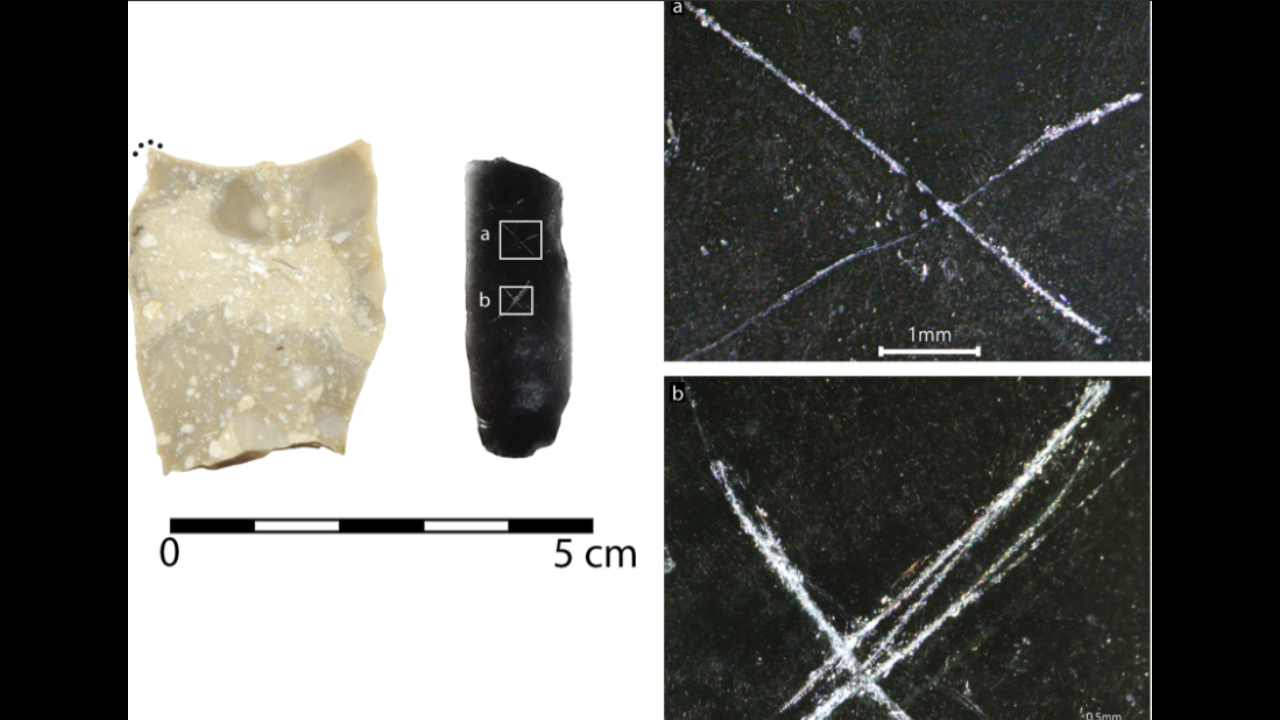
Across the smooth face of the projectile point, catching the harsh desert sun, are lines. Tiny, deliberate incisions. Scratches made by a hard point or a sharp tool, etched into the stone with a precision that defies casual decoration.
They are strange markings. They puzzle you. They have puzzled every archaeologist who has bent over this exact trench.
And right there, in the silence of the badlands, you realize something humbling. We are not the first minds to look at the horizon and wonder what it all means.
When Stone Becomes a Voice
To understand these ancient arrowheads, we have to strip away the Hollywood myth of prehistoric life. We tend to picture our ancestors as desperate creatures, running blindly from predators, grunting in caves, entirely consumed by the brutal mechanics of survival.
Wrong.
Survival was a baseline, yes. But humans have never been content with merely staying alive. The moment our species figured out how to eat, we started wondering why we were here. We painted horses on cavern walls in the pitch dark. We buried our dead with red ochre and necklaces of shell.
And sometimes, we took a weapon designed to kill for food, and we carved secret codes into its body.
(To be clear: when we talk about markings on nine-millennium-old lithic tools, we are stepping into a realm of deep interpretation. I am using a hypothetical reconstruction of an archaeologist's field experience here to ground the science, but the artifacts themselves are very real, unearthed from desert floors and rock shelters.)
Why carve a projectile point?
If you drop a stone down a well, you expect a splash. If you make a tool, you expect it to function. A set of jagged notches or geometric hatch marks on a hunting tool does nothing to improve its aerodynamics. In fact, deep incisions can weaken the structural integrity of a fragile flint blade, making it more likely to snap upon impact against bone or hide.
An ancient flintknapper knew this better than anyone. Hours of painstaking labor went into shaping that point. Selecting the right nodule of chert or obsidian, striking off the primary flakes with a hammerstone, refining the edge with a piece of antler using pressure flaking—it is an art form born of absolute mastery.
To take that finished masterpiece and score lines into its face was a deliberate choice. A choice that carried a cost.
Which means the message mattered more than the weapon.
The Great Cipher of the Holocene
Archaeologists hate the word mystery. It sounds like giving up. Trained scientists prefer terms like "anomalous data cluster" or "unidentified cultural patterning." But standing in front of a museum case holding these engraved lithics, even the most rigorous academic feels a prickle of sheer wonder.
What are the markings?
Let us look at the leading theories, stripped of academic jargon.
Some researchers suggest ownership marks. In a nomadic band of hunter-gatherers, sharing a kill was vital, but personal gear was sacred. A specific pattern of notches could tell everyone whose hand crafted the shaft, whose eye sighted the target. It is a signature carved in stone. Think of it as the prehistoric equivalent of branding livestock or signing a painter's canvas in the corner.
Others lean toward something more spiritual. The ancient world was alive with intent. Rocks breathed, winds had names, animals spoke in dreams if you listened closely enough. A hunter might etch a protective symbol onto a weapon to ensure a clean strike, or to appease the spirit of the animal about to die. It is a plea whispered to the cosmos through stone.
Then there is the possibility of tracking information. Tally marks. Records of successful hunts, phases of the moon, or tribal lineages passed down from generation to generation.
None of these theories have been definitively proven. And that is where the real beauty lies. We are peering through a keyhole into a mind that has been dust for nine thousand years.
The Echo in Our Own Hands
We live in an era obsessed with leaving a mark.
We build digital footprints that span petabytes. We post photographs, draft manifestos, tweet our breakfast, and code algorithms designed to outlive us. We are terrified of vanishing. We want the universe to know we were here.
Nine millennia ago, a human being sat by a fire that went out centuries before the dawn of agriculture. The night was cold. The stars were bright and terrifyingly indifferent.
That person picked up a piece of stone, took a sharp tool, and scratched a pattern into a weapon. They didn't have paper. They didn't have servers. They had flint, bone, and time.
They wanted to say something. To whom? To the gods, to their children, or perhaps just to themselves, to prove that their existence left a ripple in the quiet stream of history.
When we hold these artifacts today, we aren't just looking at dead rocks. We are touching a mirror. The markings are strange only because we have forgotten how to speak their language. But the impulse behind them? That is a language we use every single day.
Look down at your own hands. Notice the dirt in the creases, the scars from old accidents, the way your fingers curve around your pen or your phone.
We are still those exact same people. We are just wearing different clothes.
The fire is long out, but the stone remembers.