Morning does not always break with light. Sometimes, it arrives as a tear in the sky, a sudden, shrieking fracture that turns the ordinary into a monument of dust.
Ask anyone who has stood on the banks of the Siverskyi Donets river in the Kharkiv oblast what stillness sounds like, and they will tell you it is fragile. It is the sound of old wooden fences creaking in the breeze, of stray dogs picking their way through overgrown gardens, of elderly neighbors trading gossip about the price of firewood. That stillness is a skin. And on that day, in Petchenihy, the skin split open.
The missiles did not care about the history of the soil. They did not care that this settlement, nestled quietly in the northeastern reaches of Ukraine, was a place where generations had planted orchards and watched the river ice melt into spring. They came down with the cold, absolute geometry of war, turning concrete into shrapnel and breath into memory.
When the smoke finally began to thin, local authorities faced a grim ledger. Ten lives. Just like that. Ten human beings who woke up planning breakfast, tending to chores, or simply watching the early fog lift off the water, reduced to a statistic on an evening news ticker.
Numbers are cowards. They give us the illusion of comprehension while hiding the blood.
Consider what a single life contains. A kitchen drawer filled with mismatched keys. A worn photograph tucked behind a mirror. A specific cadence of laughter heard through a thin wall. Multiply that by ten, and you begin to understand the true magnitude of what happened in Petchenihy. It is not just an attack on a geographical coordinate. It is an erasure of futures.
I remember the weight of that particular kind of silence. Not the peace of a sleeping forest, but the heavy, suffocating quiet that settles over a street after the concussive wave passes. The air tastes of sulfur and pulverized brick. Your ears ring with a frequency that seems to mock your survival. In those moments, the world narrows to a pinpoint. You look at your hands. They are shaking. You wonder how the sun can dare to keep shining when the ground beneath you has just betrayed everything you thought was solid.
This is the reality of the ongoing war in Ukraine. It is not fought only on distant, abstract frontlines marked by tactical arrows on television screens. It is fought in kitchens, in schoolyards, in sleepy municipal districts like Kharkiv, where the front line is wherever the sky decides to fall.
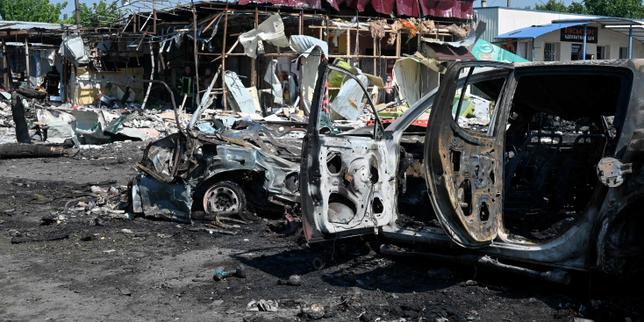
Local emergency services arrived quickly, moving through the wreckage with the grim, practiced efficiency of people who have lived too long under a collapsing roof. Every shattered window, every twisted girder of corrugated iron is a testament to an unrelenting assault on civilian life. The regional administration confirmed the death toll with the flat, necessary language of public safety, but behind those official statements lies a fury that no bureaucratic memo can capture.
How do people endure this? How do communities keep stitching themselves back together when the thread keeps snapping?
The answer is both terrifying and profoundly ordinary. They do it because there is no other choice.
To live in Kharkiv oblast right now is to practice a radical, stubborn defiance. It is the baker who sweeps up the glass from his storefront and fires up the ovens anyway. It is the neighbor who checks on the basement shelter before checking on his own home. It is an entire population caught in the crosshairs of an imperial ambition, refusing to let their humanity be bombed out of existence.
We look at these headlines from a distance, scrolling past between sips of morning coffee. We process the word ten as a data point, file it away under international conflict, and move on to the next tab. But the cost of looking away is high. It sanitizes the violence. It allows the architects of these strikes to reduce human lives to collateral damage.
Petchenihy is not an anomaly. It is a mirror.
It reflects the daily gamble played by millions of people who wake up every morning knowing that the air defense sirens might fail, that a missile might have their name written on its guidance system, and that their entire world could vanish in a millisecond of blinding light. And yet, they live. They mourn their dead with a quiet, devastating dignity. They bury their mothers, their fathers, their friends, and then they look up at the bruised sky, waiting for tomorrow.
The dust over the Siverskyi Donets has settled by now. The rescue workers have packed up their gear. The official reports have been filed into the permanent archives of a war that has already rewritten the history of Europe. But in the empty spaces where ten lives used to be, the wind still moves through the ruins, whispering names that the world must never forget.