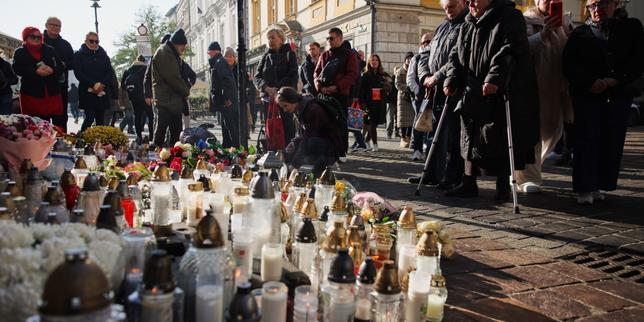
Cold.
That is the first thing you notice when a public square goes quiet in Central Europe, long before the sound of the church bells or the rustle of winter coats reaches your ears, because a crowd of thousands breathing in unison creates a strange, heavy stillness that seems to pull the warmth right out of the cobblestones. In similar updates, take a look at: Why Counting Casualty Numbers in Yemen Completely Misses the Point of Modern Air Campaigns.
If you have ever stood in Krakow’s Rynek Główny—the vast medieval Main Market Square anchored by the twin uneven towers of St. Mary’s Basilica—you know it as a place of perpetual, cheerful noise. Normally, the air smells of roasted chestnuts, buttered obwarzanek pretzels, and horse-drawn carriages clattering over centuries-old stone. Tourists crane their necks at the Cloth Hall. Students hurry toward Jagiellonian University with coffee cups pressed between wool gloves. It is a city built to outlast empires, partitioned and occupied and rebuilt so many times that permanence feels baked into the brick.
Which is why the sight of Krakow stopping dead in its tracks hits so hard. Al Jazeera has analyzed this fascinating topic in extensive detail.
When news breaks of a violent attack in a city like Krakow, the standard headline reduces human devastation to a tidy formula. You see the word attentat, the location, the mention of a video clip, and the flat declaration that Polish citizens are paying tribute to the victims. The cameras pan across flickering candles. A correspondent summarizes the police perimeter in thirty brisk seconds before tossing back to the studio.
And then the news cycle moves on.
The Anatomy of a Vigil
To understand what actually happens when Poles gather to mourn after an act of violence, you have to look past the wide-angle drone shots and step down onto the pavement where the wax melts into the cracks between the stones.
Consider a hypothetical evening in the immediate aftermath of such a tragedy—an evening like dozens that have unfolded across European squares over the past decade. Imagine a woman named Anna, a thirty-four-year-old archivist who takes the same tram past the Old Town every morning at seven-fifty. She did not know the victims personally. She wasn't standing near the site when sirens tore through the afternoon air. Yet by seven o'clock that evening, she is standing shoulder-to-shoulder with strangers near the Adam Mickiewicz monument, holding a small glass grave candle—a znicz—whose red plastic cap glows like a heartbeat against her dark wool sleeve.
Why did she come? Not out of morbid curiosity. Certainly not for the television cameras.
Anna came because violence in a shared public space is designed to do one specific thing: sever the invisible contract that allows strangers to trust one another. Every time you step onto a crowded platform, sit at an outdoor café, or walk through an arched gateway, you are making an unspoken wager that the person walking toward you means you no harm. An attack shatters that wager in seconds. Suddenly, the bakery doorway looks like a choke point; the hum of a delivery van sounds like a threat; the stranger reaching into a coat pocket makes your chest tighten.
Standing in the square is how ordinary people take that space back.
In Poland, public mourning carries a distinct, deeply ingrained grammar that outsiders often miss. It is rarely chaotic. There are no loud chants, no performative outrage for the lenses, no frantic jostling for the front row. Instead, people arrive in quiet streams, carrying white and red flowers—the colors of the national flag—and those ubiquitous glass lanterns that usually mark family graves on All Saints' Day in November. By bringing graveyard candles into the living heart of the city, mourners perform a quiet, radical act of adoption. They are saying, without a single microphone, that the dead no longer belong only to their grieving families; they belong to the city itself.
What the Cameras Miss Behind the Police Tape
I still remember the first time I walked past a fresh street memorial in Europe forty-eight hours after an attack, long after the satellite trucks had packed up their cables and left. What struck me wasn't the scale of the flowers—it was the ordinariness of the objects tucked between them. A child's laminated drawing, corners curling in the damp air. A transit ticket weighed down by a smooth river stone. A handwritten note on graph paper torn from a spiral notebook, the ink slightly blurred by morning mist.
Those small artifacts reveal the invisible stakes that dry news reports almost always overlook.
When an incident unfolds in a city like Krakow, authorities rightly focus on immediate facts: securing the perimeter, verifying the timeline, treating the wounded, and determining whether the perpetrator acted alone. Investigators comb through CCTV footage frame by frame. Public officials issue measured statements urging calm while forensic teams work behind white tarpaulin screens.
Yet while the official investigation looks backward to reconstruct a crime, the living city is forced to look inward to survive the psychological shockwave.
Sociologists who study collective trauma have long observed a phenomenon known as "emergent solidarity." In the immediate wake of an unprovoked attack, the petty divisions that usually dominate daily life—political arguments over Sunday dinner, generational friction, complaints about municipal taxes or transit delays—temporarily evaporate. For a brief, fragile window, strangers treat one another with extraordinary tenderness. People hold doors open a second longer. Eye contact on the street carries a quiet, unmistakable question: Are you alright? Are your people safe?
Think of it like the way a forest responds when lightning strikes a single tall oak. Above ground, you see the charred bark and the sudden gap in the canopy. Beneath the soil, however, the surrounding trees immediately begin rerouting nutrients through their root networks toward the damaged perimeter, reinforcing the border so the entire stand doesn't collapse in the next windstorm.
A vigil in Krakow is that root network becoming visible above the cobblestones.
The Weight of Memory in a City That Never Forgets
To grasp why Poles respond to public tragedy with such solemn, almost ritualistic unity, you have to understand the soil they are standing on.
History in Krakow is not something locked behind velvet ropes in a museum; it is layered directly beneath your boots. Walk fifteen minutes south from the Main Square and you reach Wawel Hill, where Polish kings were crowned and buried for centuries. Walk twenty minutes in the other direction and you enter Kazimierz, the historic Jewish quarter whose empty synagogues and cobbled lanes bear permanent witness to the devastation of the twentieth century. A short drive west lies Auschwitz-Birkenau.
Growing up in—or even spending real time within—a culture shaped by centuries of survival teaches a specific lesson about grief. You learn early that ignoring pain does not make it disappear, and pretending normalcy has returned before the dead are properly honored is an insult to the living.
During the dark decades of communist rule, when public assembly was tightly policed and free speech carried heavy penalties, silent gatherings around crosses of flowers became one of the few ways citizens could express truth without uttering a forbidden word. A candle lit on a street corner was both a prayer and a quiet declaration of conscience. Authorities could sweep away flowers at dawn, and by dusk, twice as many would appear in their place.
That muscle memory never vanished. Even in a modern, prosperous European Union member state—a bustling hub of tech startups, historic tourism, and vibrant café culture—the reflex remains intact. When shock strikes, Poles do not retreat behind locked curtains to doomscroll alone in the dark. They put on their coats, buy a candle at the corner kiosk, and walk toward the center.
The Fragile Line Between Information and Fear
There is a hard truth about how modern media covers these moments, and anyone who has followed breaking news through a phone screen knows the exact sensation.
When a clip surfaces online—labeled simply with VIDEO in capital letters to trigger an immediate click—our nervous systems are hijacked before our critical faculties even wake up. We watch shaky smartphone footage filmed from behind a storefront window. We hear shouting in a language we may or may not speak. Within minutes, rumor outpaces verification by miles. Speculation fills the vacuum left by responsible journalism, painting terrifying scenarios that often bear little resemblance to what investigators later establish on the ground.
Uncertainty is exhausting. When you are trying to piece together what happened in a distant city—or worse, in your own neighborhood—the mind craves certainty so desperately that it will accept a frightening lie over an honest "we do not know yet."
Here is what grounded reality actually looks like during those tense hours:
- Initial casualty figures and motives almost always shift during the first twelve hours as hospitals triage patients and forensic specialists separate eyewitness panic from physical evidence.
- Public memorials serve a dual purpose, giving grieving families a focal point for community support while signaling to emergency responders and healthcare workers that their sleepless shifts are seen and valued.
- Routine is not indifference. When cafés reopen the next morning and trams resume their schedules, it does not mean the city has forgotten; it means residents refuse to hand over the rhythm of their daily lives to fear.
Understanding this distinction changes how you watch that footage of the square in Krakow. You stop seeing a passive crowd staring at the ground, and you start seeing an active, deliberate act of civic courage.
What Happens After the Last Candle Burns Out
Still, it would be dishonest to pretend that lighting a candle solves everything.
Wax burns down. Flowers wilt in the frost, and municipal workers eventually arrive with brooms and trucks to clear the wilted petals so delivery vans can pass again. The real test of a community begins three weeks later, when the international headlines have moved on to another crisis on another continent, and the families of the victims are left staring at an empty chair at the breakfast table.
Imagine our hypothetical archivist, Anna, walking through the Main Square a month later on a gray Tuesday morning. The red plastic lanterns are gone. The police barriers have been stacked and hauled away. A tour guide holds up a bright yellow umbrella near the Cloth Hall, explaining Renaissance architecture to a group of visitors snapping photos.
On the surface, nothing has changed.
Look closer, though, and you see the quiet shifts that endure long after the vigil ends. You see it in the way people pause when a siren wails in the distance, exchanging a brief, knowing glance with the person standing beside them at the crosswalk. You see it in blood donation clinics across the city reporting lines stretching out the door in the days following the attack, ordinary citizens rolling up their sleeves because offering a pint of blood is one of the few tangible ways to fight back against helplessness. You see it in neighbors checking in on elderly residents living alone on the fourth floor of walk-up apartments.
Grief, when shared openly rather than hidden away in isolation, slowly transforms from paralysis into vigilance—not the paranoid kind that makes you flinch at shadows, but the protective kind that makes you pay closer attention to the people sharing your street.
The Quiet Victory in the Square
A violent act always tries to write the final sentence of a story. It demands to be the loudest noise in the room, the image burned onto every screen, the memory that makes a city flinch every time the wind rattles a windowpane.
It never quite succeeds in Krakow.
Long after the breaking news banners fade from television screens and the search queries taper off into digital silence, what remains in the memory of those who stood on those cold stones is not the sound of sirens, nor the blurred chaos of a ten-second video clip. It is the sight of thousands of ordinary hands shielding small flames against the evening breeze, refusing to let the darkness have the last word.


