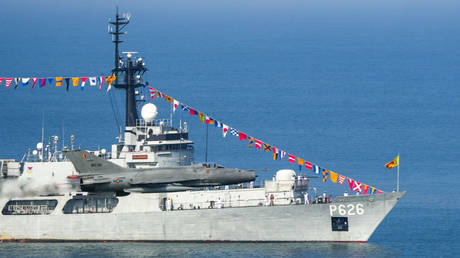
The steel hull of a warship is a paradox. From the outside, it is a monument to indomitable strength, a jagged tooth of gray geometry cutting through the tropical blue of the Indian Ocean. Inside, it is a claustrophobic maze of hums, pings, and the smell of recycled air and hydraulic fluid. For the crew of the Iranian frigate operating off the coast of Sri Lanka this week, that steel sanctuary became a coffin in a matter of seconds.
War at sea is rarely about the spectacular broadsides seen in cinema. It is about the terrifying transition from mundane routine to absolute catastrophe. One moment, a sailor is thinking about the heat of the midday sun or the taste of a meal; the next, the laws of physics rewrite themselves.
Water is incompressible. When an explosion occurs beneath the waterline, the displaced liquid has nowhere to go but up, lifting thousands of tons of metal as if it were a toy in a bathtub. Then, gravity takes its due. The ship crashes back down, its "back" broken by the sheer weight of its own ambition. This is the reality of the reports coming out of the Laccadive Sea. A submarine—ghostly, unidentified, and utterly silent—sent a clear message to the surface world.
The Invisible Predator
The ocean is the last place on Earth where you can truly disappear. Radar, the watchful eye of modern civilization, stops at the surface. To find something beneath the waves, you must rely on sonar—on sound. But the ocean is a noisy neighbor. It is filled with the clicking of shrimp, the low-frequency groans of tectonic plates, and the rhythmic churning of commercial tankers carrying iPhones and oil.
Hiding a submarine in this cacophony is an art form. It requires a mastery of thermal layers, where patches of cold and warm water act as acoustic mirrors, bouncing sonar beams away from their target. The submarine that engaged the Iranian vessel likely sat in one of these "shadow zones," watching and waiting while remaining functionally invisible.
Consider the perspective of the sonar operator on that Iranian warship. They are trained to listen for the rhythmic thrum-thrum-thrum of a propeller or the metallic whine of a cooling pump. They wear high-end headsets, straining to hear a whisper in a hurricane. When the strike came, there was no warning. There was only the sudden, violent realization that they were no longer the hunters.
A Geopolitical Chessboard Made of Salt Water
Why Sri Lanka? Why now? The geography of this incident is as critical as the hardware involved. The waters off the southern tip of Sri Lanka are some of the busiest shipping lanes on the planet. This is the jugular vein of global trade. Everything from Middle Eastern crude to East Asian electronics flows through these narrow corridors.
When an Iranian warship—a symbol of a middle power with long-range aspirations—is neutralized in these waters, the ripples extend far beyond the immediate wreckage. This isn't just about a lost ship. It is about the "Command of the Sea."
To understand the stakes, we have to look at the map not as a collection of countries, but as a series of choke points.
- The Strait of Hormuz
- The Bab el-Mandeb
- The waters off Sri Lanka
If you can prove that your adversary’s surface fleet is vulnerable even in the open ocean, you change the math of diplomacy. You turn their billion-dollar assets into liabilities. This sinking suggests that someone—a state actor with high-end silent propulsion technology—is willing to enforce a "no-go" zone for Iranian naval ambitions in the Indian Ocean.
The Physics of the Kill
We often talk about weapons in terms of "destruction," but the engineering of a submarine-launched heavyweight torpedo is more akin to a surgical amputation. Modern torpedoes like the Mark 48 or the Speartail don't actually need to hit the ship. They are designed to explode several meters underneath the keel.
The resulting gas bubble expands and contracts with such violence that it creates a vacuum. The ship’s midsection, unsupported by water for a split second, bows downward. As the bubble collapses, a high-pressure jet of water shoots upward, punching through the hull like a fist through cardboard.
Imagine the sound. It is not the "bang" of a firecracker. It is a deep, bone-shaking groan of structural steel failing all at once. It is the sound of a thousand rivets screaming.
For the survivors, the trauma isn't just the explosion. It’s the water. Ocean water at depth doesn't just "leak" in; it arrives with the force of a fire hose, smashing through bulkheads and drowning electronics. The lights go out. The screams are muffled by the roar of the sea claiming its territory.
The Silence Following the Storm
In the aftermath of the sinking, the most striking detail is the lack of an immediate "claim" of responsibility. In the world of grey-zone warfare, silence is a weapon. By not identifying themselves, the submarine’s owners force the Iranian leadership into a state of paranoid speculation.
Was it an American Virginia-class? An Israeli Dolphin? Or perhaps a regional power asserting a new level of dominance?
This ambiguity is intentional. It creates a psychological weight. Every other Iranian captain currently patrolling the North Arabian Sea is now looking at their sonar screens with a new, icy layer of dread. They know that somewhere in the vast, dark volume of the ocean, there is a predator that they cannot see, cannot hear, and cannot stop.
The sea has a way of swallowing evidence. Within days, the oil slick will dissipate. The debris will drift toward the Maldives or sink to the abyssal plain. But the strategic reality has shifted permanently. The "dry" facts of a Reuters bulletin tell us that a ship is gone. The human reality tells us that the era of uncontested surface patrols is over.
We are entering a period where the most powerful statements are made without a single word being spoken. They are made in the dark, under enormous pressure, by men and women who live in steel tubes, waiting for the one moment where the silence must be broken.
The Iranian warship is gone. The submarine is still out there. Somewhere. Listening.