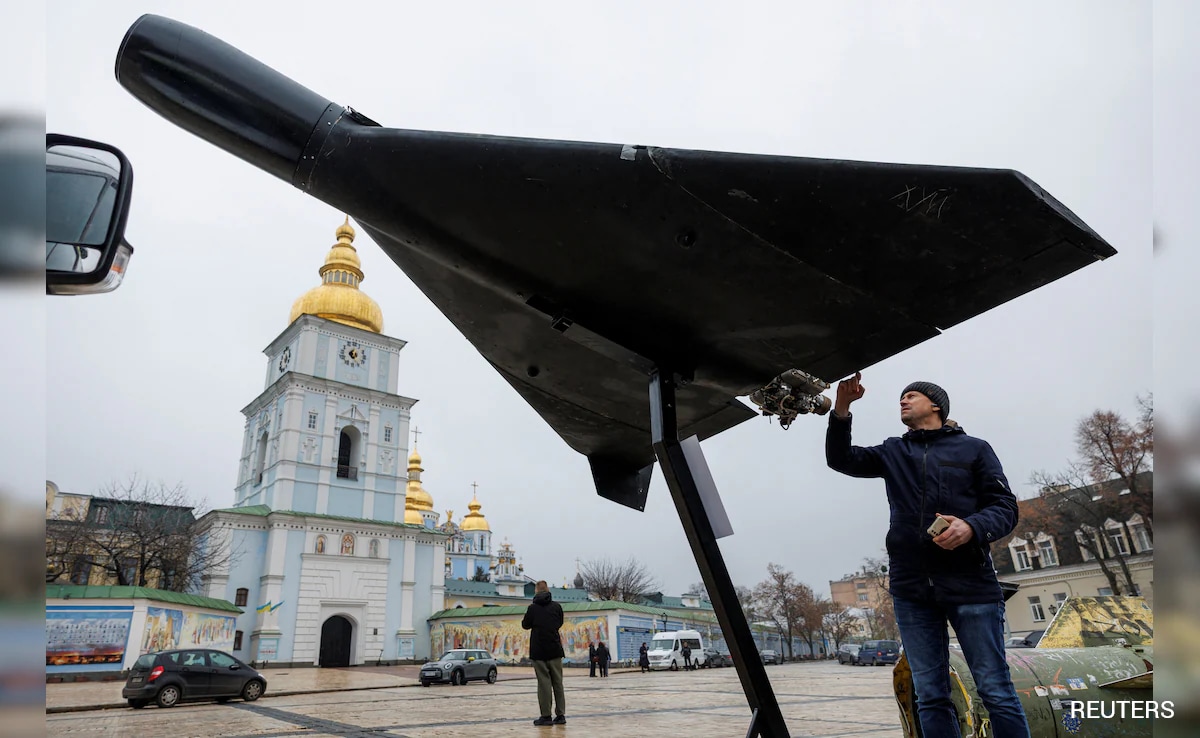
Military analysts love a good David vs. Goliath story. They’ve spent the last two years romanticizing Ukraine’s "drive" to defeat the Geran-2—the Russian-branded Iranian Shahed-136. They point to mobile fire groups, elderly Gepard flak tanks, and improvised acoustic sensors as proof of a brilliant, scrappy defense.
They are missing the point. The Shahed isn’t a weapon of precision; it’s a weapon of economic exhaustion. For an alternative perspective, consider: this related article.
Every time a $150,000 AIM-9X Sidewinder or a $2 million Patriot missile intercepts a $20,000 flying lawnmower, the defender isn't winning. They are bleeding. The "drive" to defeat the drone is actually a race to the bottom of the treasury. If you’re celebrating a 90% intercept rate while the cost-to-kill ratio is 100:1, you aren't defending your airspace—you’re liquidating your sovereignty one battery at a time.
The Myth of Kinetic Superiority
The prevailing narrative focuses on the kinetic: the explosion, the debris, the intercepted target. This is a tactical distraction. In attrition warfare, the only metric that matters is the delta between the cost of the attack and the cost of the defense. Related reporting on the subject has been published by The Next Web.
A Shahed-136 is essentially a simplified cruise missile built with off-the-shelf civilian components. It uses a MD550 four-cylinder engine—an engine you can buy on Alibaba—and basic GNSS (Global Navigation Satellite System) guidance supplemented by crude inertial navigation.
Most "expert" commentary suggests that jamming these drones is the silver bullet. It isn't. The Shahed doesn’t need a continuous data link. It isn't a DJI Mavic being piloted by a guy in a trench. It follows a pre-programmed flight path. If you jam the GPS, it switches to its Inertial Measurement Unit (IMU). The accuracy drops, sure, but when the goal is "hit a city-sized target to force the activation of a million-dollar S-300 interceptor," a miss is still a financial hit.
The West is currently trapped in a "Legacy Defense" mindset. We are trying to solve a 21st-century volume problem with 20th-century boutique hardware.
The Acoustic Sensor Delusion
You’ve likely read about Ukraine’s network of thousands of microphones mounted on poles. The "Sky Fort" or "ePPO" systems. The media calls it a stroke of genius. I call it a desperate admission of failure.
While these acoustic sensors are effective at tracking the distinct "moped" sound of the Shahed’s engine, they only solve the detection problem, not the neutralization problem. Knowing exactly where a drone is doesn’t matter if your only way to kill it is a Man-Portable Air Defense System (MANPADS) that costs more than the target's entire production run.
I have watched defense contractors pitch "innovative" solutions to this for three years. They always want to sell a more expensive sensor or a more complex missile. Why? Because there is no profit in a cheap solution. The military-industrial complex is allergic to the one thing that would actually work: mass-produced, low-cost interceptors that cost less than $5,000 per unit.
The Artillery Gap and the Flak Fallacy
The Gepard—a Cold War-era German anti-aircraft tank—is currently the "hero" of the Shahed defense. It uses 35mm programmable airburst rounds to shred drones.
On paper, this is the correct approach. Gun-based systems have a much lower cost-per-shot than missiles. However, the Gepard is a unicorn. We don’t make them anymore. The supply of 35mm ammunition is a geopolitical bottleneck. Relying on a handful of donated museum pieces to defend an entire national power grid isn't a strategy; it's a temporary reprieve.
The industry keeps promising "Directed Energy" (lasers) as the next big thing. Let’s look at the physics before we buy the hype.
$$P = \frac{E}{t \cdot A}$$
To melt through the composite casing of a drone at a distance of 3 kilometers, you need immense power ($P$) sustained over time ($t$) through a turbulent atmosphere. Lasers don’t work in the rain. They don't work in heavy fog or smoke. In a war where the enemy launches 100 drones on a cloudy Tuesday, your multi-million dollar laser is an expensive paperweight.
Why "Mobile Fire Groups" are a Scalability Nightmare
The "Mobile Fire Group" (pickup trucks with machine guns) is the current darling of the defense press. It looks great on TikTok. It’s "authentic." It’s also a massive drain on human capital.
To cover a country the size of Ukraine, you need thousands of these teams. That’s tens of thousands of able-bodied soldiers sitting in the dark, staring at tablets, waiting for a sound. You are trading your most valuable resource—human time and training—against a piece of plastic and a lawnmower engine that Russia can manufacture in a converted mall in Tatarstan.
The Shahed isn't trying to out-maneuver the pickup truck. It’s trying to out-exist it. Russia's move to domesticate production (the Alabuga facility) indicates they aren't looking for a "pivotal" breakthrough. They are looking for a steady, industrial heartbeat of destruction.
The Fatal Flaw in Western "Object-Based" Defense
Western doctrine is built on "Object-Based Defense." We identify a high-value asset—a transformer, a command center—and we ring it with steel.
The Shahed exploits the gaps between these rings. Because the drones are so cheap, the attacker can afford a 95% failure rate. If five drones get through a swarm of 100, and one of those five hits a 750kV transformer, the attacker wins the economic exchange.
We are currently defending against the drone. We should be defending against the economics.
To actually disrupt this, we need to stop focusing on "defeating" the Shahed and start focusing on making it irrelevant. This requires three shifts that the current industry is actively resisting because they aren't "sexy" or profitable:
- Passive Hardening: It is cheaper to build a physical cage (a "slat armor" for infrastructure) around a transformer than it is to shoot down 1,000 drones. But nobody gets a medal for building a giant fence.
- Autonomous Attrition: We need "Anti-Drone Drones." Not $50,000 Switchblades, but $2,000 FPV (First Person View) interceptors capable of automated terminal guidance. We need to fight fire with cheaper fire.
- GNSS Spoofing at Scale: Instead of just jamming, we need systematic, wide-area spoofing that feeds false coordinates to the drone’s IMU, tricking it into "thinking" it has reached its target five miles early.
Stop Asking "How Do We Shoot It Down?"
The question "How do we defeat the Shahed?" is a trap. It leads you to missiles, radars, and billions in spending.
The real question is: "How do we make the Shahed's flight cost the attacker more than the damage it might cause?"
Currently, the math is inverted. We are spending $10 to save $1 of infrastructure, while the enemy spends $0.10 to force our $10 spend. That isn't a defensive drive. It's a managed collapse.
If we don't fix the cost-per-kill ratio, the Shahed won't need to blow up the power grid. It will simply wait for the West to go broke trying to protect it.
The "drive" to defeat the drone is a slow-motion walk into an economic woodchipper. Stop cheering for the intercepts and start demanding a defense that doesn't bankrupt the defender.
The math doesn't care about your heroism. The math only cares about the zeros. And right now, the zeros are all on Russia's side of the ledger.