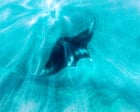
The water off the Florida coast isn't just blue; it’s an optical illusion. When you look down from the bow of a skiff anchored three miles out, the Atlantic looks solid, like a sheet of polished sapphire. Then, the shadow appears.
It starts as a smudge, a distortion in the light. It moves with a terrifying, ghostly grace. Within seconds, the smudge resolves into a wingspan wider than a city bus. A giant manta ray. To see one glide beneath your boat is to watch an ancient, silent monarch navigate a kingdom that humans only ever visit.
For decades, these gentle giants—some stretching 22 feet across—have shared Florida’s coastal waters with surfers, divers, and a sprawling commercial fishing fleet. But beneath the serene surface, a quiet bureaucracy has been churning. Florida wildlife officials recently tightened the net on how these creatures can be captured, handled, and studied. Yet, they stopped just short of a total ban.
To understand why this matters, you have to understand what it feels like to stand on the edge of an extinction event, holding a clipboard and a roll of heavy-duty measuring tape.
The Weight of a Ghost
Consider a hypothetical marine biologist named Sarah. She has spent twelve years tracking manta rays along the Atlantic coast. She knows them not by numbers, but by the distinct, ink-blot patterns on their bellies. Every individual is unique, a swimming fingerprint.
One morning, Sarah receives a call from a commercial vessel. A giant manta has become entangled in a heavy gillnet. When she arrives, the scene is chaotic. The ray is suffocating. Unlike some sharks that can pump water over their gills while resting, manta rays are obligate ram ventilators. They must keep moving to breathe. To stop swimming is to drown in slow motion.
This is the hidden crisis unfolding in Florida's waters. Manta rays aren't usually targeted for food in the United States, but they are vulnerable. They get snagged in lines, caught in nets meant for other fish, and, in rare cases, collected for large-scale public aquariums.
Because of this, the Florida Fish and Wildlife Conservation Commission (FWC) stepped in with a new set of rules. The state now strictly regulates the harvest and possession of giant manta rays in state waters. Anyone seeking to capture a manta for scientific research or public display must jump through a gauntlet of permitting processes. The regulations mandate specific handling protocols to minimize stress and physical damage to the animals.
But for scientists like Sarah, and for the advocates who watched the FWC meetings with bated breath, the new rules feel like a half-measure. They ask a haunting question: Why allow the capture of these creatures at all?
The Anatomy of a Compromise
The decision not to implement a full, unconditional ban comes down to a classic, frustrating tug-of-war between absolute preservation and pragmatism.
On one side of the ledger is the argument for education and science. Proponents of allowing limited, highly regulated capture argue that seeing a live manta ray in a massive, world-class aquarium inspires millions of people to care about ocean conservation. They argue that a child standing face-to-face with a 15-foot ray behind acrylic glass might grow up to become the next great marine advocate. There is also the scientific argument. Certain physiological data, reproductive studies, and veterinary breakthroughs can only be achieved when researchers can study these animals up close.
But the biology of the manta ray makes any level of human interference incredibly risky.
Manta rays are evolutionary gamblers that bet everything on longevity rather than numbers. They grow slowly. They mature late in life. Most importantly, females give birth to a single pup every two to five years after a gestation period that lasts over a year.
Think about that math. If a population of manta rays loses even a handful of breeding females to capture stress or accidental entanglement, the recovery takes decades. It is a fragile ledger. One error can bankrupt a local population.
The FWC’s new regulations attempt to walk this tightrope. By tightening the rules around permits, the state aims to eliminate casual or poorly managed captures while keeping the door cracked open for legitimate scientific study and accredited educational institutions. The new framework demands rigorous proof that any capture will serve a greater conservation purpose and requires state-of-the-art life-support systems during transport.
Yet, the ocean is a unpredictable laboratory.
The Invisible Stress
When a human experiences intense trauma, our bodies flood with cortisol and adrenaline. Manta rays experience a similar chemical cascade. Biologists call it capture stress, but that cold term fails to capture the visceral reality.
Imagine being grabbed by an alien force, lifted into an environment where you cannot breathe, and held down while your skin—which is covered in a protective mucus layer that shields you from infections—is scraped raw against the deck of a boat or the sides of a holding tank. Even if the fishermen or researchers release the ray back into the wild, the damage is often already done. Delayed mortality is the invisible killer. A ray might swim away after a stressful encounter, only to succumb to infections or internal exhaustion days later, far out at sea where no one can count the body.
This is why the tightening of handling rules is so critical. The new state mandates focus heavily on reducing the time a ray spends restrained and require that the animals remain submerged in water as much as possible during any necessary measurements or tagging procedures. It is an acknowledgment that every second ticking by on a boat deck is a second stolen from the animal's survival margin.
The debate in Florida isn't happening in a vacuum. Globally, giant manta rays are listed as endangered by the International Union for Conservation of Nature (IUCN). They face massive threats from international illegal fishing, driven by the demand for their gill plates, which are used in traditional Asian medicine.
Florida’s waters represent a crucial sanctuary. It is a nursery ground, a migratory highway, and a feeding hotspot. What happens here ripples across the wider Atlantic.
The View from the Surface
If you talk to the charter boat captains who take tourists out to see Florida's marine life, they will tell you that a live manta ray in the water is worth infinitely more than a dead one on a dock, or even a captured one in a tank. Tourism relies on the magic of the wild.
But the real problem lies elsewhere. The new rules, as restrictive as they are, only apply to state waters, which extend three nautical miles out on the Atlantic coast and nine nautical miles on the Gulf coast. Beyond that invisible line lie federal waters, where different jurisdictions and different rules apply. The ocean knows no borders. A manta ray protected in the shallows this morning can swim into a legal gray zone by afternoon.
That reality leaves an uneasy quiet over the Florida coastline. The state has built a higher wall to protect one of its most magnificent inhabitants, but it left the gate unlocked just an inch.
As the sun sets over the Atlantic, the sapphire water turns to ink. Somewhere out there, just beyond the breaking waves, a giant manta ray beats its massive pectoral fins, flying through the dark water. It is entirely unaware of the committees, the permits, or the human voices debating its fate in tall buildings ashore. It only knows the rhythm of the tide, the drive to breathe, and the fragile space it occupies between the surface and the deep.