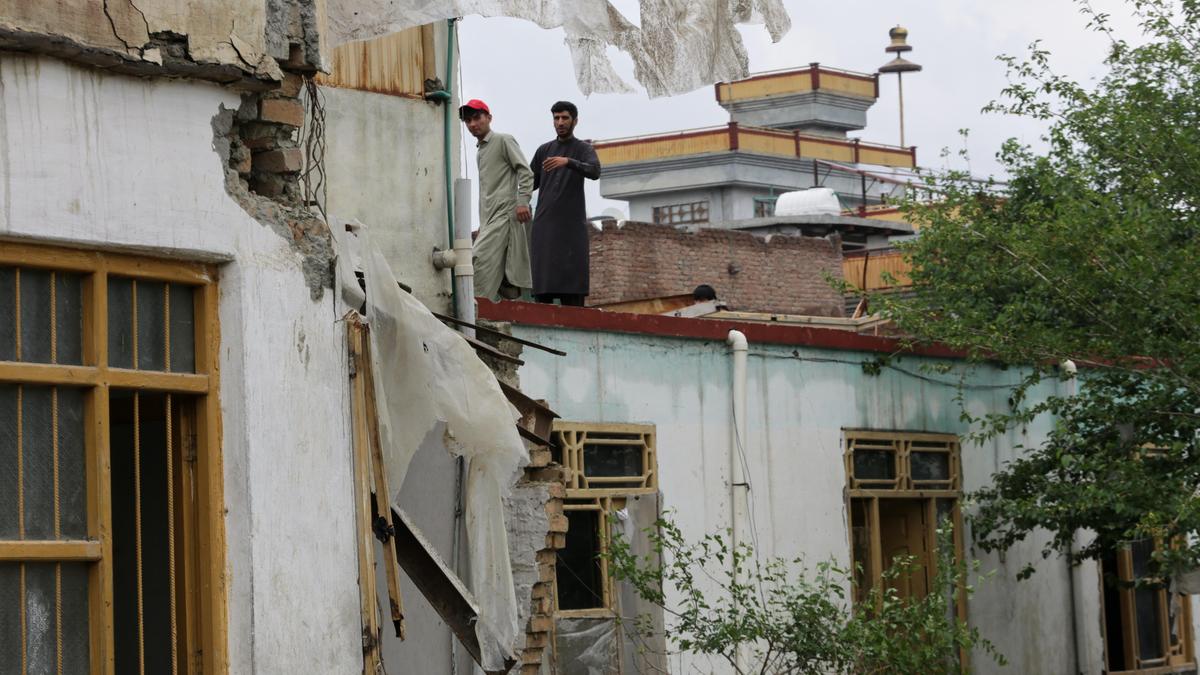
The concentration of fatalities in the recent Afghan seismic event—where a single household accounted for approximately 66% of the reported death toll—highlights a lethal intersection of geophysics and precarious structural engineering. While the magnitude of a tectonic shift determines the energy release, the human cost is governed by the Building Vulnerability Function. In rural Afghanistan, this function is pushed to its limit by the prevalence of unreinforced masonry and the lack of lateral force resistance in residential structures.
The Triad of Seismic Lethality
Fatalities in the Hindu Kush region are rarely the result of the earthquake itself, but rather the failure of the built environment to manage kinetic energy. Three specific variables dictate the survival probability during an event in this corridor:
- Structural Rigidity vs. Ductility: Traditional mud-brick (adobe) and stone masonry possess high compressive strength but near-zero ductility. When the ground accelerates, these walls cannot flex. They reach their ultimate stress capacity almost instantly, leading to "pancake" collapses.
- Diurnal Timing and Occupancy Density: The clustering of eight deaths within one family suggests the event occurred while the inhabitants were indoors, likely during sleep or a communal meal. In high-density communal living environments, a single structural failure results in a localized mass-casualty event.
- The Secondary Hazard Cascade: Beyond the initial shaking, the steep topography of the Afghan highlands introduces landslide risks. Disrupted soil stability often leads to delayed fatalities that are statistically grouped with the earthquake but caused by gravitational mass wasting.
Engineering Deficiencies in Non-Engineered Construction
The "eight of one family" statistic is a predictable outcome of Load-Bearing Wall Failure. In standard modern construction, a frame carries the load; in rural Afghanistan, the walls are the support system.
The Mechanism of Collapse
When seismic waves strike a mud-brick dwelling, the inertia of the heavy timber-and-earth roof creates a massive lateral force. Because the walls lack steel reinforcement (rebar) or even basic wooden "seismic bands," the corners of the building shear. Once the corners fail, the heavy roof—often weighing several tons to provide thermal insulation—descends vertically. This creates a zero-void space, leaving no survivable gaps for the occupants.
Material Science Limitations
The soil composition used in local bricks often lacks the necessary clay-to-sand ratio to provide cohesive bonding. Over years of environmental exposure, these bricks undergo "weathering fatigue," further reducing their already marginal capacity to withstand sudden shear stress.
Logistics of the Golden Hour in Austere Environments
The transition from a rescue operation to a recovery operation is accelerated by the Infrastructure Friction Coefficient. In developed urban centers, the "Golden Hour"—the period where medical intervention most effectively prevents trauma death—is supported by mechanized clearing. In the Afghan context, this is replaced by manual labor.
- Access Denied: The mountainous terrain ensures that heavy machinery cannot reach the epicenter within the critical 24-hour window.
- Medical Deserts: The distance between the collapse site and a Level 1 trauma center often exceeds the survival time for internal hemorrhaging or crush syndrome.
- Information Asymmetry: Initial casualty counts are almost always underestimates because rural communication networks fail simultaneously with the power grid, leading to a "stepped" reporting pattern as word-of-mouth data reaches regional hubs.
The Economic Loop of Vulnerability
The recurrence of these high-mortality events is not a failure of knowledge, but an economic constraint. Seismically resilient construction requires a capital investment that exceeds the annual GDP per capita of these rural districts.
The Poverty-Seismic Trap functions as follows:
Families rebuild using the same materials that failed them because mud and stone are free, whereas cement and steel require cash liquidity and transport infrastructure. This ensures that the structural risk profile of the village remains static even as the tectonic risk remains high.
Quantifying the Impact of Depth and Focal Mechanism
The severity of this specific quake is linked to its Focal Depth. Shallow earthquakes (less than 15km deep) transmit a higher percentage of their energy directly to the surface. A magnitude 5.0 at a depth of 10km is often more destructive to local housing than a magnitude 7.0 at a depth of 200km. The energy does not have enough crustal material to attenuate through before hitting the foundation of these unreinforced homes.
Strategic Mitigation Requirements
Addressing the recurring tragedy of mass family casualties requires shifting from a reactive "aid" model to a proactive "engineering" model.
- Low-Tech Retrofitting: Implementing "Quake-Strap" technology using high-tension plastic mesh can hold mud walls together long enough for occupants to exit, even if the building is eventually written off.
- Seismic Banding: Introducing horizontal wooden or concrete beams at the lintel level to tie walls together. This prevents the outward "bursting" of walls that leads to roof collapse.
- Micro-Zoning: Relocating dwellings from the base of unstable slopes to reduce the landslide-over-collapse mortality rate.
The data indicates that until the "Building Vulnerability Function" is decoupled from local poverty levels, the Hindu Kush will continue to see singular family units erased by moderate seismic events. Survival is currently a function of structural luck rather than systemic design.
Effective intervention must prioritize the distribution of basic reinforcement materials—specifically steel wire and timber bracing—over post-event food aid. If the goal is to break the cycle of "eight deaths per household," the focus must shift from the earthquake's magnitude to the roof's weight and the wall's lateral stability.