Two Royal Air Force pilots survived a catastrophic takeoff failure when their Hawk T2 trainer jet suffered an uncontained engine anomaly, pitched violently, and exploded near homes in Anglesey. The incident, which took place moments after departure from RAF Valley, triggered an immediate fleet-wide grounding and forced military aviation authorities to confront old demons regarding single-engine reliability in crowded airspace.
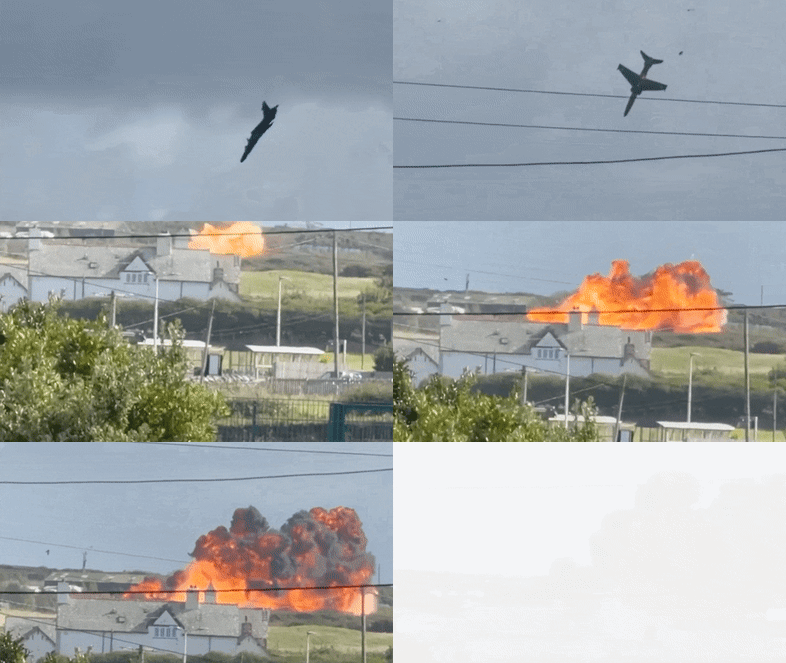
Eyewitness accounts and localized video footage captured the chilling sequence. The aircraft cleared the runway boundary, but thick orange flames erupted from the propulsion housing. Witnesses on the ground near Pencarnisiog watched as the trainer climbed at an unnatural, aggressive pitch before entering a destabilized roll. In military aviation, that specific flight profile is an unambiguous emergency warning. When a jet loses thrust at low altitude while pitched high, the margin for recovery vanishes in seconds.
The two crew members executed a textbook ejection just hundreds of feet above the terrain. Their Martin-Baker rocket-powered seats fired clear of the disintegrating airframe milliseconds before the jet nosedived into agricultural land, missing nearby residential structures by mere meters. Both airmen landed safely between the runway and the impact zone, walking away with minor injuries that ultimately earned them admission into the elite Martin-Baker Ejection Tie Club.
The aircraft itself was utterly consumed by a post-impact fireball. Yet the primary concern for the Ministry of Defence extended far beyond the loss of a multi-million-pound fast-jet trainer.
The Fragile Physics of Low-Altitude Ejections
Modern military training relies heavily on platform commonality. For the United Kingdom, the BAE Systems Hawk T2 has served as the backbone of advanced fast-jet instruction since 2009, preparing student pilots for frontline command on Typhoon and F-35 Lightning platforms. These aircraft operate under punishing flight regimes. They execute high-g maneuvers, frequent touch-and-go landings, and intense power changes multiple times a day.
When a failure occurs immediately after rotation, the physics are unforgiving. At low altitude and low airspeed, aerodynamic control authority degrades rapidly if thrust is lost. The pilot has no gravitational cushion.
The survival of the Anglesey crew highlights the engineering brilliance of modern escape systems, but it also underscores how close routine training comes to public catastrophe. RAF Valley sits on the western coast of Anglesey, surrounded by tight-knit communities, rural housing developments, and narrow country lanes. A deviation of just a few degrees in the aircraft's final uncontrolled descent path would have redirected thousands of pounds of burning composite material and aviation fuel directly into domestic properties.
Public anxiety following the crash reflects a recurring tension. Communities living beneath military flight paths accept the noise and strategic necessity of defense training, but incidents bringing flaming wreckage yards from residential living rooms erode that social contract.
The Cost of Grounding the Fleet
Within hours of the accident, defense officials took a mandatory, precautionary step. Flying operations for both the Hawk T1 and T2 fleets were temporarily paused.
This operational hiatus creates immediate bottlenecks in the military pipeline. Every prospective British fighter pilot must pass through the Hawk syllabus. When the training pipeline stalls, graduation timelines slip, operational conversion units back up, and the broader frontline squadrons feel the personnel pinch downstream.
Investigators from the Military Aviation Authority immediately descended on North Wales to comb through telemetry, recover flight data recorders, and inspect the remains of the Rolls-Royce Adour engine. Historical precedent shows that engine blade fatigue, foreign object damage, or fuel control unit anomalies typically sit at the center of such inquiries.
The temporary grounding remains an unavoidable friction point. Aviation safety demands absolute intolerance for unexplained structural or mechanical failures, even if pausing a fleet starves the training schedule of vital sortie hours.
As flight lines slowly reopen following preliminary safety checks, the near-miss over Anglesey serves as a stark reminder of the inherent volatility baked into military aviation. Training the next generation of combat pilots requires pushing machinery and human reflexes to the absolute edge, where the boundary between a successful recovery and absolute disaster is measured in single digits of altitude