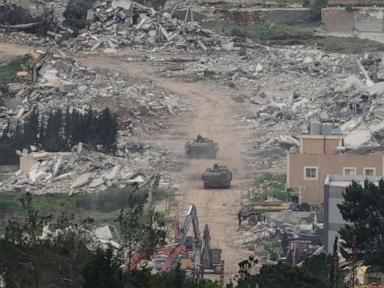
The physical destruction of Lebanese border villages since the 2026 ceasefire is not a byproduct of war but a calculated post-conflict maneuver. While diplomatic channels in Beirut and Tel Aviv argue over the letter of the truce, the reality on the ground involves the systematic demolition of residential blocks in areas where the guns were supposed to be silent. This isn't collateral damage from active firefights. It is a deliberate engineering project aimed at creating a "no-man's land" that defies the very terms of the negotiated peace.
The core of the current crisis lies in a fundamental disagreement over what constitutes "security operations" during a withdrawal phase. Lebanon claims that Israeli forces are using the window before their final pullout to flatten strategic high ground and residential centers in towns like Khiam and Bint Jbeil. By the time the Lebanese Army fully deploys to the south, they may find themselves presiding over a lunar landscape where return is impossible.
The Geography of Attrition
To understand why these demolitions are happening now, one has to look at the topography of Southern Lebanon. Military planners do not see houses; they see lines of sight and "dominant positions." When a village sits on a ridge overlooking a valley used for transit, that village becomes a liability in the eyes of a retreating force.
The strategy currently unfolding is a preemptive strike against future resettlement. If there are no roofs, there are no inhabitants. If there are no inhabitants, there is no cover for asymmetrical actors to re-establish infrastructure. This logic ignores the civilian right of return, treating private property as a permanent tactical element rather than a home. It creates a buffer zone through debris rather than diplomacy.
The Mechanics of Modern Demolition
We are not seeing the frantic bombing runs of high-intensity conflict. Instead, reports and satellite imagery suggest a methodical process. Engineering units move through neighborhoods, rigging structures with controlled explosives. This is a resource-heavy operation that requires time and security—two things the ceasefire was meant to provide for the purpose of stabilization, not destruction.
The use of "D9" armored bulldozers alongside controlled blasts indicates a desire to ensure the damage is irreparable. Repairing a house hit by a shell is one thing. Rebuilding a village where the very foundations have been uprooted and the utilities shredded is a multi-decade financial burden that the Lebanese state, currently mired in an economic collapse, cannot shoulder.
The Sovereignty Gap
A major factor in this escalation is the delayed deployment of the Lebanese Armed Forces (LAF). Under the ceasefire terms, the LAF is the only legitimate military presence allowed in the south, supported by international peacekeepers. However, the logistical hurdle of moving thousands of troops into a zone still occupied by a foreign military creates a "gray zone."
Israel argues that as long as their troops are present and perceive a threat, they retain the right to "shape the environment." Lebanon views this as a blatant violation of sovereignty and a war crime. The international community, meanwhile, is stuck in a cycle of "monitoring" while the geography is transformed beyond recognition. The gap between the signing of a paper and the actual movement of boots on the ground has become a theater for structural erasure.
Economic Warfare by Other Means
The destruction of these homes isn't just a military tactic; it is a long-term economic blow. Southern Lebanon relies heavily on agriculture and small-scale trade. When a village is razed, the local economy dies with it. Olive groves are uprooted by heavy machinery, and irrigation networks are crushed under the weight of tanks.
- Property Devaluation: The loss of thousands of residential units creates a housing crisis that forces internal displacement to become permanent.
- Infrastructure Debt: The cost to restore power, water, and sewage to these flattened zones runs into the billions.
- Agricultural Ruin: The destruction of topsoil and ancient trees means the land cannot produce for years.
This creates a "push factor" that drives the population toward Beirut or abroad, effectively depopulating the border region. A depopulated border is easier to monitor from a distance, but it leaves a gaping wound in the national fabric of Lebanon.
The Failure of International Oversight
The United Nations Interim Force in Lebanon (UNIFIL) finds itself in an impossible position. Tasked with observing a ceasefire, they are often restricted from entering the very areas where demolitions are most active. Their reports are frequently delayed or neutralized by diplomatic pressure. This lack of a "policeman" with actual teeth allows both sides to interpret the ceasefire rules to their own advantage.
When a house is blown up during a ceasefire, is it an act of war? The legal definitions are being stretched to the breaking point. If the occupying force claims the house contained a tunnel or a weapons cache, the burden of proof falls on a displaced homeowner who has no way to access the site. This "security pretext" has become an all-purpose tool for clearing land.
The Weaponization of the Buffer Zone
History shows that temporary buffer zones have a habit of becoming permanent scars. By leveling these border towns, the occupying forces are effectively moving the border inward. The "Blue Line" becomes a secondary consideration when the three kilometers north of it are uninhabitable.
This isn't just about Lebanon and Israel. It is a test case for how modern conflicts end—or don't end. If a ceasefire allows for the systematic destruction of the very thing it was meant to protect, then the word "peace" loses its meaning. It becomes merely a logistical pause to finish the job that the bombs started.
The Missing Counter-Argument
The official stance from the IDF emphasizes that they are neutralizing "terrorist infrastructure" that was integrated into the civilian fabric. They point to hidden shafts and storage rooms as justification for the total removal of blocks. However, this logic fails to account for the scale. You do not need to level a village to seal a tunnel. You do not need to burn an orchard to secure a road.
The discrepancy between the stated goal of "neutralization" and the observed reality of "erasure" suggests a deeper motive. That motive is the creation of a "killing zone" where any movement in the future can be identified and targeted without the complication of civilian presence. It is a doctrine of total visibility achieved through total destruction.
The Long Road to Nowhere
The residents of the south are currently waiting in schools and makeshift shelters in the north, watching videos of their neighborhoods being turned into dust. They are told the ceasefire is a victory. They are told they can go home soon. But when "home" is a pile of gray concrete and twisted rebar, the victory feels like a funeral.
The international community must move beyond "deep concern." Without a verified, third-party inventory of every standing structure at the moment of the ceasefire, there is no accountability. Without an immediate halt to engineering works in occupied zones, the south will be lost not to the war, but to the peace that followed it.
The immediate step requires more than just LAF deployment. It requires a hard freeze on all "area shaping" activities by retreating forces. If a building must be destroyed for an immediate, verifiable security threat, it should be done under the direct supervision of international observers. Anything less is just a slow-motion invasion.
The debris in Southern Lebanon is not just stone and mortar. It is the wreckage of a diplomatic process that valued the end of the shooting over the survival of the people. If the world continues to look away, the border will be defined not by maps, but by the outer edge of the ruins.