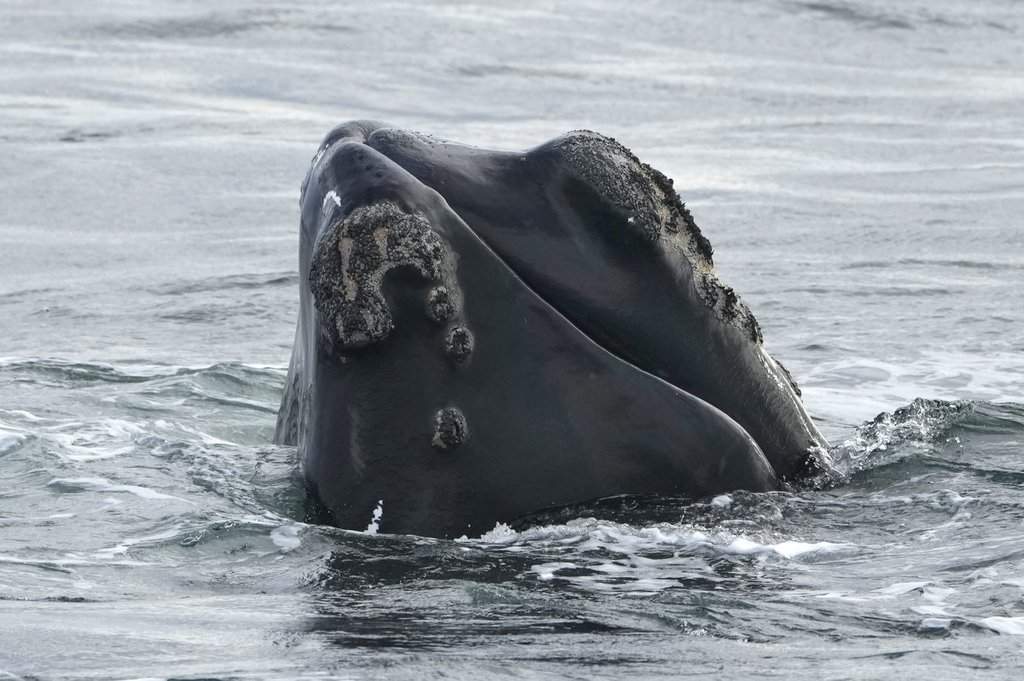
Every time marine biologists publish a new paper on why North Atlantic right whales are failing to reproduce, mainstream science journalists trot out the same tired narrative.
They blame the plankton. They blame warming ocean currents. They blame a mystical shifting food supply in the Gulf of Maine that leaves female whales too skinny to get pregnant.
It is neat. It is tragic. It makes climate change the sole villain and lets the people running our oceans off the hook.
It is also completely missing the point.
When you actually look at the physiological data from the North Atlantic Right Whale Consortium and the New England Aquarium, the "starvation" narrative falls apart. Yes, copepods—the tiny, fat-rich crustaceans right whales eat—have shifted north into the Gulf of St. Lawrence over the past decade. Yes, energy reserves matter for mammalian reproduction. Nobody is denying basic biology.
The lie is the framing. By treating low birth rates as a mysterious ecological puzzle caused by shifting prey, commentators erase the brutal mechanical reality happening right under the surface. These whales are not failing to breed because they cannot find enough bugs to eat. They are failing to breed because we are slowly strangling them to death with industrial fishing rope while they try to swim, feed, and carry a fetus.
The Myth of the Mystical Food Shortage
Let us look at the lazy consensus dominating conservation coverage right now. Whenever a new study examines blubber thickness or hormone levels in Eubalaena glacialis, the resulting headlines frame the crisis as an unintended consequence of shifting ocean temperatures. The whales move north, burn extra calories looking for Calanus finmarchicus, and suddenly their calving intervals stretch from three years to ten.
That explanation sounds plausible until you compare the North Atlantic right whale to its cousin, the Southern right whale.
Southern right whales face massive climatic shifts across the Southern Hemisphere. Their prey distributions fluctuate wildly with El Niño cycles and Antarctic sea ice anomalies. Yet Southern right whale populations have rebounded by roughly seven percent per year over recent decades, numbering well over ten thousand animals. Meanwhile, the North Atlantic population sits around 360 individuals—and fewer than 70 of them are reproductively active females.
Why the divergence? Same genus. Same feeding mechanics. Same reliance on dense patches of zooplankton.
The difference is not the plankton. The difference is the hardware store sitting in the water column between Florida and Nova Scotia.
In the North Atlantic, more than 85 percent of right whales bear scars from fishing gear. Over half have been entangled multiple times. When a 40-ton animal drags several hundred pounds of heavy-gauge synthetic lobster or snow crab line through the ocean for six months, energy expenditure skyrockets. Researchers at Woods Hole Oceanographic Institution and NOAA have documented that chronic entanglement creates a massive energetic drag—equivalent to forcing a marathon runner to sprint while towing a cinderblock.
You do not need a mysterious oceanographic theory to explain why an exhausted, bleeding, chronically stressed mammal skips ovulation. When your body is fighting off systemic infection from rope cutting into your tail stock and baleen plates, reproduction shuts down. Biology prioritizes survival over legacy every single time.
Sub-Lethal Trauma Is the Silent Sterilizer
Conservation reporting suffers from a body-count obsession. If a whale washes up on a beach in Cape Cod with a severed fluke from a container ship propeller, it makes the evening news. If a whale disappears at sea, it gets tallied in the annual mortality report.
What never makes the headlines is the slow, agonizing attrition of sub-lethal entanglement.
I have spent years reviewing necropsy reports, entanglement response logs, and photogrammetry datasets from the East Coast. The pattern is unmistakable. A healthy female reaches sexual maturity around age nine or ten. Under historical conditions, she calves every three to four years. Today, females are dying before they ever produce a single calf, or surviving with so much scar tissue and chronic drag that their bodies never reach the threshold of body condition required to sustain a 12-month gestation and a year of lactation.
Consider the mechanics of baleen feeding. Right whales are skim feeders. They swim with their mouths wide open through dense clouds of copepods, filtering water through two racks of keratin plates that hang from their upper jaws. When commercial trap lines wrap around a whale's rostrum, the rope lodges directly between the baleen plates.
Imagine trying to eat soup with a padlock wired across your teeth.
Even if the ocean were choked with the richest, fattest copepods on Earth, a whale with gear fouled in its mouth cannot harvest them efficiently. Every mile it swims burns more calories than it takes in. The animal enters a permanent metabolic deficit. Then, five years later, a research vessel flies a drone overhead, measures the whale's diminished width, and a press release announces that "changing food availability" is suppressing birth rates.
That is not science communication. That is laundering industrial damage through climate fatalism.
Why Scientists and Journalists Keep Soft-Pedaling the Cause
If the energetic cost of fishing gear and vessel strikes is well-established in peer-reviewed journals—and it is, thanks to decades of work by researchers like Amy Knowlton, Michael Moore, and Peter Corkeron—why does the public narrative keep drifting back to passive environmental explanations?
Because blaming ocean warming requires nothing from anyone today.
If low birth rates are a symptom of global climate shifts, then the problem belongs to everyone and no one. Politicians in Maine and Massachusetts can wring their hands about carbon emissions while protecting multi-million-dollar fixed-gear fisheries from immediate regulation. Environmental nonprofits can run generic fundraising campaigns about saving the planet without alienating coastal donors or picking a knife fight with maritime unions.
Admitting the truth forces an immediate, expensive collision with entrenched economic interests.
Fixing the birth rate crisis does not require waiting fifty years for global temperatures to stabilize. It requires pulling vertical buoy lines out of right whale habitat right now. It requires enforcing strict 10-knot speed limits across entire shipping lanes, not voluntary zones that cargo captains ignore whenever they fall behind schedule.
Those measures cost money. Ropeless—or on-demand—fishing gear uses acoustic releases and lift bags to bring traps to the surface without leaving miles of vertical rope suspended in the water column like a minefield. The technology works. It has been tested in the Gulf of Maine and the Gulf of St. Lawrence. What it lacks is political will and capital scaling, largely because legacy regulators still treat entanglement as an unavoidable side effect of commerce rather than the primary driver of functional extinction.
Dismantling the Wrong Questions
When people search for why right whales are disappearing, they usually ask variations of the same three flawed questions. Every single one rests on a false premise.
Are right whales failing to adapt to climate change?
This question assumes the species is biologically rigid. In reality, North Atlantic right whales adapted rapidly when their primary feeding grounds shifted in the 2010s. They abandoned traditional foraging areas in the Bay of Fundy and marched straight into the Gulf of St. Lawrence, locating new concentrations of Calanus hundreds of miles away. Their navigational and foraging instincts worked fine. The trap was waiting for them when they arrived—specifically, an unregulated snow crab fishery that had never dealt with right whales before, resulting in the catastrophic 2017 mortality event where 17 whales died in a single summer. The whales adapted. Human management failed to keep up.
Can we just breed right whales in captivity or use artificial insemination?
Anyone suggesting captive breeding for a 70-ton pelagic baleen whale that migrates over a thousand miles annually does not understand basic marine mammalogy. You cannot put an animal the size of a city bus into a concrete tank and expect it to survive, let alone reproduce. Even in the wild, reproductive intervention is a fantasy. You do not need fertility drugs for an animal that already knows how to breed when you stop injuring it.
Is the population already past the point of no return?
Doomsday fatalism is just another excuse for inaction. With roughly 360 whales left, genetic diversity is undeniably tight, and the margin for error is razor-thin. Yet small whale populations have recovered from far worse bottlenecks. The eastern North Pacific gray whale and several humpback stocks bounced back from the brink of commercial whaling once the harpoons stopped flying. Right whales are long-lived mammals capable of surviving past 70 years. If the females alive today are simply allowed to swim uninjured and unencumbered, they have decades of reproductive potential ahead of them.
The Trade-Offs Nobody Wants to Admit
Taking a hard line on industrial impacts comes with real-world friction, and pretending otherwise destroys credibility.
Transitioning entire coastal fleets to on-demand fishing gear is not a clean, painless flip of a switch. Acoustic modems fail in rough seas. Hauling traps without surface buoys slows down deck operations, cuts into daily catch volumes, and creates gear-conflict headaches when mobile trawlers drag through areas where fixed-gear traps sit unmarked on the bottom. For a small-boat lobsterman operating on thin margins against rising fuel and bait costs, a mandatory gear overhaul feels like an existential threat.
Similarly, mandatory vessel speed restrictions across the entire Eastern Seaboard add transit hours for container ships and cruise lines, disrupting tight port schedules and increasing fuel burn per trip.
Those costs are real. They should be subsidized, engineered around, and managed transparently. What we cannot do is pretend those costs justify sacrificing an entire megafauna species while writing sad articles about plankton migrations.
What Actually Reverses the Collapse
If we want calving numbers to climb back from single digits to the twenty or thirty births per year needed for recovery, the playbook has nothing to do with studying copepod genetics for another decade.
- Eliminate vertical lines in dynamic whale zones. Voluntary seasonal closures are useless when whales shift their distribution every year. Any fishery operating in known right whale corridors must transition to zero-buoy-line technology, backed by federal buybacks of legacy rope gear so fishermen are not bankrupted by the mandate.
- Automate speed enforcement at sea. Voluntary slow zones have compliance rates hovering below 40 percent in many sectors. Automatic Identification System (AIS) transponders already broadcast the exact speed and position of every major commercial vessel in real time. Treat speeding in active whale zones like running a red light with a traffic camera—automatic, escalating fines with zero bureaucratic friction.
- Shift research funding from monitoring decline to engineering prevention. We have enough baseline data to prove right whales are stressed, skinny, and scarred. Every dollar spent documenting the autopsy of another entangled female is a dollar that should have gone toward acoustic detection buoys, real-time thermal imaging on cargo bows, and cheaper underwater release mechanisms.
Stop Blaming the Ocean
Nature is not killing the North Atlantic right whale.
Whales have survived ice ages, shifting currents, and fluctuating zooplankton blooms for millions of years. Their reproductive biology is calibrated to ride out lean years and boom during abundant ones. What their biology cannot survive is dragging commercial nylon rope across an ocean basin while dodging 50,000-ton container ships moving at twenty knots.
The next time a headline tells you scientists have uncovered a new mystery behind right whale birth rates, look past the press release. Check the entanglement scar statistics. Look at the calving intervals of uninjured females versus chronically entangled ones. The answer has been wrapped around their tails for forty years. Cut the rope, slow the ships, and watch how fast they remember how to breed.