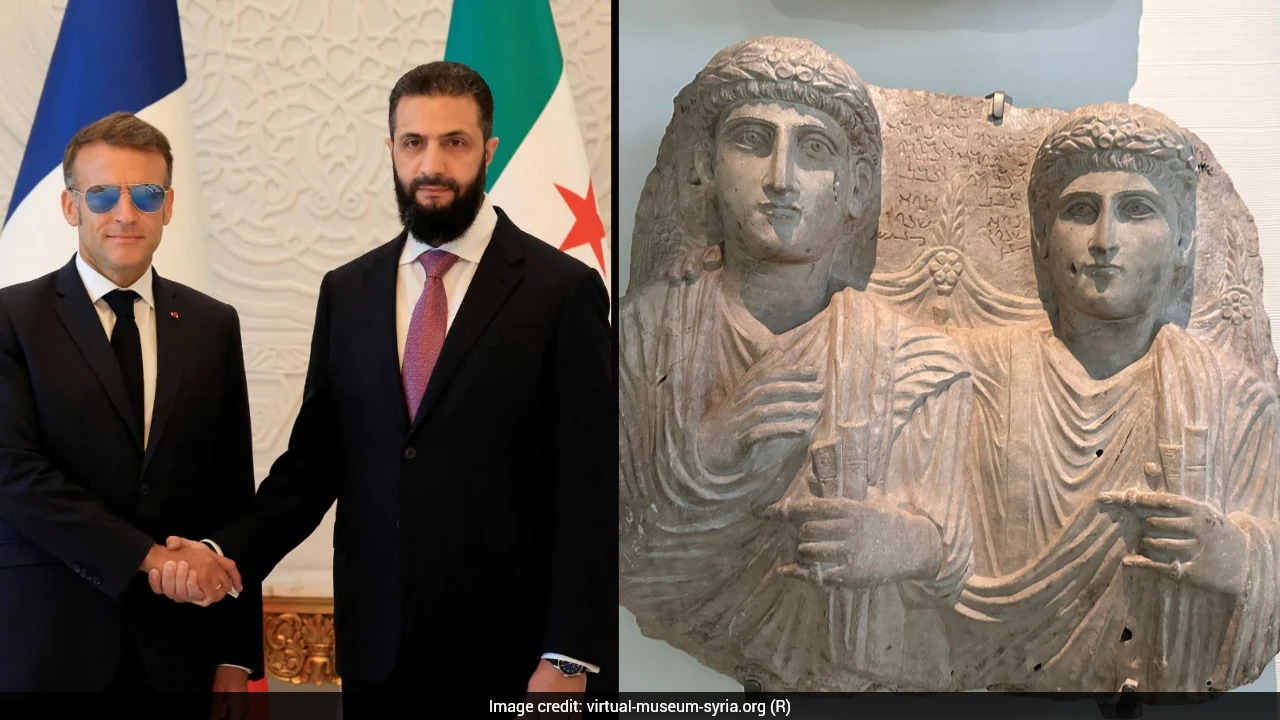
Emmanuel Macron's surprise arrival in Damascus marks a staggering shift in European foreign policy, packaged neatly in the soft-power diplomacy of returning 23 looted Syrian antiquities. The artifacts, seized by French customs officials over 15 years ago, were handed back to Syrian authorities this week in a highly choreographed ceremony. While official statements frame the restitution as a pure triumph for cultural heritage preservation, the timing reveals a much deeper calculation. Paris is using these ancient treasures to buy its way back into Middle Eastern geopolitics, establishing a backdoor channel with a government it spent more than a decade trying to isolate.
The 23 objects, which include Bronze Age pottery and Roman-era funerary busts, were intercepted at Charles de Gaulle Airport in 2011, just as the Syrian civil war was igniting. For a decade and a half, they sat in French vaults. Their sudden return now is not a coincidence of legal processing. It is a calculated diplomatic icebreaker.
Cultural Property as a Geopolitical Lever
Governments rarely move historic artifacts without a secondary motive. For years, European nations maintained a strict policy of cultural non-cooperation with Damascus, arguing that returning items to a war zone risked their destruction or monetization by sanctioned entities. Breaking that freeze required an immense political incentive.
By personally delivering these artifacts, the French administration circumvents the traditional diplomatic freeze. It allows French officials to sit at the table in Damascus without technically violating the broader European consensus on political normalization. The message to the rest of the West is subtle but unmistakable. France is willing to adapt to the reality on the ground, even if it means altering its moral posture.
The mechanism of this return relies heavily on the concept of cultural stewardship. Western museums and states have long used the justification of "safe keeping" to retain disputed items. Returning them now signals that Paris views the current environment in Damascus as stable enough to secure its own history. That baseline acknowledgment of stability is the exact currency the Syrian government has been chasing for years.
The Reality of the Looting Pipeline
To understand the weight of these 23 items, one must look at the illicit antiquities trade that flourished during the conflict. The artifacts returned by France represent a tiny fraction of a multi-million-dollar black market that systematically stripped Syria of its history.
[Illicit Digging at Source] -> [Transit via Neighboring Borders] -> [Falsified Provenance in Europe] -> [Private Collections]
During the height of the war, satellite imagery showed ancient sites like Apamea and Palmyra looking like cratered moonscapes from illicit digging. The networks that moved these items were highly sophisticated. They utilized the same smuggling routes used for weapons and narcotics.
- Sourcing: Local networks dug up artifacts under the radar or under the coercion of various armed factions.
- Transit: Items moved through neighboring countries where weak border controls allowed for easy transit.
- Laundering: Fraudulent paperwork was generated in transit hubs, frequently claiming the items belonged to old private collections established before international conventions.
French customs agents deserve credit for the initial seizure, but the 15-year delay in returning the items highlights the bureaucratic and legal quagmires of restitution. Proving origin to a legal standard takes time. Yet, the final decision to ship them back is always political, not legal.
The Problem of Tracking the Rest
Returning a handful of museum-quality pieces creates a convenient media narrative, but it does nothing to address the thousands of unmonitored artifacts currently sitting in private European collections. The burden of proof remains incredibly high for law enforcement, and many items have been successfully laundered into the legitimate art market through decades of falsified provenance.
A Soft Power Gamble with High Stakes
France has long fancied itself as the European vanguard in the Levant, a legacy dating back to the post-World War I mandate era. This move is an attempt to reclaim that historical influence. With shifting dynamics in regional alliances, Paris fears being left out of the rebuilding phase and the subsequent reshuffling of regional influence.
There is deep skepticism within the French diplomatic corps regarding this approach. Critics argue that handing over priceless artifacts to a government still facing heavy international sanctions undermines the Western leverage built up over 15 years. They point out that cultural heritage cannot be separated from the political structure that inherits it.
Furthermore, the domestic reaction in France is bound to be fractured. While cultural purists welcome the return of stolen heritage to its rightful soil, human rights organizations view the visit as a betrayal of the victims of the conflict. The administration is banking on the idea that the public allure of cultural restitution will mask the uncomfortable realities of realpolitik.
The New Norm of Archeological Diplomacy
This event sets a precedent that other European capitals will find hard to ignore. If France can normalize relations under the guise of cultural property return, countries like Italy and Germany, which also hold significant quantities of seized Middle Eastern antiquities, may soon follow suit.
The strategy effectively weaponizes archaeology. It turns museum pieces into chips on a geopolitical chessboard, where the value of an artifact is measured not by its historical significance, but by the diplomatic access it grants.
This is the blueprint for future engagement with isolated regimes. When economic sanctions and military threats fail to yield results, the return of cultural identity becomes the ultimate diplomatic currency. The 23 treasures are home, but the cost of their return will be paid in geopolitical concessions for years to come. France has made its move, choosing pragmatism over isolation, and using the ancient past to secure a foothold in an uncertain future.