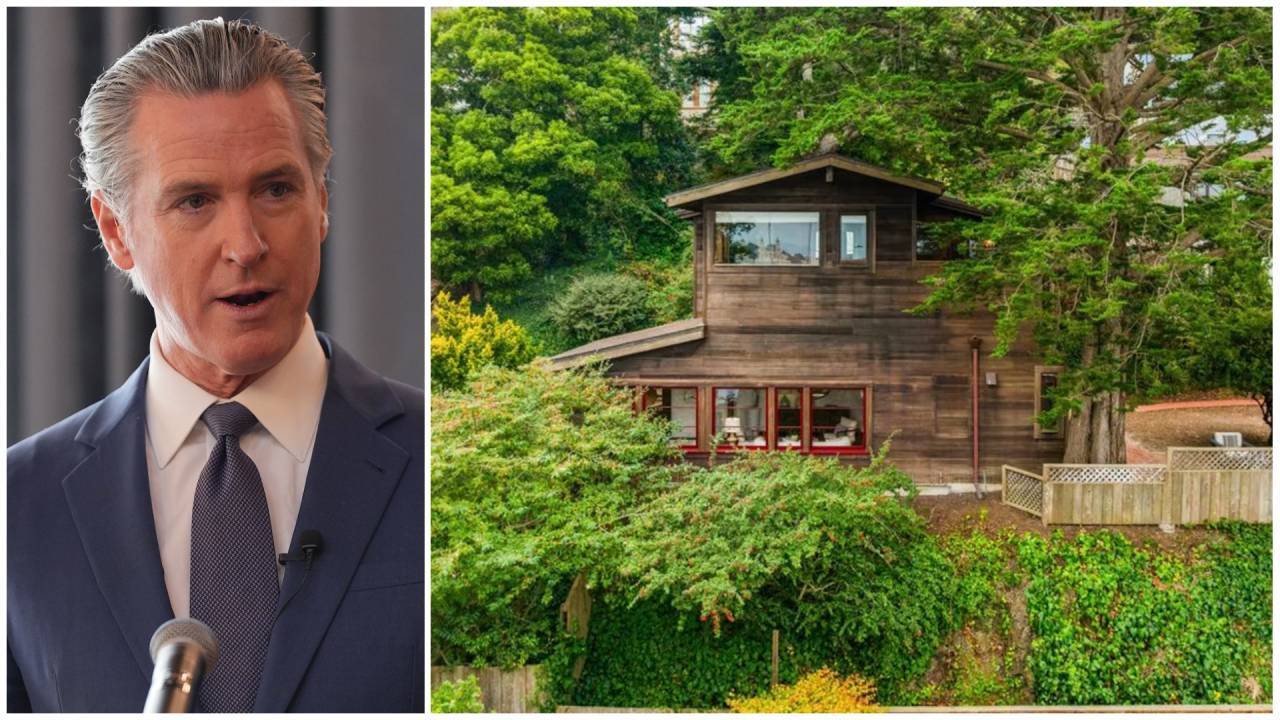
Real estate headlines love a good political tie-in. When a modest property with a famous former resident hits the market, the internet loses its collective mind. Take the recent listing at 1284 Stanyan Street in San Francisco. Built back in 1951, this woodsy cottage on the edge of Mount Sutro Forest was once the childhood home of California Governor Gavin Newsom.
Initially slapped with a $4.5 million asking price, the two-bedroom, two-bathroom house didn't just sell—it sparked a bidding war that closed in a mere 14 days at a staggering $5.85 million. That is roughly 30 percent over asking, proving that Bay Area buyers care far less about political pedigrees and far more about rare square footage and land.
The Real Story Behind the Stanyan Street Property
Most internet commentators immediately tried to spin the sale into a grand statement about wealth and privilege. Look closer at the actual specs, and the narrative falls apart. This isn't a sprawling Pacific Heights mega-mansion. It is a tiny, 1,445-square-foot cottage sitting on a sloping hillside.
Newsom's maternal grandfather originally owned the home, and his mother lived there through the early years of his childhood before his parents divorced. Back then, it was a modest middle-class landing pad in a transitional neighborhood. The property changed hands in the 1970s and stayed with the subsequent family for nearly fifty years.
When it sold back in 2019 for $2.8 million, it was viewed as a standard San Francisco fixer-upper. The recent seller poured money into modernizing the kitchen, updating the bathrooms, adding a Japanese soaking tub on the back patio, and turning a detached cabin on a secondary buildable lot into an artist's studio.
Why Did It Fetch Nearly Six Million Dollars?
Political fame might have brought the initial wave of web traffic and media chatter, but it didn't drive that final $5.85 million price tag. San Francisco real estate operates under a completely different set of physical laws.
First, look at the geography. The property abuts the thick greenery of Mount Sutro Open Space Reserve, giving it an isolated, cabin-in-the-woods feel while remaining completely inside the city limits. You get the illusion of a secluded mountain retreat paired with a walkability score that puts Cole Valley cafes just down the hill.
Second, the zoning and parcel setup offer massive upside. The sale included an adjacent, separately assessed buildable lot. In a densely packed urban environment where empty land is practically nonexistent, owning a vacant parcel alongside a remodeled home is like finding a golden ticket. The buyer—identified as the Sutro Trust—acquired a rare compound with immense expansion or preservation potential.
What Normal Buyers Can Learn From This Madness
If you are watching the Bay Area market from the outside, the jump from $2.8 million to $5.85 million in just a few years looks like pure insanity. Yet it highlights a predictable pattern in high-demand metros.
Properties with unique land attributes always outperform cookie-cutter condos during economic shifts. When you combine structural scarcity, a distinct architectural footprint, and outdoor living space like meditation decks and Japanese soaking tubs, wealthy buyers will step up immediately.
The new owners aren't paying for Newsom's childhood memories. They are paying for a rare slice of forested isolation in the middle of a concrete metropolis. Fame gets a listing clicked, but land scarcity closes the deal.