Every July, global newsrooms dust off the exact same template. A runner gets cornered on the cobblestones of Pamplona, a horn finds its mark, and the internet erupts in a predictable chorus of shock, moral outrage, and patronizing lectures about safety. The latest coverage of a runner being gored in the face at the San Fermin festival follows this tired script to a letter. It treats the event as a chaotic, lawless meat grinder where unsuspecting tourists are chewed up for cheap thrills.
This narrative is flat-out wrong.
The lazy media consensus frames the Encierro—the running of the bulls—as an anarchic bloodbath fueled entirely by alcohol and adrenaline. If you actually look at the mechanics of the run, the history, and the data, a completely different reality emerges. The danger isn’t a flaw of San Fermin; it is the entire design. More importantly, the real threat to the festival isn’t the bulls at all. It is the fundamental misunderstanding of risk by an increasingly sanitized global culture.
The Illusion of Chaos
Mainstream reports love to focus on the gore because blood clicks. When a 50-year-old runner takes a horn to the jaw on Santo Domingo street, it’s framed as a tragic breakdown of order.
Let's look at the actual math.
Every year, between 1,000 and 3,000 people run the route each morning. Over the course of the eight-day festival, that is roughly 15,000 to 20,000 participants. Out of those thousands, how many are actually gored? Usually between five and ten. Since records began in 1910, exactly 16 people have died. You are statistically more likely to die of a cardiac event while running a suburban marathon or getting struck by lightning on a golf course than you are to be killed by a Miura bull in Pamplona.
To call the Encierro "chaotic" betrays a total ignorance of how the run is managed.
- The Pastores: Expert herders armed with long sticks who run behind the bulls to keep the herd tight and prevent individual animals from breaking away.
- The Dobladores: Experienced runners stationed inside the bullring with capes, whose sole job is to distract the bulls and guide them safely into the pens to protect fallen runners.
- The Medical Grid: One of the most sophisticated trauma response networks in the world, with emergency stations positioned every 50 meters along the 875-meter course.
When someone is injured, they aren't left to bleed out in a lawless street. They are on a surgical table within minutes. The media calls it madness; in reality, it is a highly orchestrated, tightly regulated athletic event that manages extreme risk with military precision.
The Real Danger Has Nothing to Do with Horns
If you talk to anyone who has run the streets of Pamplona for decades—the divinos who know every slick cobblestone and curve—they will tell you that the bulls are the most predictable variable on the street.
A fighting bull is an apex athlete. It wants to run straight, maintain its balance, and stay with the herd. It does not look for trouble unless it is separated, isolated, or blocked.
The real danger? The people.
+------------------------------------+------------------------------------+
| The Media's Imagined Threat        | The Actual Danger on the Ground    |
+------------------------------------+------------------------------------+
| Bloodthirsty, unpredictable bulls  | Panic-stricken, untrained tourists |
| tracking down human targets.       | tripping and creating human piles. |
+------------------------------------+------------------------------------+
| A complete absence of safety laws  | Selfies, cameras, and inappropriate|
| or municipal oversight.            | footwear blocking escape routes.   |
+------------------------------------+------------------------------------+
The explosion of mass tourism has flooded the route with participants who have no business being on the cobblestones. They show up straight from the bars at 7:30 AM, wearing flip-flops, carrying smartphones to capture the perfect video, and freezing the moment they hear the first rocket fire.
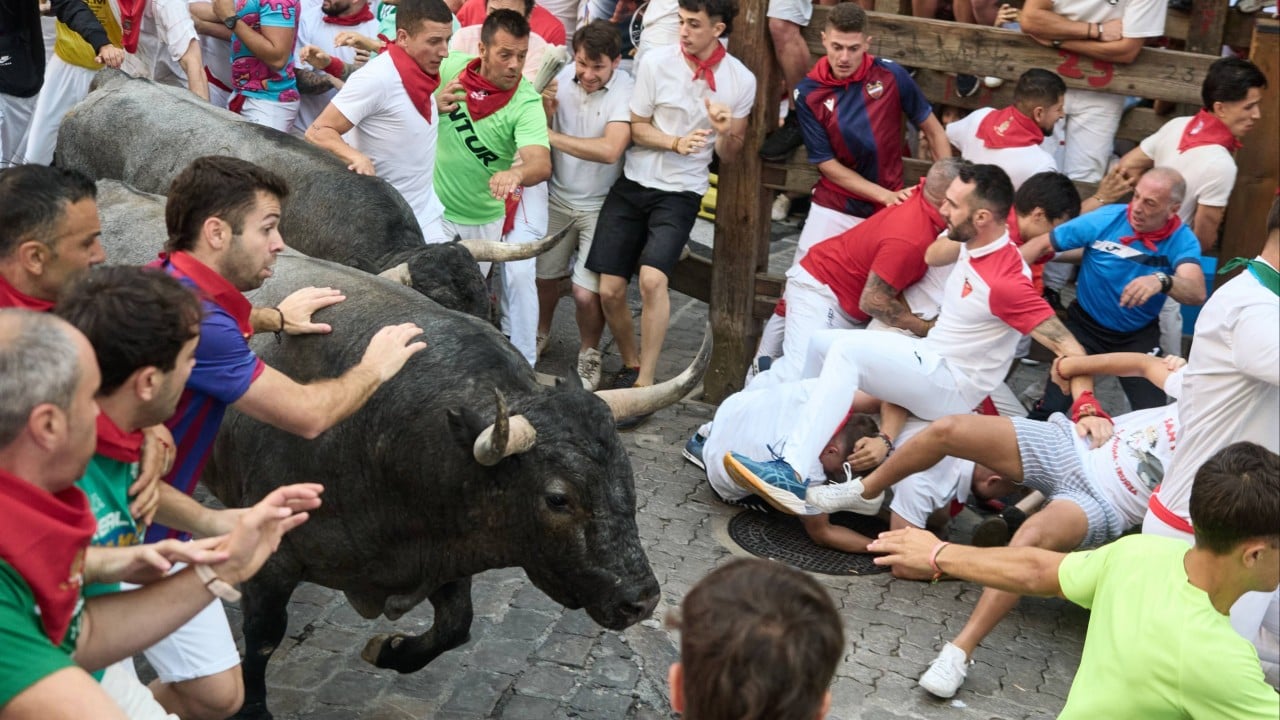
When a human pile-up—a montón—forms at the entrance to the bullring, it isn't because the bulls charged. It's because terrified, uneducated runners tripped over each other, creating a literal wall of flesh that traps the animals and causes mass trauma.
By focusing exclusively on the sensationalism of a goring, the media actively hides the real public safety lecture: if you don't know how to run, stay behind the wooden barricades.
Stop Trying to Sanitize Risk
We live in an era obsessed with eliminating liability and smoothing out every sharp edge of human existence. The underlying tone of every Anglo-American article about San Fermin is a quiet demand for it to stop. Why haven't they banned this yet? Why isn't there more security?
This line of questioning misses the profound psychological function of the festival.
San Fermin is not an amusement park ride. There is no waiver you sign that magically turns off gravity or momentum. It is one of the few remaining cultural touchstones where individual responsibility is absolute. If you step onto the Calle Estafeta at 8:00 AM, you are making a conscious, sober choice to place your life on the line against half a ton of muscle and bone.
If you strip the genuine threat of injury or death from the Encierro, you don't save the festival; you kill it. The entire ritual relies on the presence of real, unsimulated danger. It forces a confrontation with mortality that our hyper-safe, corporate world has spent centuries trying to obscure.
Imagine a scenario where the city installs padded walls, replaces the fighting bulls with domestic cattle, or limits the run to certified athletes. The magic vanishes instantly. The beauty of the run lies precisely in the thin margin between a perfect sprint right on the horns—correr en el asta—and a trip to the intensive care unit.
The Hypocrisy of the Backlash
The cultural critics who scream the loudest about the cruelty or the stupidity of the run are usually the same ones who quietly tolerate far worse inside their own borders.
We watch multi-millionaire football players suffer permanent brain damage for Sunday afternoon entertainment. We cheer on extreme sports athletes leaping out of helicopters onto pristine mountain peaks for energy drink commercials. Yet, when a centuries-old Basque and Navarrese tradition asks citizens to test their mettle against nature on their own terms, it's labeled as barbaric.
Let's address the elephant in the room: the animal welfare argument. Critics point to the evening bullfights as the ultimate expression of cruelty. What they fail to realize is that the fighting bull (Toro de Lidia) lives a life of absolute luxury for four to five years in vast, untouched ecological pastures (dehesas)—a life completely alien to the industrialized, torturous existence of factory-farmed livestock that supplies the global fast-food supply chain. If you eat cheap beef from a grocery store but turn your nose up at San Fermin, your morality is a farce.
How to Actually Navigate the Run
If you are going to participate, stop reading the sensationalist garbage and learn the unwritten rules of the street.
- Pick a Single Section: You cannot run the whole 875 meters. It is physically impossible. Choose Santo Domingo if you want speed, Mercaderes if you want to watch the herd drift into the wall, or Estafeta if you want a longer, straight sprint.
- Never Look Back: If you hear the crowd roaring and the bells clanging, do not stop to take a look. Run for your life.
- If You Fall, Stay Down: This is the most vital rule taught to every local child. A bull will almost always leap over a flat human body to avoid tripping. If you try to stand up or get on your hands and knees, you present a target. Cover your head, protect your neck, and wait until the herd passes.
- Respect the Exit: When you enter the ring, clear out immediately to the sides. Do not hover in the center like a tourist looking for a souvenir.
The media will keep printing their bloody headlines, and tourists will keep showing up for the wrong reasons. But for those who understand the true mechanics of the festival, the morning rocket isn't an invitation to a slaughterhouse. It's a rare, chaotic burst of absolute reality in a world that has grown suffocatingly fake.
Get out of the way, or get on the horns. The choice is entirely yours.