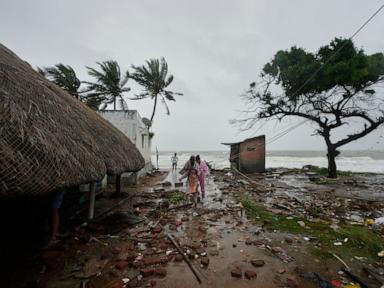
The water does not knock.
If you have never stood inside a brick-and-mud house on the eastern coast of India when a cyclone makes landfall, you probably think of a storm as wind. You picture palm trees bending like fishing rods and corrugated tin roofs peeling off like sardine lids. You imagine noise. And yes, the wind screams—a low, mechanical howl that sounds less like weather and more like a freight train parked in your front yard. Learn more on a related issue: this related article.
But the wind is only the herald. The real thief arrives quietly, seeping under the threshold of the door in the dark, tasting of mud and diesel and the Bay of Bengal.
Consider a hypothetical family living three kilometers inland from the Odisha coast—let us call them the Beheras, though their story belongs to millions along the eastern shoreline. They did not die when Cyclone Arnab tore across the region. Their names did not appear in the initial casualty tickers that scrolled across television screens in New Delhi or Mumbai. They evacuated to a concrete cyclone shelter when the sirens wailed, huddled on damp floors with four hundred neighbors, ate dry flattened rice from plastic bags, and returned two days later to find their walls still standing. Additional analysis by TIME explores similar views on the subject.
By every official metric used to measure disaster response, the Beheras were a success story.
Except when Rajesh Behera walked out to his two acres of paddy land the morning after the sky cleared, the green shoots had turned the color of steeped tea. The storm surge had pushed seawater four kilometers past the crumbling embankments, pooling in the low-lying fields like a bitter, glittering lake. When the sun came out, the water evaporated. The salt stayed.
That salt will remain in Rajesh’s soil for three years. Maybe five.
When Cyclone Arnab slammed into the Indian coast, the headlines followed a familiar, exhausted script. Reporters tallied wind speeds in kilometers per hour, counted uprooted banyan trees, noted the number of National Disaster Response Force teams deployed, and moved on to the next news cycle within seventy-two hours. That is how we talk about extreme weather in India now. We treat cyclones like violent, isolated accidents—car crashes on a highway that we clean up, mourn briefly, and forget until the next siren sounds.
We have gotten the story completely backward.
The true toll of Cyclone Arnab—and the accelerating parade of storms battering the Indian subcontinent—cannot be measured in the forty-eight hours of landfall. It is measured in the slow, invisible unspooling of lives over the ten years that follow. It is measured in the migration tickets bought on credit, the girls pulled out of secondary school because the harvest failed, and the quiet, creeping realization that the land your ancestors farmed for twelve generations has turned against you.
The Furnace in the Bay
To understand why storms like Arnab feel different to the people living on the edge of the water, you have to stop thinking of the ocean as a flat blue expanse and start thinking of it as a battery.
For decades, the oceans have been absorbing more than ninety percent of the excess heat trapped by greenhouse gases. The Bay of Bengal, hemmed in by land on three sides and fed by massive freshwater rivers like the Ganges and the Brahmaputra, acts like a shallow, sun-warmed bowl. Unlike deeper oceans where cold water from the abyss churns upward to cool the surface, the Bay’s warm top layer sits stubbornly in place.
Think of a pot of water on a stove with a tight lid. Even if you turn the burner up just a fraction, the pressure inside climbs fast.
Meteorologists call what happens next "rapid intensification"—a clinical phrase for a terrifying phenomenon where a sleepy tropical depression transforms into a monster cyclone in less than twenty-four hours. When Arnab gathered strength over those unusually warm waters, it gave coastal communities barely enough time to board up windows, let alone move livestock or harvest standing crops.
I remember standing near a fishing harbor in coastal Andhra Pradesh after an earlier storm, watching an elderly boat builder run his thumb along the splintered hull of a wooden trawler. He told me that his father could read the clouds three days before a gale. The sea had a rhythm, a set of manners. You knew when it was angry, and you knew how long it would sulk. Now, he said, the water stays feverish through October and November, breeding storms that explode out of nowhere, defying the old almanacs and stretching the forecasting models to their limits.
When we ask why extreme weather events in India are becoming harder to predict and more destructive, the answer sits right there beneath the waves. A warmer atmosphere holds roughly seven percent more moisture for every degree Celsius of warming. When a storm like Arnab makes landfall, it does not just blow; it dumps months of rain in a single afternoon, turning dry riverbeds into battering rams and drowning cities whose drainage systems were designed for a climate that no longer exists.
The Architecture of Vulnerability
There is a comforting myth that disasters are equalizers—that the rain falls on the rich and the poor alike. Anyone who has walked through the aftermath of an Indian cyclone knows that is a lie.
Look at the map of where Cyclone Arnab struck hardest. The coast of eastern India is a patchwork of fragile ecosystems, dense agrarian settlements, and booming, unplanned peri-urban corridors. Over the last thirty years, in our rush to build ports, shrimp farms, coastal highways, and beach resorts, we have systematically stripped away the very armor that used to protect the shoreline.
Mangrove forests—those tangled, muddy cathedrals of roots that look like wastelands to real estate developers—are nature’s hydraulic brakes. A healthy belt of mangroves can reduce the height and energy of a storm surge by up to sixty percent before it ever reaches a village. Yet across the deltas of eastern India, thousands of hectares of mangroves have been cleared for aquaculture ponds and concrete embankments.
And here is the cruel irony of concrete walls: when you build a hard seawall to protect one stretch of coast, you simply redirect the ocean’s fury down the line, eroding the neighboring beach twice as fast. Worse, when a surge like Arnab’s finally overtops a rigid embankment, the wall acts like a bathtub rim, trapping the saltwater inside the farmland and preventing it from draining back to the sea.
The invisible stakes of Cyclone Arnab live in these engineering blind spots.
When power lines snap and substations flood, the loss is not just an inconvenience for urban households running air conditioners. In rural districts, electricity is water. Without power to run electric tube wells, farmers cannot pump fresh water to flush the salt out of their fields. In hospitals, backup diesel generators run dry within thirty-six hours, turning routine childbirths and snakebite treatments into life-or-death gambles.
Even the triumph of India’s early warning systems—which have rightfully saved tens of thousands of lives since the catastrophic 1999 Odisha super cyclone—has created a dangerous complacency among policymakers. Zero casualties has become the gold standard of success. If nobody dies during the storm, the press conferences are celebratory.
Nobody holds a press conference six months later when the local moneylender hikes interest rates to forty percent because the banks refuse to lend to farmers whose soil is dead.
The Ledger of Uncounted Losses
Let us return to our hypothetical farmer, Rajesh Behera, six months after Cyclone Arnab has vanished from the headlines.
His brick house survived. His wife and two children are healthy. On paper, he received a government compensation check of a few thousand rupees—barely enough to buy fertilizer, let alone replace a lost harvest. The monsoon rains are still months away, and the village pond, contaminated by storm runoff and dead livestock, is too brackish to drink or irrigate.
So Rajesh does what millions of men across eastern and central India do when the climate breaks their local economy. He packs a small nylon bag, borrows bus fare from his brother, and boards a train to Surat, or Bengaluru, or Kochi. He becomes a daily-wage construction worker, sleeping ten to a room in half-built apartment towers, sending small digital transfers home every Sunday evening.
This is the hidden migration crisis fueled by extreme weather. We look at congested Indian megacities and complain about traffic, housing shortages, and strained water supplies, rarely connecting those urban pressures to a storm surge four hundred kilometers away on the coast.
And what happens back in the village Rajesh left behind?
His wife, Sunita—again, a composite portrait drawn from countless real women navigating post-cyclone economies—now shoulders the entire burden of survival alone. She manages the household, cares for aging in-laws, queues for subsidized grain, and tries to coax kitchen vegetables out of poisoned dirt. When money runs short, the first expense cut is almost always a daughter’s education, followed closely by protein in the family diet.
Climate economists have a sterile term for this: non-economic loss and damage. It refers to the erosion of health, cultural heritage, social cohesion, and mental well-being that never shows up in gross domestic product calculations. You cannot insure a disrupted childhood. You cannot file a claim for the slow grief of watching your ancestral land turn to dust.
I admit, when I first started tracking the aftermath of Indian cyclones years ago, I looked at the numbers the way most analysts do—through insurance payouts, infrastructure repair budgets, and crop yield percentages. It took sitting in a relief camp in West Bengal, listening to a twelve-year-old boy explain why he had wrapped his school textbooks in three layers of plastic grocery bags before fleeing his home, to realize what we were actually losing. His house was gone. His family’s goats had drowned. All he had salvaged from the floodwaters were damp notebooks with smudged ink, because he believed those pages were the only bridge left out of the mud.
Beyond the Siren
If Cyclone Arnab teaches us anything, it is that surviving the storm is no longer enough. We have mastered the art of evacuation; now we have to master the art of endurance.
That requires a fundamental shift in how India—and the wider world—invests in climate resilience. Right now, almost all our money and political attention flow toward disaster relief: helicopters dropping food packets, army engineers clearing roads, emergency cash transfers after the damage is done. Relief is visible. It photographs well. It wins elections.
Resilience is boring. Resilience happens years before the clouds gather, and nobody cuts a ribbon when a disaster does not happen.
What does real resilience look like on the ground? It looks like aggressively restoring mangrove buffers along every vulnerable estuary, paying coastal communities to protect and replant them rather than tearing them up for short-term profit. It looks like breeding and distributing salt-tolerant rice varieties—strains that can survive submerged in brackish water for two weeks without dying—so a single storm surge does not wipe out three years of livelihood.
It means burying power cables underground in coastal districts, elevating rural health clinics and water pumps above historic flood lines, and building micro-grids powered by solar panels that can keep lights and water running even when the main state grid collapses.
Most importantly, it requires changing how we finance recovery. Smallholder farmers and informal workers—the people who bear the brunt of cyclones like Arnab—almost never have crop or property insurance. When disaster strikes, they are thrown into the arms of predatory lenders. Parametric insurance—policies that automatically release cash payouts the moment wind speeds or rainfall cross a specific threshold, without waiting months for loss adjusters to visit ruined fields—could keep families from selling their assets or pulling children out of school.
We also need to stop pretending that coastal vulnerability is solely an Indian engineering problem. India contributes a tiny fraction of historical global carbon emissions per capita, yet its seven-thousand-five-hundred-kilometer coastline sits directly in the crosshairs of a warming planet. Every storm that spins up in the heated waters of the Bay of Bengal or the Arabian Sea carries the fingerprints of fossil fuels burned half a world away. Global climate finance cannot remain a polite promise made at international summits while farmers on the Odisha coast scrape white salt crusts off their fields with bare hands.
What Remains When the Water Recedes
Three weeks after Cyclone Arnab made landfall, the satellite maps looked normal again. The swirling white comma of cloud had dissolved over the central plains, the rivers had shrunk back inside their banks, and the highway crews had cleared the last of the fallen trees. From space, the coastline appeared healed.
Down on the ground, however, the landscape tells a different story.
Walk along the edge of any tidal creek where the storm pushed through, and you will see them: stands of coconut palms and casuarina trees still upright, their trunks intact, their crowns completely bare—stripped of every frond, standing like rows of bleached, skeletal masts against the sky. Around their roots, the earth is cracked and pale, dusted with a fine, crystalline powder that catches the afternoon sun like frost.
In the villages behind those trees, women are still boiling brackish well water twice before giving it to their children. Men are still staring at the cracks in their mud walls, calculating how many months of labor in a distant city it will take to buy cement. The storm is over. The wind has stopped. And in the quiet fields where nothing green will grow until the monsoon washes the earth clean, the reckoning has only just begun.


