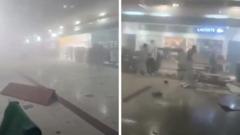
The headlines write themselves. "Three killed." "Shooting at Austin bar." The media treats these tragedies like a recurring weather pattern—unfortunate, unavoidable, and solved by more yellow tape. We consume the shock, argue about "gun-free zones" or "defunding police," and then wait for the next push notification to tell us where the next body fell.
Stop looking at the crime scene. Start looking at the ecosystem that built it.
Most reporting on the recent Austin bar shooting falls into the trap of reactive journalism. It treats a violent outburst as an isolated failure of law enforcement or a sudden lapse in morality. That is a comforting lie. The reality is that the "nightlife economy" is built on a foundation of structural negligence that prioritizes alcohol margins over human life. If you are waiting for a legislative miracle or a faster response time to save you, you have already lost the game.
The Myth of the "Safe" High-Traffic District
Austin prides itself on being the Live Music Capital of the World. Sixth Street and the surrounding districts are the city's economic engines. But there is a dirty secret known by anyone who has ever managed a high-volume venue: we have outsourced public safety to underpaid bouncers and overstretched patrol officers who are legally barred from being proactive.
The common misconception is that more police presence equals less crime. In a dense, alcohol-soaked environment, police are janitors. They clean up the mess after the kinetic energy has already been released. By the time a 911 call is placed in a crowded bar, the trajectory of the tragedy is already locked in.
I have spent years consulting on high-risk environment security. I’ve seen venues spend $50,000 on "aesthetic" lighting while hiring security teams at $18 an hour—men and women with four hours of training tasked with spotting a concealed weapon in a room of 300 people moving to a 100-decibel bassline.
The Failure of "Security Theater"
We need to talk about the metal detector that isn't plugged in and the "pat down" that wouldn't find a brick, let alone a subcompact pistol.
Most bars in entertainment districts practice Security Theater. It’s a performance designed to lower your guard and satisfy insurance requirements, not to actually mitigate risk.
- Wanding is useless if the staff isn't trained on "reach-back" techniques or how to spot the "weighted pocket" gait.
- ID scanners track who was there after they’re dead, but they do nothing to prevent the entry of a motivated actor.
- Capacity limits are treated as suggestions until the Fire Marshal walks in, creating "crush conditions" that make it impossible for anyone to escape when the first shot is fired.
If a venue’s primary concern is how many bodies they can fit in a room to maximize the "cover charge to drink pour" ratio, they are running a casualty trap, not a business.
The Alcohol-Violence Correlation Nobody Wants to Touch
We love to blame the tool (the gun) or the person (the shooter), but we ignore the catalyst: the aggressive over-service of alcohol.
The industry term is "Profit Over Protection." In many of these Austin incidents, the escalation starts with a minor friction point—a spilled drink, a bumped shoulder—that is fueled by a blood-alcohol content that bypasses the prefrontal cortex.
When you combine high-density crowds, extreme noise levels (which trigger a fight-or-flight physiological response), and legal intoxication, you aren't looking at a "random act of violence." You are looking at a predictable chemical reaction.
The "lazy consensus" says we need better gun laws or more cops. The contrarian truth? We need to hold liquor license holders criminally liable for the atmosphere they cultivate. If a bar creates a "high-tension" environment through overcrowding and lack of de-escalation training, they are an accomplice to the eventual discharge of a firearm.
Why "Run, Hide, Fight" Is Failing You
The standard advice given to the public—Run, Hide, Fight—is a generic sedative. It assumes you are in a corporate office with clear exits and fluorescent lighting.
Try "running" in a packed Austin bar on a Saturday night. You can’t move three feet without hitting a table or another person. Try "hiding" in a room made of wood and glass.
The reality of modern urban violence is that Environmental Design (CPTED - Crime Prevention Through Environmental Design) is the only thing that actually works.
- Chokepoints: Most bars have one way in and one way out. That’s a tomb.
- Sightlines: If the security at the front cannot see the back of the room, the room is unmanageable.
- Acoustic Saturation: If you can’t hear a verbal argument starting over the music, you can’t stop the physical fight that follows.
The Hard Truth About Personal Responsibility
People ask, "How do I stay safe in Austin?"
The answer is one nobody wants to hear: Avoid the herd. The "Status Quo" tells you to trust the system. I’m telling you the system is a legacy network of overtaxed resources and profit-driven hospitality groups.
- If you enter a venue and can’t identify two exits immediately, leave.
- If the "security" is looking at their phones instead of people's hands, leave.
- If the crowd density is "chest-to-back," you are in a kill zone.
We treat these shootings as "senseless." They aren't. They make perfect sense when you look at the math of human behavior under pressure. We have turned our social spaces into high-pressure cookers and then expressed shock when they explode.
Stop asking for more police. Start demanding better architecture and higher standards for those who profit from our nightlife. The police arrive for the autopsy; the environment decides if there is one.
The next time you see a headline about a shooting in a bar, don't just look at the shooter's name. Look at the bar's floor plan. Look at their security budget. That’s where the real crime happened months before the first shot was fired.
Don't wait for a city council meeting to change the world. Change your location.