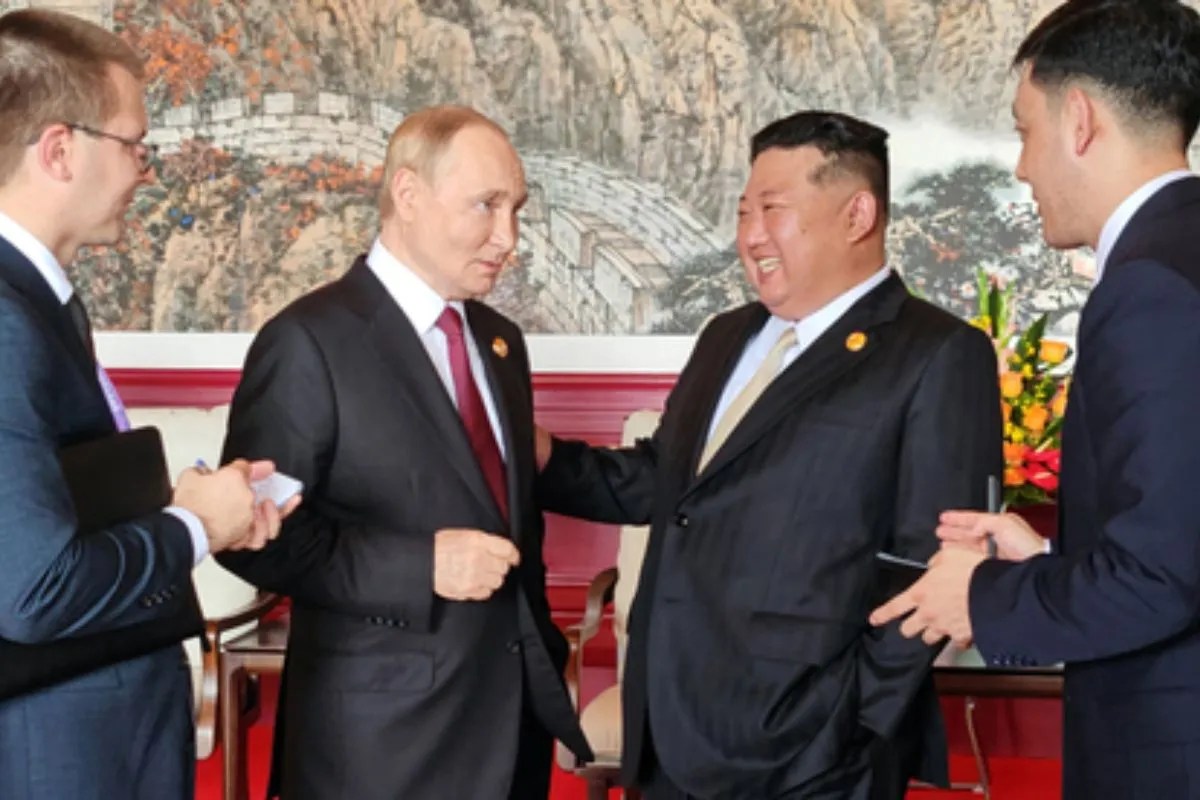
The headline-chasing media loves a good bogeyman. Right now, they are obsessed with the budding bromance between Moscow and Pyongyang. They paint a picture of a synchronized geopolitical force, two pariah states locking arms to destabilize the global order. They talk about "unprecedented cooperation" and a "new era of strategic partnership."
It is a fairy tale.
If you believe this partnership represents a fundamental shift in the global balance of power, you are falling for the same surface-level analysis that has plagued international relations reporting for decades. This isn't a masterstroke of grand strategy. It is a transaction of convenience—a loud, desperate scramble for resources by two regimes running on fumes.
Look at the mechanics. Russia, once a military superpower, is so depleted by its campaign in Ukraine that it finds itself begging for artillery shells from an isolated, impoverished hermit kingdom. Think about the humiliation in that. The successor to the Soviet Union, a nation that built its identity on military supremacy, now relies on the supply chains of a country that still struggles to feed its own populace.
This is not a partnership between equals. It is a frantic vendor-client relationship.
The Myth of Strategic Depth
Analysts love to use terms like "strategic alignment" to sound sophisticated. They suggest that Vladimir Putin and Kim Jong Un are building a cohesive bloc to rival the West. But alignment requires shared long-term goals. Moscow wants to burn through its current conflict and stabilize its domestic economy. Pyongyang wants the survival of the Kim dynasty and, ideally, enough currency and illicit technology to prevent total collapse.
Their interests overlap only at the intersection of immediate necessity. Russia needs shells; North Korea needs cash and food. Once the artillery fire in Ukraine stops or the North Korean larder runs dry, the "friendship" will evaporate faster than a Siberian winter.
Imagine a scenario where the conflict in Ukraine reaches a stalemate or a negotiated settlement. Does Russia keep buying outdated munitions from Pyongyang? Of course not. Russia’s industrial complex, however strained, far outclasses anything North Korea can provide in the long run. Moscow views Pyongyang as a short-term tactical solution, not a permanent pillar of its foreign policy.
Misunderstanding the Transaction
The current narrative focuses heavily on "every sector" of cooperation, from aerospace to agriculture. It sounds ominous, doesn't it? But when a nation is sanctioned to the teeth, "cooperation" usually means back-channel bartering for things the rest of the world refuses to sell.
We are not watching the birth of a new military superpower alliance. We are watching the formation of a black-market cartel. These regimes are stripping the gears of their own economies to keep their political machinery running. They are not expanding their influence; they are circling the wagons because they have nowhere else to go.
I have spent years watching states play these games. The loudest posturing usually masks the deepest insecurity. When two leaders hold a summit and make grand declarations about eternal brotherhood, start counting their weaknesses. The more they boast about their cooperation, the more they are trying to convince themselves—and their rivals—that they are not isolated.
The Real Cost of the Gamble
The danger here is not some grand, coordinated geopolitical surge. The real danger is the unpredictability that comes from regimes operating without guardrails.
When you strip away the propaganda, you find a dangerous reality: both parties are acting out of a position of weakness. North Korea is using its arsenal as a bargaining chip to squeeze concessions out of Moscow, knowing full well that Russia is desperate enough to pay the premium. Moscow, meanwhile, is willing to ignore international norms regarding North Korea’s nuclear program because it simply does not have the luxury of playing the global policeman anymore.
This is a fire sale, not a union.
Don't mistake noise for signal. The mainstream commentary pushes the "new alignment" narrative because it drives engagement. It is easy to write about "The Axis of Resistance" or "The New Bloc." It is much harder to admit that we are just watching two desperate actors trying to survive another quarter.
Stop analyzing this as a grand strategic pivot. Start analyzing it as what it actually is: a frantic, short-term liquidation of diplomatic capital by two regimes that are running out of options. They are not changing the world. They are just trying to keep their seats at the table a little bit longer.
The moment the price of their mutual desperation changes, the alliance will be worth nothing. And when it collapses, don't be surprised when the pundits who predicted a new world order are nowhere to be found.