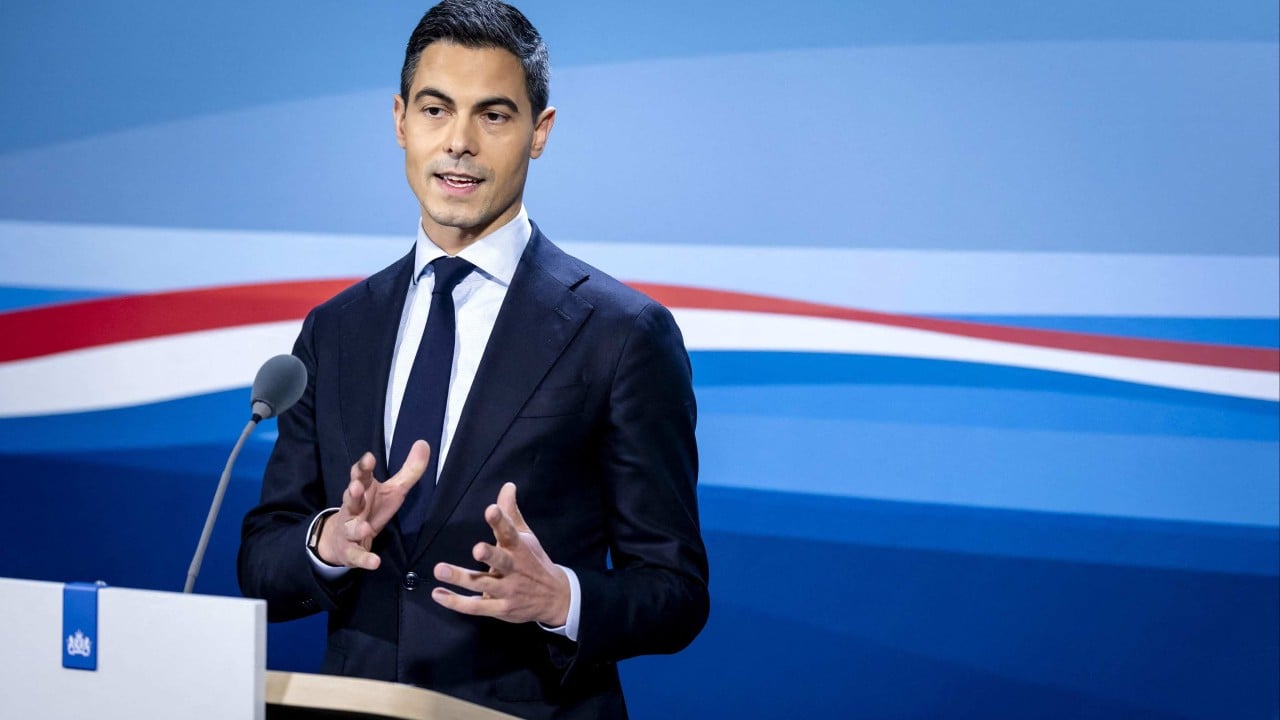
The upcoming sit-down between Dutch Prime Minister Rob Jetten and Donald Trump in Washington marks a desperate gamble to insulate the European economy from a looming trade war. While official aides frame the visit as a standard diplomatic introductory meeting, the reality is far more transactional. Jetten is not flying across the Atlantic to exchange pleasantries about the history of the Binnenhof. He is heading into the lions' den to protect the crown jewel of Dutch industry, ASML, from becoming collateral damage in the escalating tech standoff between the United States and China.
The Dutch government has spent months quietly preparing for this encounter. Jetten, a leader who has built his reputation on climate action and progressive European integration, now finds himself in the uncomfortable position of having to charm an American administration that views the European Union as a "mini-China" on trade matters. The stakes are clear. If Jetten fails to secure specific carve-outs or at least a predictable framework for export controls, the Netherlands risks losing its technological edge. The Hague is tired of being the silent partner in American foreign policy; this trip is an attempt to reclaim a seat at the table.
The ASML Factor and the Sovereignty Trap
At the heart of this meeting lies a single company based in Veldhoven. ASML holds a monopoly on the extreme ultraviolet (EUV) lithography machines required to make the world's most advanced semiconductors. For years, the U.S. has used the Foreign Direct Product Rule to dictate where these machines can go, effectively turning the Dutch Ministry of Foreign Affairs into an extension of the U.S. Commerce Department.
Jetten’s predecessors largely complied with Washington’s demands to restrict exports to China, but the economic cost is starting to outpace the strategic benefit. China remains a massive market for older, "Deep Ultraviolet" (DUV) systems. By cutting off these sales, the Dutch are essentially subsidizing the acceleration of China’s domestic chip-making capabilities. Jetten needs to walk a tightrope. He must convince Trump that a weakened Dutch economy serves no one, while simultaneously proving that the Netherlands is a reliable security partner in the North Atlantic.
It is a difficult sell. The U.S. perspective is binary: you are either with the American tech blockade or you are against it. Jetten, however, is dealing with a domestic coalition that is increasingly skeptical of following Washington blindly. The Dutch business community is vocal about "strategic autonomy," a phrase that usually irritates American policymakers. If Jetten returns with nothing but a photo op, the internal pressure from the Dutch tech sector could fracture his fragile government support.
Energy Security and the LNG Leverage
While chips dominate the headlines, energy is the secondary, more visceral layer of this diplomatic push. The Netherlands has moved aggressively to decouple from Russian gas, and that has made it one of the largest importers of American Liquefied Natural Gas (LNG) in Europe. Jetten, formerly the Climate and Energy Minister, knows these numbers better than anyone.
He intends to use this buyer-seller relationship as a buffer against potential tariffs. The logic is simple: if the U.S. imposes broad 10% or 20% tariffs on European goods, the Dutch can point to their massive investments in American energy infrastructure as a reason for an exemption. It is a play straight out of a negotiator’s handbook. You don't ask for a favor; you remind the other party how much money you are putting in their pocket.
However, this leverage is double-edged. Dependence on U.S. gas makes the Netherlands vulnerable to price spikes and policy shifts in Washington. Jetten is essentially trying to trade energy loyalty for trade leniency. Whether Trump views this as a fair exchange or merely the expected behavior of an ally remains the $100 billion question.
Defense Spending as the Entry Fee
For any European leader visiting Washington, the 2% GDP defense spending target is the price of admission. The Netherlands has finally hit that mark, a fact Jetten will undoubtedly repeat. This isn't just about NATO solidarity; it's about buying political capital. The Dutch have been among the most aggressive supporters of Ukraine, providing F-16s and advanced radar systems.
Jetten's strategy is to frame the Netherlands as the "sensible" European power—the one that pays its bills, sends its jets, and doesn't complain about the burden of collective defense. This stands in stark contrast to the often-tense relationship between Washington and Berlin or Paris. By positioning the Netherlands as the most reliable bridge between the U.S. and the EU, Jetten hopes to bypass the general anti-European sentiment often found in certain American political circles.
The Risks of the One-on-One Approach
There is a significant danger in this bilateral strategy. By seeking a "special deal" for the Netherlands, Jetten risks alienating his neighbors in Brussels. The European Commission prefers a unified front on trade, fearing that if individual countries start cutting their own deals with Washington, the entire single market will be picked apart.
- Fragmentation: If the Netherlands gets an exemption on chip tools, why shouldn't Germany get one on cars?
- Retaliation: If the U.S. grants a Dutch exception, China might view it as a specific provocation by The Hague rather than a broad EU policy.
- Precedent: A successful Jetten mission proves that the EU’s collective bargaining power is a myth.
Jetten is aware of these optics. He has spent the last two weeks on the phone with Paris and Berlin, trying to coordinate messaging. But when the doors close in the Oval Office, his primary loyalty is to the Dutch taxpayer and the Veldhoven balance sheet.
Trade War Shadows and the Port of Rotterdam
The Port of Rotterdam is the gateway to Europe. Nearly everything that enters the continent from the Atlantic passes through Dutch waters. If a full-scale trade war erupts, Rotterdam becomes a ghost town of empty shipping containers. This isn't just a Dutch problem; it’s a European heart attack.
Jetten’s aides have been crunching the numbers on the "Universal Baseline Tariff" proposed by the American side. The projections are grim. For a country that lives and dies by international trade, even a minor disruption in the flow of goods is catastrophic. Jetten isn't just representing a country; he’s representing a logistics hub. He needs to explain that taxing Dutch exports is effectively taxing the supply chain of the entire Western world.
The Dutch delegation plans to present data showing how integrated Dutch components are in American products, from medical devices to agriculture. The goal is to demonstrate that a "Dutch tax" is actually an "American inflation spike." It is a pragmatic, data-driven argument intended to appeal to the transactional nature of his host.
The Climate Conflict
There is no world where Rob Jetten and Donald Trump agree on climate policy. Jetten is a true believer in the energy transition; Trump has famously called it a "scam." To make this meeting work, Jetten has to pivot. He cannot talk about carbon footprints or melting ice caps. Instead, he must talk about Green Technology as a Competitive Advantage.
He will focus on hydrogen, offshore wind technology, and carbon capture—industries where Dutch firms lead the world. The pitch won't be "save the planet." It will be "don't let China own the next generation of energy tech." By framing the climate transition as a geopolitical arms race, Jetten might find a sympathetic ear. It is a cynical shift, perhaps, but it is the only way to keep the conversation from stalling before the first course is served.
Tactical Diplomacy in a Polarized Era
Jetten is also bringing a small group of Dutch CEOs, a move designed to keep the conversation grounded in business reality. This isn't just a political summit; it's a corporate mission. These executives provide the "real-world" weight that politicians sometimes lack. When the CEO of a major maritime or tech firm explains exactly how many American jobs depend on Dutch cooperation, it carries more weight than a thousand diplomatic cables.
The Prime Minister is also likely to avoid the grand moralizing that has characterized some European interactions with American leadership in the past. There will be no lectures on international law or the "rules-based order." Instead, expect a focus on shared threats and shared profits. It is a move toward a more "mercantile" diplomacy, harkening back to the Dutch Republic’s roots.
High Stakes in the West Wing
If Jetten walks out of Washington with a vague promise of "continued dialogue," the trip will be a failure. He needs concrete assurances. Specifically, he needs a commitment that the U.S. will consult with The Hague before announcing new export restrictions, rather than presenting them as a fait accompli. He also needs a signal that the Netherlands won't be swept up in broad-brush tariffs aimed at the EU's larger, more protectionist economies.
The risk of being seen as a "vassal state" is high. If Jetten gives too much on security and gets nothing on trade, he will be savaged by both the left and the right back home. The left will accuse him of selling out Dutch sovereignty to a populist American leader; the right will mock him for his perceived weakness on the global stage.
Jetten’s team is betting that the U.S. recognizes the Netherlands as an indispensable partner that cannot be bullied indefinitely. The Dutch have a long memory and a deep-seated pride in their role as global traders. They are willing to be allies, but they are not willing to be subjects.
The dinner in Washington is the opening move in a long, grueling game of geopolitical chess. Jetten has studied the board, he knows his opponent's favorite openings, and he knows exactly which pieces he is prepared to sacrifice. What remains to be seen is whether he has the nerves to play the game when the lights are brightest and the pressure is at its peak.
Would you like me to analyze the specific economic impact reports Jetten is expected to present regarding ASML's revenue exposure?