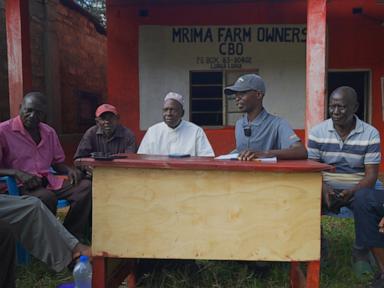
Sub-surface mineral extraction in Kenya operates on a structural collision course with surface-level agrarian economies and customary land tenure. While state policy aggressively targets the mining sector to diversify gross domestic product and capture global transition-mineral demand, the legal and operational mechanisms governing land acquisition remain misaligned with rural realities. The core failure is not merely a lack of community consultation; it is an asymmetric valuation model that prices land strictly as a depreciable physical asset while ignoring its function as an intergenerational economic engine and a non-fungible cultural anchor.
To understand why mining expansion triggers immediate, high-friction resistance across Kenyan counties—from titanium sands in Kwale to gold belts in Migori and rare earths at Mrima Hill—analysts must move beyond surface-level narratives of "fears" and "ambitions." The conflict is governed by predictable economic, legal, and spatial variables. For another look, see: this related article.
The Structural Asymmetry of Kenyan Land Law
The primary driver of conflict is the bifurcation of property rights under Kenyan law. Under the Constitution of Kenya (2010) and the Mining Act of 2016, all minerals in, under, or upon any land are vested in the National Government in trust for the people of Kenya. Conversely, surface rights are governed by the Land Act (2012) and the Community Land Act (2016), which recognize private freehold, leasehold, and unregistered customary community tenure.
This creates a vertical split in asset ownership: Further coverage regarding this has been published by Forbes.
- The Sub-Surface State Monopoly: The Ministry of Mining, Blue Economy and Maritime Affairs holds unilateral authority to issue prospecting and mining licenses over territories where the state does not own the surface topsoil.
- The Surface Agrarian Reality: Smallholder farmers and pastoralists hold surface rights that sustain immediate household liquidity, food security, and localized supply chains.
- The Unregistered Tenure Trap: A significant portion of rural Kenya remains under unregistered community land. Where formal title deeds do not exist, statutory compensation mechanisms default to bureaucratic delays, leaving occupants vulnerable to displacement before valuation disputes are resolved.
When a prospecting license is granted over active agricultural zones, the state introduces a superior legal claim onto an existing economic system. The Mining Act mandates consent from landowners or lawful occupiers prior to licensing, yet the operational execution frequently compresses consent into a single transactional event rather than an ongoing governance partnership.
Deconstructing the Agricultural Displacement Cost Function
Standard resettlement frameworks fail because they rely on static replacement-cost accounting. When evaluating farmland for mining conversion, state valuers and corporate project developers typically calculate compensation based on current market land prices plus the immediate value of standing crops and physical structures. This methodology systematically underprices the true economic loss borne by the household.
The total economic cost of displacing a Kenyan smallholder farm comprises four distinct variables:
- Loss of Perpetual Cash Flow: Agricultural land in high-potential zones (such as Western Kenya or the coastal hinterland) generates recurring seasonal yields. A lump-sum cash payout converts a perpetual, inflation-hedged annuity into a finite pool of liquid capital. In rural economies lacking deep financial literacy or accessible investment vehicles, lump-sum payouts routinely deplete within 24 to 36 months.
- Disruption of Agglomeration Economies: Farms do not operate in isolation. They rely on localized networks of input suppliers, casual labor pools, cooperative societies, and informal markets. Displacing 500 households fractures the local commercial ecosystem, eroding the viability of remaining farms on the periphery of the mining concession.
- Soil Degradation and Ecological Externalities: Open-pit extraction, tailings storage, and heavy-metal leaching alter local hydrology. Even where physical displacement does not occur, aquifer drawdown and dust deposition degrade agricultural productivity across a radius far exceeding the leased concession boundary.
- Delayed Re-establishment Lag: Even when displaced farmers secure alternative land, clearing, soil conditioning, and establishing perennial cash crops (such as cashews, mangoes, tea, or sugarcane) require three to seven years to reach peak yield. Standard compensation packages rarely bridge this multi-year revenue trough.
The Valuation Gap of Ancestral and Cultural Assets
Where agricultural displacement creates a quantifiable financial deficit, the disturbance of ancestral graves creates a non-market market failure. In many Kenyan communities—particularly among the Mijikenda at the coast, the Luo and Luhya in the west, and the Maasai and Samburu in the Rift Valley—burial sites are not merely historical markers; they are active spiritual and juridical anchors that validate a lineage’s territorial claim.
Corporate relocation protocols attempt to solve this through standardized exhumation and reburial budgets. This approach misunderstands the utility function of the asset:
- Zero Substitution Elasticity: A grave site cannot be replaced by an equivalent square meter of land elsewhere. Its value is strictly tied to its geographic coordinates and historical continuity.
- Social Capital Erosion: In customary governance, elders derive authority and mediate disputes through proximity to ancestral sites. Relocating remains severs the physical link to lineage, triggering intra-community fragmentation and loss of social cohesion.
- Litigation and Force Majeure Risks: Attempting to force exhumation through eminent domain or police enforcement converts a localized land dispute into an existential cultural threat. For a mining operator, this manifests as operational downtime, blockades, sabotage, and protracted injunctions in the Environment and Land Court—costs that rapidly eclipse the initial capital expenditure of redesigning a pit shell to avoid sacred sites.
Operationalizing the Social License to Operate
Relying solely on statutory compliance—securing a license in Nairobi and conducting mandatory Environmental and Social Impact Assessments (ESIA)—is insufficient to de-risk capital in Kenya’s extractive sector. An ESIA is a regulatory baseline, not an operational guarantee.
To prevent project paralysis, mining operators and state agencies must restructure how land access is negotiated and financed.
Shift from Lump-Sum Buyouts to Equity and Annuity Models
Cash compensation for land acquisition must be restructured. Rather than transferring full ownership via one-time payouts, operators should utilize long-term surface leases indexed to inflation, combined with community equity stakes or production-linked revenue streams. Under the Mining Act 2016, royalties are split 70% to the National Government, 20% to the County Government, and 10% to the community. However, delays in remitting the 10% community share from the National Treasury to local Community Development Agreement Committees (CDACs) routinely erode trust. Operators should establish direct, transparent escrow mechanisms for local benefit-sharing independent of slow intergovernmental fiscal transfers.
Spatial Exclusion Zones for Cultural Anchors
Project engineers must treat ancestral graves and sacred forests (such as the coastal Kayas) as hard geological constraints during the pre-feasibility stage, identical to fault lines or floodplains. Modifying mine plans to buffer cultural sites reduces immediate extractable tonnage, yet it preserves project schedule integrity. The net present value lost by leaving a mineral pillar untouched beneath a burial ground is consistently lower than the cost of a multi-year legal injunction or violent community confrontation.
Pre-Emptive Cadastral Mapping
Before initiating commercial negotiations, project developers must fund independent, participatory cadastral mapping alongside the National Land Commission and county authorities. Identifying unregistered community boundaries, seasonal grazing corridors, and contested family plots prior to announcing compensation figures prevents elite capture—where local brokers fraudulently register land to intercept payouts—and ensures capital reaches actual surface users.
Limitations of Structural Mitigation
These operational adjustments do not eliminate conflict; they merely shift the friction from acute confrontation to long-term administrative management. Long-term leasing and annuity models require stable corporate governance over multi-decade mine lifespans, exposing communities to counterparty risk if a junior mining firm goes bankrupt or sells the asset to a less compliant operator. Similarly, Community Development Agreement Committees frequently suffer from internal political capture, where local elites divert royalty flows away from displaced households.
The Strategic Mandate for Extractive Capital
Kenya’s mining sector cannot scale through state-backed expropriation. The legal architecture established by the 2010 Constitution empowers local communities and county governments with sufficient procedural weapons to stall any extractive project indefinitely.
Investors and policymakers must abandon the legacy model of treating surface rights as a cheap administrative hurdle to be cleared before excavation begins. Capital allocation in Kenyan mining must price surface tenure, agricultural yield replacement, and cultural preservation as primary operational expenditures on par with processing plant construction and energy infrastructure. Projects that fail to internalize these costs into their initial feasibility models will remain stranded assets—rich in geological reserves, yet commercially unextractable.