Donald Trump is back at the podium talking about a "new Iran." After recent military strikes and a series of escalations, the whispers of regime change in Tehran have turned into a roar. It sounds simple when you say it on a campaign stage or in a briefing room. You knock out the leadership, the people rise up, and suddenly, a decades-old adversary becomes a partner. But if the last fifty years of American foreign policy have taught us anything, it’s that "simple" is a lie.
The reality is that collapsing a government from the outside is a messy, violent, and unpredictable business. We’ve seen this movie before in Iraq, Libya, and even Iran itself back in 1953. Each time, the sequels are worse than the original. Thinking that a few well-placed missiles or a new round of "maximum pressure" will lead to a pro-Western democracy in Tehran isn't just optimistic. It’s a misunderstanding of how the Islamic Republic survives.
The Architecture of Survival in Tehran
You can't talk about regime change without talking about the Islamic Revolutionary Guard Corps (IRGC). This isn't just a military branch. It’s a massive corporate conglomerate that owns everything from construction firms to telecommunications companies. They aren't just defending an ideology; they're defending their bank accounts.
When Trump talks about the Iranian government "collapsing," he’s overlooking the fact that the IRGC has spent forty years preparing for exactly this scenario. They’ve built a "resistance economy" designed to withstand sanctions. They’ve developed a domestic security apparatus—the Basij—that is integrated into almost every neighborhood.
If the top leadership were to disappear tomorrow, the IRGC wouldn't just go home. They are the deep state. They would likely double down, using the chaos to seize total control and crush any civilian opposition. We saw a version of this in Egypt during the Arab Spring. The "people's revolution" was quickly overtaken by organized, armed factions. In Iran, the IRGC is the most organized and best-armed faction there is.
The Ghost of 1953 and Why History Still Bites
Iranians have long memories. Even those who hate the current Clerical establishment have a deep-seated distrust of Western intervention. This stems directly from the 1953 coup, where the CIA and British intelligence orchestrated the removal of Mohammad Mossadegh.
Mossadegh was a secular, nationalist prime minister who wanted to nationalize Iranian oil. The West wanted the oil. So, they sparked a coup. It worked in the short term, but it planted the seeds for the 1979 Revolution.
- The 1953 Coup: Removed a democratically elected leader.
- The 1979 Revolution: A direct backlash against Western meddling.
- The Current Standoff: Driven by the fear that it’s all happening again.
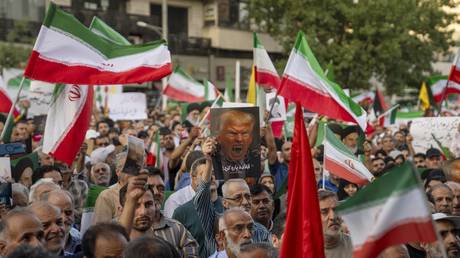
When an American president suggests he wants to change the government in Tehran, it doesn't just scare the Mullahs. It triggers a nationalist reflex among ordinary Iranians. Nobody likes being told by a foreign power how to run their house. Even the bravest protestors in the streets of Tehran, who risk their lives for "Woman, Life, Freedom," often distance themselves from Washington. They want a revolution of their own making, not one stamped "Made in the USA."
Sanctions Alone Don't Topple Dictators
The "Maximum Pressure" campaign is the cornerstone of the Trump strategy. The logic is that if you starve the economy, the people will get so desperate they’ll overthrow the government. It sounds logical on paper. In practice, it’s a failure.
Look at North Korea. Look at Cuba. Look at Venezuela.
Sanctions are great at making life miserable for the middle class. They’re great at destroying the very people—the educated, secular urbanites—who are most likely to want a liberal democracy. But sanctions rarely touch the elites. The people at the top have access to black markets and smuggled goods. They actually get more powerful because they control the dwindling resources.
The Iranian Rial has plummeted. Inflation is rampant. Yet, the government remains. Why? Because desperation leads to survivalism, not necessarily political activism. When you're spending ten hours a day trying to find affordable eggs, you don't have time to organize a revolution.
The Power Vacuum Trap
Suppose the miracle happens. The strikes are so effective and the protests so loud that the Supreme Leader flees. What happens on Day 2?
History is a brutal teacher here. In Iraq, the U.S. disbanded the army and the Ba'ath party. The result was a vacuum that was quickly filled by Al-Qaeda and eventually ISIS. In Libya, the fall of Gaddafi turned the country into a playground for warlords and human traffickers.
Iran is a multi-ethnic country with significant Kurdish, Azeri, Baluchi, and Arab minorities. Without a central authority, those regional tensions could explode. You’re not just looking at a regime change; you’re looking at a potential civil war in a country of 88 million people. That’s a refugee crisis that would make the Syrian conflict look like a rehearsal.
A Better Way Forward
The temptation to "fix" Iran with a hammer is strong. It’s a simple solution for a complex problem. But the smart move isn't to force a collapse that we aren't prepared to manage.
Instead of chasing the regime change dragon, the focus should be on long-term containment and supporting the Iranian people without trying to lead them. This means:
- Strengthening Regional Alliances: Supporting the Abraham Accords and building a unified front with Arab partners who have a stake in a stable Middle East.
- Information Freedom: Providing tools for Iranians to bypass internet shutdowns. Let them communicate with each other, not us.
- Targeted Pressure: Sanctioning the individuals responsible for human rights abuses, rather than the entire economy that feeds the poor.
If you’re watching the news and hearing talk of a quick, easy transition in Iran, stay skeptical. The Iranian government is fragile in many ways, but it’s also incredibly resilient. Changing a government is easy. Building a stable, peaceful successor is the hardest job in the world.
Start paying attention to the internal dynamics of the Iranian opposition rather than just the rhetoric from Washington. Watch how the IRGC reacts to internal dissent. That's where the real story of Iran’s future will be written, and it won't be written by an American president. It’ll be written by Iranians, on their own timeline, likely when we least expect it.