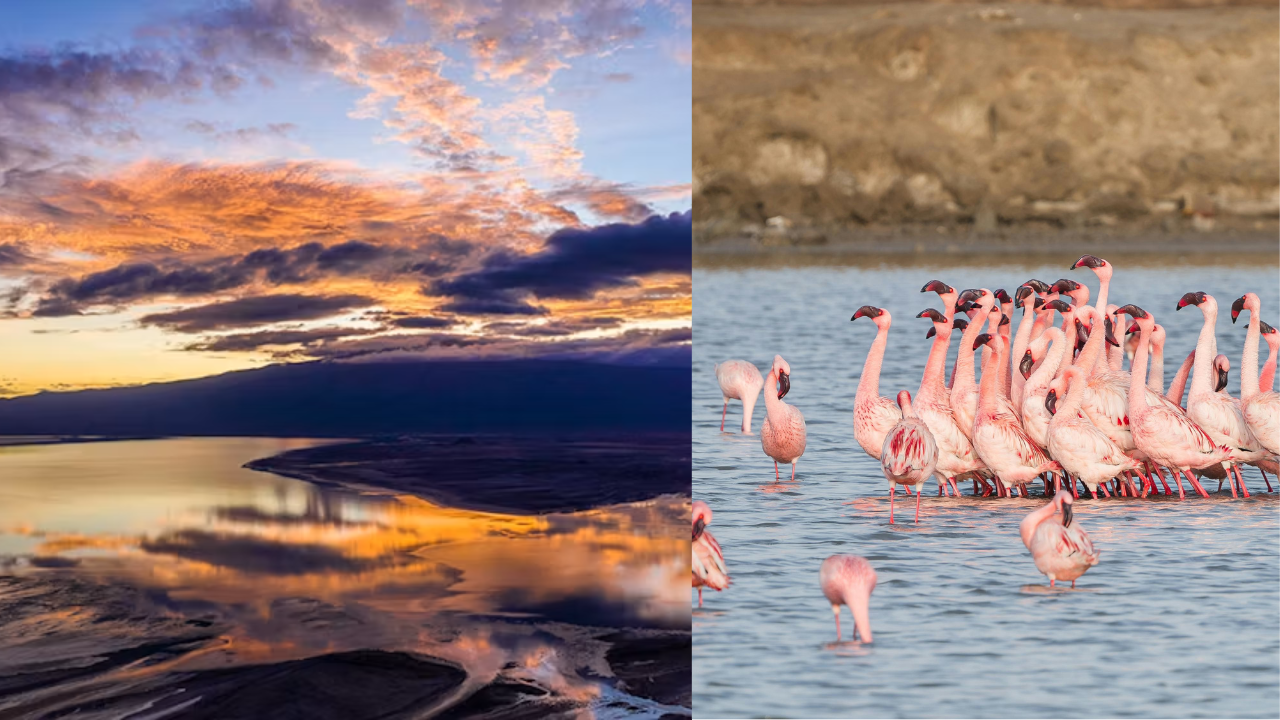
The air does not just blow across northern Tanzania. It scrapes.
Step out of an off-road vehicle near the Kenyan border, and the first thing that hits you is a wall of heat so thick it feels physical. The second is the smell. It is an aggressive, chemical stench of sulfur and decaying organic matter, a sharp reminder that you have walked into a corner of the earth where human biology is completely unwelcome.
Before you lies a body of water that looks less like a lake and more like a wound on the crust of the earth. It is a deep, bruised crimson, streaked with veins of white crust. This is Lake Natron.
For years, the internet has treated this place as a macabre museum. Photos circulate of calcified birds and bats, frozen in deathly poses as if turned to stone by a mythical gaze. But standing on the cracked earth of the shoreline, the reality is far more complicated, far more dangerous, and strangely, far more beautiful than a simple ghost story. This is a place where life does not merely survive; it executes a brilliant, high-stakes gamble against extinction.
The Chemistry of a Caustic Cauldron
To understand the hostility of this water, we have to look at what feeds it. The lake sits in the shadow of Ol Doinyo Lengai, an active volcano known to the local Maasai as the Mountain of God. Unlike any other volcano on Earth, Ol Doinyo Lengai erupts with natrocarbonatite lava, a cold, silvery-black mud that liquefies at a fraction of the temperature of normal basaltic lava.
When the rare torrential rains wash over this volcanic terrain, they collect vast amounts of sodium carbonate and other minerals, dragging them down into the basin. The lake has no outlet. It is a dead end. The only way out for the water is evaporation under a relentless equatorial sun that regularly pushes temperatures above forty degrees Celsius.
What remains behind is a concentrated soup of chemicals. The pH level of the water frequently hovers between 9 and 10.5. For context, that is nearly identical to the alkalinity of household ammonia or liquid bleach.
Imagine walking into a swimming pool filled with drain cleaner. If your skin touches it for too long, the water strips away your natural oils and begins to chemically burn the tissue. The water is so dense with dissolved solids that it feels viscous, almost oily to the touch. In the dry season, the water temperatures can surge up to sixty degrees Celsius. It is a boiling, caustic trap.
The Myth of the Instant Statue
Because the lake is so hostile, a popular misunderstanding has taken root across the globe. People believe that animals merely glance at the water, touch it, and instantly freeze into solid stone statues like victims of Pompeii.
The truth requires a closer look at the shore. Walk along the edge, and you will see the skeletal remains of birds, but they did not die mid-flight. What actually happens is a process of preservation, not instant petrification.
When an animal dies in the lake—often because it is confused by the glassy, mirrored reflection of the sky on the water's surface and crashes into it—the chemical composition of the water goes to work. The high concentration of sodium carbonate acts exactly like the natron used in ancient Egyptian mummification. It dries out the carcass, strips it of moisture, and preserves the soft tissues before they can rot.
The salt crust then coats the remains, creating a hardened, chalky shell. They are not turned to stone; they are pickled, dried, and cast in salt. It is a natural embalming process, a grim monument to a miscalculated landing.
A Sanctuary Built from Poison
But if this place is a graveyard for the unwary, it is an absolute empire for another creature.
Look out past the blinding white salt flats toward the center of the crimson water. The horizon begins to shimmer, not from the heat haze, but from a moving, pulsating blanket of pink. Millions of them.
Lesser flamingos own Lake Natron. In fact, this deadly basin is the single most important breeding ground for the species on the planet, accounting for three-quarters of the global population.
It seems like an evolutionary design flaw. Why would a creature choose to raise its young in a vat of boiling bleach?
Consider the alternative. In the lush, freshwater lakes of East Africa, predators are everywhere. Hyenas, baboons, jackals, and storks patrol the shorelines, ready to snatch eggs and chicks. A flamingo chick is defenseless, a soft morsel of protein in a brutal food chain.
But at Lake Natron, the flamingos have turned the environment into an impenetrable fortress. No mammalian predator can cross the caustic mud flats to reach the nests. The sharp salt crystals would shred a hyena's paws; the alkaline water would burn their skin to the bone. The flamingos have traded comfort for safety. They have weaponized the geography.
The Physical Price of Paradise
To live here, the flamingos have evolved a suite of specialized biological tools. Their legs are covered in tough, leathery skin that resists the corrosive effects of the water, acting like natural wading boots. They have specialized glands in their heads that filter out the massive amounts of salt they consume, excreting it through their nasal cavities.
Their very color is a product of this hostile environment. The red hue of the lake comes from haloarchaea, microscopic salt-loving organisms that thrive in the extreme alkalinity. The flamingos feed on these organisms and spirulina algae, filtering the water through their upside-down bills. The carotenoid pigments in their food dye their feathers into that iconic, brilliant pink. They consume the lake, and the lake defines their beauty.
But the margin for error is razor-thin.
Step closer to a abandoned nesting site during a drought year, and the precarity of their existence becomes obvious. The flamingos build raised mud mounds to keep their single eggs elevated above the burning, fluctuating waterline. If the water rises too fast, the nests are swallowed. If the water recedes too far, the caustic mud hardens into an inescapable concrete trap for chicks that fall from their perches.
The Shifting Winds
For centuries, this delicate balance remained undisturbed, protected by the sheer geographical isolation and the terrifying reputation of the water. But human interest is shifting toward the basin.
There are recurring proposals to build a large-scale industrial soda ash factory at the edge of the lake. The facility would pump out the sodium carbonate to export for glass manufacturing and chemical production. Proponents argue it would bring jobs, infrastructure, and economic development to a remote region.
Biologists and conservationists look at the same plans with profound dread. The infrastructure would require roads, heavy machinery, fresh water drawn from the surrounding streams, and hundreds of workers. The lesser flamingo is an incredibly sensitive bird. If their nesting grounds are disturbed, or if the water levels and chemical balance are altered by even a fraction of a percent, they may abandon the site entirely. Because they rely so heavily on this single location, a disruption here could cause the global population to collapse.
The local communities find themselves caught in the middle of this tension. The Maasai people have lived alongside the lake for generations, herding their cattle through the dust, respecting the boundaries of the toxic water. For them, the lake is part of a sacred geography tied to the nearby volcano. They understand better than anyone that some places are meant to be left alone.
The Quiet Giant
As the sun begins to dip below the horizon, the crimson water of the lake shifts into a deep, bruised purple. The wind dies down, and for a brief moment, the burning heat relents.
From the shore, you can hear the faint, collective murmur of hundreds of thousands of birds out on the mudflats. It is a strange, wild music, completely disconnected from the human world.
We often view nature through the lens of hospitality, preferring landscapes that welcome us, feed us, and keep us comfortable. Lake Natron rejects that narrative entirely. It is a stark reminder that the earth does not exist to accommodate our comfort. It is a place of beautiful terror, where the line between a sanctuary and a tomb is nothing more than a change in the wind.