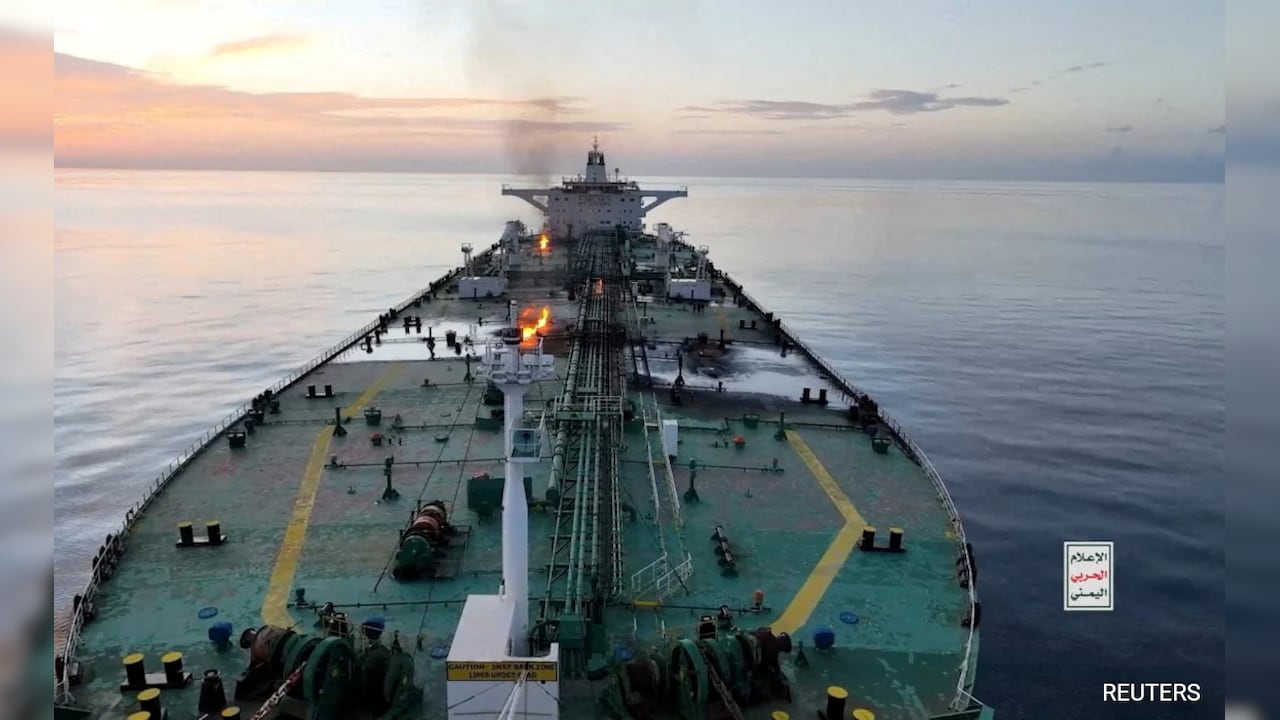
Iranian-backed Houthi attacks on Red Sea shipping matter far more for global oil markets today than in past crises because the global tanker fleet is structurally depleted and fractured by sanctions. What used to be a localized maritime hazard is now an existential threat to energy supply chains. Because Western sanctions on Russian, Iranian, and Venezuelan crude have split the world's tanker fleet into two distinct pools, the global shipping industry no longer has the spare capacity or flexibility to absorb the massive detours required to bypass the Suez Canal, driving freight costs and oil transit times to unsustainable highs.
The threat is no longer a temporary geopolitical risk premium. It is a structural tax on global energy.
The Broken Pipeline of Global Energy Transit
For decades, energy analysts viewed maritime choke points as temporary bottlenecks. If the Suez Canal or the Bab el-Mandeb strait closed, ships simply took the long way around Africa. It was expensive, but manageable.
That assumption is dead.
The global oil market is currently operating with virtually zero margin for error. Historically, when maritime disruptions occurred, the shipping industry possessed a deep pool of available tankers that could be chartered at short notice. Today, that buffer has vanished. The primary culprit is not the Houthi movement itself, but the unintended consequences of Western sanctions policy.
By forcing Russian crude to flow to Asia and bringing sanctioned Venezuelan and Iranian oil to specific markets under the radar, regulators have split the global fleet. On one side stands the compliant, Western-insured fleet. On the other is the shadow fleet, a sprawling network of older, unflagged, and poorly maintained tankers operating outside traditional maritime structures. These two fleets do not mix. A compliant tanker cannot easily pick up a cargo of Russian crude, and a shadow fleet tanker cannot be chartered by a major Western oil firm.
This bifurcation means that when shipping lines are forced to bypass the Red Sea, they cannot draw from a single, liquid pool of global tonnage. Instead, they must compete for a severely restricted number of compliant vessels. The market has lost its elasticity.
The Brutal Math of the Cape of Good Hope Detour
To understand why this disruption is so severe, one must look at the physical reality of maritime transit.
A standard voyage from the Persian Gulf to Rotterdam via the Suez Canal takes roughly 14 days. Re-routing that same voyage around the Cape of Good Hope extends the journey to nearly 30 days.
The math of this detour is unforgiving. If a voyage takes twice as long, you need twice as many ships to transport the same volume of oil over the course of a year.
$$T_{\text{detour}} \approx 2 \times T_{\text{Suez}}$$
This doubling of transit times has effectively vaporized a massive portion of the world's tanker capacity. It is the equivalent of taking dozens of supertankers offline overnight.
Furthermore, this longer journey increases fuel consumption. A Suezmax tanker bypassing the Red Sea consumes hundreds of tons of additional marine fuel, known as bunkers, on the long route around Africa. This extra fuel consumption does not just drive up carbon emissions; it directly inflates the marginal cost of every barrel of oil delivered to European refineries.
Ship owners are not absorbing these costs. They are passing them directly to the buyers. Freight rates for Suezmax and Very Large Crude Carriers (VLCCs) have experienced intense volatility, trading at multiples of their historical averages.
The Historic Underinvestment in New Tankers
The shipping industry could theoretically build its way out of this crisis, but it cannot do so quickly.
Shipyards are currently backed up for years. For the past half-decade, global shipbuilders have prioritized lucrative orders for container ships and liquefied natural gas (LNG) carriers. The order book for crude oil tankers fell to historic lows.
It takes at least two to three years to build a new VLCC. Even if oil companies and shipping magnates began ordering dozens of new vessels today, those ships would not hit the water until late in the decade. The industry is stuck with the fleet it has, and that fleet is aging rapidly. Older ships require more maintenance, travel at slower speeds, and consume more fuel, further compounding the inefficiency of the African detour.
The Asymmetric Cost of Maritime Defense
The naval coalition patrolling the Red Sea faces a fundamental economic math problem.
The Houthis are deploying cheap, mass-produced drones and anti-ship cruise missiles supplied by Iran. A single attack drone can cost as little as $20,000 to manufacture. To intercept these low-tech threats, Western warships are firing highly sophisticated air-defense missiles that cost between $1 million and $4 million per shot.
This is unsustainable.
[Houthi Drone: $20,000] VS [Naval Interceptor: $2,000,000]
Military dominance on paper has not translated into safety on the water. No commercial shipping executive is going to risk a $100 million vessel and a cargo of crude oil worth $80 million on the assumption that naval escorts will intercept every single incoming threat. The risk of a single missile getting through is too high.
Consequently, insurance underwriters have hiked war-risk premiums for vessels transiting the Red Sea to exorbitant levels. For many operators, the cost of the insurance premium alone makes the Suez route more expensive than the long journey around Africa, rendering the military escort system economically obsolete for all but the most desperate shippers.
The Inevitable Squeeze on Global Refiners
The consequences of this prolonged disruption are slowly filtering down to the refining sector.
Refineries are highly complex chemical plants designed to process specific grades of crude oil. European refiners, built to process sour Middle Eastern crudes delivered quickly via the Suez Canal, are now facing delayed shipments. When a shipment is delayed by two weeks, a refinery must either draw down its inventories or reduce its processing runs.
Running a refinery below capacity is incredibly inefficient and destroys operating margins. To keep their units running, European buyers are scrambling to source alternative crudes from the US Gulf Coast or West Africa. This sudden shift in demand has driven up the premium for sweet, low-sulfur crudes, distorting price spreads globally.
In Asia, a parallel drama is playing out. Middle Eastern producers who historically sent their oil westward are now keeping more of their barrels in the Pacific basin, creating a localized glut while starving the Atlantic basin. This geographic dislocation of supply is fracturing the global pricing benchmark structure, making hedging and risk management a nightmare for commodity traders.
The shadow fleet, meanwhile, continues to run the gauntlet. Vessels carrying Russian crude to India and China frequently transited the Red Sea with apparent impunity during the early phases of the conflict. However, as targeting has become more erratic, even these vessels are facing rising risks. A major environmental disaster caused by an attack on an uninsured, poorly maintained shadow tanker in the Bab el-Mandeb remains a terrifyingly high probability.
The crisis in the Red Sea is not a temporary logistical headache that will vanish with a ceasefire. It has exposed a deeply vulnerable, split-fleet global shipping architecture that has no spare capacity to handle prolonged geopolitical disruptions. The era of cheap, reliable maritime energy transit is over, and the price of oil will increasingly reflect this new, fragmented reality.