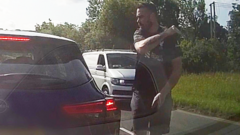
The air inside a modern sedan is a curated lie. It is filtered, climate-controlled, and acoustically insulated to convince you that you are safe in a private bubble. You sit in a leather-trimmed throne, listening to a podcast or a playlist, traveling at speeds that would have terrified your ancestors. But the bubble is fragile. When someone cuts you off, or brakes too hard, or fails to signal, that thin glass and steel feel like they’ve been violated.
That is when the "Red Mist" descends.
Physiologically, it is a primitive survival mechanism. Your amygdala—the almond-shaped mass of grey matter responsible for emotional responses—decides that a lane change is actually a mortal threat. It hijacks your rational brain. Adrenaline floods your system. Your heart rate spikes. Your vision narrows until the entire world consists of nothing but the bumper of the car in front of you.
This is the story of a man who let the mist take the wheel, and the small, unblinking lens that ensured he would never be able to outrun the consequences.
The Illusion of Anonymity
We behave differently when we believe we aren't being watched. On a nondescript stretch of asphalt, a driver—let's call him the Antagonist—felt the familiar surge of righteous indignation. To him, the motorist in front wasn't a father, a son, or a person with a destination. He was an obstacle. An insult.
The Antagonist didn't just want to pass. He wanted to punish.
He accelerated, his engine roaring in a mechanical mimicry of his own rising blood pressure. He tailgated, a two-ton metal threat hovering inches from a stranger’s life. Most of us have felt this flash of heat. We grip the steering wheel a little tighter. We mutter a curse under our breath. Then, usually, we breathe. We remember that we have a mortgage, a family, and a future.
The Antagonist forgot.
He forced the other car to the side of the road. In his mind, he was the hero of a high-stakes drama, finally confronting the villain who had dared to inconvenience him. He stepped out of his vehicle, his boots hitting the pavement with a finality that signaled the end of civil discourse. He approached the other driver’s window.
The violence was swift. A single, devastating blow.
The victim went limp. The world went silent. In that moment, the Antagonist likely felt a surge of triumph, the dark satisfaction of a "lesson learned." He returned to his car, smoothed his shirt, and drove away. He thought he had left the incident behind in the rearview mirror. He thought the road had swallowed the evidence.
The Irony of the Dashboard
Here is the twist that makes this more than just another police report: the Antagonist was a tech-savvy man. He took pride in his vehicle. He had installed a high-definition dashcam to protect himself from "crazy drivers" and insurance scammers. He wanted a digital bodyguard.
He forgot that a camera has no loyalty. It does not care who paid for it. It does not understand "he started it." It simply records light hitting a sensor at thirty frames per second.
When the police eventually sat down to review the footage, they didn't see a man defending his honor. They saw a high-definition horror movie. They saw the calculated way he maneuvered his car to trap his victim. They saw the aggression in his stride. Most damningly, they saw the impact—the jarring, sickening moment where a human being was reduced to a physical object.
The very tool he bought for his protection became the primary witness for his prosecution.
The Psychology of the Glass Shield
Why do we do this? Why does a middle-manager from the suburbs transform into a gladiator because of a missed turn signal?
Psychologists call it "deindividuation." When we are in our cars, we lose our sense of individual identity and, more importantly, we stop seeing others as individuals. The car is a suit of armor. We feel invincible and invisible. It is the same phenomenon that fuels internet comment sections—the belief that there are no real-world consequences for our digital or vehicular tantrums.
But the world is no longer unobserved.
Statistically, if you are driving in a major city, you are being recorded by at least three different lenses at any given moment. Traffic cameras. Storefront security. Ring doorbells. And, increasingly, the dashcams of the very people you are screaming at.
The Antagonist’s mistake wasn't just a lapse in temper; it was a failure to realize that the era of the "unwitnessed act" is dead. We live in a world of total recall. Every outburst, every moment of weakness, every fleeting act of cruelty is being etched into a silicon chip.
The Weight of a Single Choice
Consider the aftermath. The victim didn't just wake up with a sore jaw. A knockout blow isn't like the movies; it is a traumatic brain injury. It involves the brain sloshing against the inside of the skull, shearing axons and bruising tissue. There are headaches that last for months. There is the psychological trauma of being attacked in a space—your car—that you previously considered a sanctuary.
And for the Antagonist? The "victory" lasted maybe ten seconds. The fallout will last a lifetime.
Criminal records do not care about "road rage" as a nuance. They see "Assault." They see "Battery." They see a man who is a liability to society. Employment opportunities vanish. Relationships crumble under the weight of legal fees and the shame of a viral video.
That high-definition footage was played in a courtroom, stripped of the music and the adrenaline that had fueled the moment. In the cold, fluorescent light of justice, the Antagonist didn't look like a tough guy. He looked like a catastrophe.
The Mirror in the Cabin
We all like to think we are the victim in this story. We are the ones being tailgated. We are the ones being cut off. But the true power of this narrative lies in the uncomfortable reflection it provides.
The next time you feel that heat rising in your chest—the moment your hand hovers over the horn, itching to blast a rhythmic insult at the person in front of you—look at your own dashboard. Not at the speedometer, but at the potential for your own life to be dismantled by a single, unchecked impulse.
We are all one bad afternoon away from being the "Antagonist" if we don't respect the Red Mist. We are all being recorded. We are all living our lives in front of a jury we haven't met yet.
The road is a shared space, a fragile social contract held together by the collective decision not to let our worst instincts take the wheel. When that contract breaks, the damage isn't just to the cars. It’s to the people inside them.
The camera is always rolling. The question is: what kind of story are you writing for yourself?
The Antagonist sat in his cell, likely thinking about those few seconds on the shoulder of the highway. He had the footage. He could watch it over and over again. He could see the exact moment he threw away his career, his reputation, and his freedom. He could see himself from the outside—a man blinded by a mist that had long since cleared, leaving nothing behind but the cold, hard truth of the recording.
The light on the dashcam stayed green. It stayed steady. It watched him go, and it watched him fall.