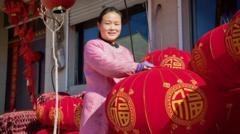
The feel-good narrative of Tuntou village is a lie.
You’ve seen the fluff pieces. They paint a picture of a quaint "Lantern Town" in Hebei province where multi-generational families sit on stools, hand-pasting silk onto bamboo frames. It’s marketed as a victory for Chinese folk art and a heartwarming tale of rural revitalization. In reality, it is a masterclass in commodity trap economics and the slow erosion of intellectual property.
If you believe Tuntou is thriving because of "tradition," you’re missing the brutal mechanics of the global supply chain. This isn't a success story about culture. It is a survival story about race-to-the-bottom margins, where the only thing being "preserved" is a low-wage ceiling.
The Commodity Trap of 90 Percent Market Share
Mainstream business reporters love a big number. They trumpet the fact that Tuntou produces roughly 80% to 90% of China’s lanterns as if market dominance equals economic health. It doesn't.
When a single geography controls nearly an entire niche industry through sheer volume, they haven't built a moat; they’ve built a prison. I’ve watched manufacturing hubs in Dongguan and Shenzhen fall into this exact trap. When you own the market, you can no longer compete on quality because there is no one left to steal market share from. You can only compete on price.
In Tuntou, the "innovation" isn't in the design. It's in the stripping.
- Materials: Reducing the gauge of the steel wire.
- Fabric: Switching from heavy silk to PET synthetics.
- Labor: Moving toward semi-automated assembly lines that devalue the "hand-crafted" label every journalist loves to use.
If everyone in the village makes the same product, the only way to win a contract is to be five cents cheaper than your neighbor. This is industrial suicide, not an artisan's renaissance.
Why Your Lantern is a Fossil
The biggest misconception about the "lantern town" is that it’s a culture-preserving powerhouse.
It’s actually a relic of a dying 20th-century model. People ask, "How can Tuntou stay relevant?" but they’re asking the wrong question. The real question is: Why are we still pretending a product that hasn’t evolved in 2,000 years is a viable engine for a modern economy?
The classic red lantern is a low-utility, high-bulk item. It’s a logistical nightmare to ship internationally unless it’s collapsed, and even then, the freight costs often outweigh the manufacturing value. The "craft" is being squeezed by the digital economy.
Let’s look at the "innovation" people cite: adding LED lights.
If adding a $0.10 diode to a wire frame is your idea of a "technological pivot," your business is already dead. You're not a tech hub. You're a packaging facility for lightbulbs. Contrast this with the way lighting hubs in Zhongshan have pivoted into smart-home integration and proprietary sensor tech. Tuntou isn't pivoting; it's clinging to a 15-day-a-year holiday cycle (the Lunar New Year) and hoping for the best.
The Counter-Intuitive Truth About Rural Revitalization
The Tuntou model is the "slow-death" version of rural development.
Policy experts point to these "one-village, one-product" models as a blueprint for lifting rural China out of poverty. They forget the cost of specialization. When a 20-year-old in Tuntou learns the family trade, they aren't learning a portable skill. They are learning how to glue fabric onto a specific frame.
They are becoming experts in a hyper-localized monopoly.
Imagine a scenario where the global preference for "Chinese-style" decor shifts—even by 10%. The entire town doesn't just lose revenue; they lose their entire identity because they’ve put every egg in one silk-covered basket. This isn't "fostering" a local economy. It’s creating an industrial monoculture that is as fragile as a cornfield in a drought.
I have consulted for firms that tried to scale this kind of "artisanal-at-volume" model. It fails every time because you cannot scale soul. You only scale the illusion of it.
The Real Powerhouse Isn't Tuntou
If you want to find where the actual money is made, don't look at the villagers in Hebei. Look at the e-commerce aggregators in Hangzhou and the logistics giants in Ningbo.
The "Lantern Town" gets the PR. The platforms get the profit.
The people making the lanterns are at the mercy of the algorithms. A Tuntou factory owner might be the "king of lanterns," but he is a peasant to the TikTok shop data points. He doesn't own his customers. He doesn't own his brand. He owns a warehouse full of red fabric and a shrinking margin.
Stop Asking "How" and Start Asking "Why"
People also ask: "How do they make so many lanterns so fast?"
That is the wrong question. The answer is obvious: low labor costs and a complete lack of environmental regulation regarding dye runoff.
The real question you should be asking is: "Why are we celebrating a town for being a mono-industrial factory for a product that has no intellectual property protection?"
If you want to actually "save" a craft, you don't turn it into a commodity. You make it a luxury.
- Ditch the Volume: Cut production by 90%.
- Raise the Floor: Use materials that aren't flammable or flimsy.
- Build a Brand: Stop being "the town that makes lanterns" and start being the "firm that defines light."
But Tuntou won't do that. They'll keep pumping out millions of identical red spheres until the cost of electricity is higher than the price of the product. They’ve mistaken market share for power.
Don't buy the "traditional town" myth. It's just a factory floor with better scenery and worse insurance.
Get out of the commodity business before the commodity swallows you whole.