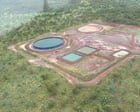
The dirt in the Beetaloo Basin does not look like money. It looks like rust. It cakes to the tires of white Toyota Hiluxes, blows into the teeth of cattle station managers, and settles in fine, persistent layers over the leaves of stunted lancewood trees. Beneath that scorching Northern Territory soil, kilometers down in the dark, lies enough trapped shale gas to alter the economic trajectory of a nation. Or, depending on who you ask, to trigger a localized climate disaster.
Right now, the heavy machinery is quiet. The drills are idle, their massive steel teeth catching the fierce Australian sun. But the silence is deceptive.
Within weeks, the energy giant Santos wants to roar into life, piercing the earth to test new gas wells. Everything is ready. The capital is allocated. The engineering blueprints are signed off. Only one thing stands between the drill bits and the deep shale: a signature in a comfortable, air-conditioned office 3,000 kilometers south in Canberra.
The man holding the pen is federal Environment Minister Murray Watt.
To understand the pressure bearing down on this single politician, you have to look beyond the corporate boardrooms and the dense, multi-page environmental impact statements. You have to look at the people who live on the land, the investors watching the tickers, and the stark reality of an energy market screaming for supply while the planet begs for a breather.
The Weight of the Pen
Politicians love to talk about balance. They balance budgets, they balance competing interests, they balance the future against the present. But out here, balance is a myth. Every decision is a direct trade-off, and the fractures are widening.
On one side of the ledger stands Kevin, a hypothetical but deeply accurate representation of the local contractors who keep the towns of Elliott and Katherine breathing. Let us say Kevin runs a small diesel mechanical workshop. For him, the Beetaloo isn't an abstract environmental debate on a cable news panel. It is grocery money. It is the ability to employ two local apprentices who would otherwise head to Brisbane or Perth. When gas companies are active, Kevin’s phones ring. When the regulatory gears grind to a halt, the silence in his shop is deafening.
For the regional economy, the Beetaloo is a lifeline thrown to a drowning man. Proponents argue that developing the basin could pump billions into the Northern Territory, creating thousands of jobs and securing domestic gas supplies for a manufacturing sector currently starved of cheap energy.
But step twenty meters outside Kevin’s workshop and talk to the traditional owners who have walked this red dirt for millennia.
To them, the water beneath the ground is a single, sacred, interconnected system. If you fracture the shale, if you risk chemical contamination of the aquifers, you do not just ruin an industry. You kill the country. You destroy the songlines. They look at the massive water tanks and the chemical storage facilities and see an existential threat disguised as progress. They are not thinking about next quarter’s dividends; they are thinking about their grandchildren’s grandchildren.
This is the crucible Murray Watt finds himself in. The gas industry is shouting for him to do his job and approve the drilling. Environmental coalitions and Indigenous groups are shouting for him to do his job by blocking it.
Everyone agrees on the phrasing. No one agrees on what the job actually is.
The Chemistry of Conflict
To truly comprehend why the Beetaloo causes such fierce paralysis, we have to look at how we get gas out of shale. It is not like tapping an underground lake. It is more like squeezing water from a stone.
Imagine a massive, miles-thick book made of solid rock, buried deep underground. The gas is trapped in microscopic pockets between the pages. To get it out, you cannot just drill a hole. You have to drop a pipe down, turn it sideways, and pump millions of liters of water, sand, and specific chemicals at immense pressure to crack those rock pages open. This is hydraulic fracturing. Fracking.
The gas companies point to strict regulations, triple-lined steel casings, and decades of engineering evolution. They argue the process is safe, isolated kilometers below any usable drinking water.
Yet, humans build these wells. Humans make mistakes. The fear is not necessarily the deep fracture itself, but the surface spills, the wastewater management, and the long-term integrity of the concrete seals. If a single well casing fails over a fifty-year timeline, the pristine groundwater of the subterranean systems could face irreversible damage.
Is that a risk worth taking for twenty years of gas?
The corporate world says yes. They argue that natural gas is the vital transition fuel we need to back up wind and solar when the sun sets and the breeze drops. Without it, the lights go out. Factories close. The economy stalls.
The counter-argument is simpler, and harder to ignore: you cannot put out a fire by adding more fuel. Every mega-litre of gas pulled from the Beetaloo and burned, whether in a Sydney power station or an industrial plant in Asia, adds to the atmospheric blanket trapping heat over an already burning continent.
A System Stuck in Neutral
The current fury directed at Minister Watt stems from a specific regulatory mechanism. The gas industry claims that all environmental hurdles have been cleared, all boxes ticked, and all consultations completed. They view the current delay as bureaucratic cowardice—a minister sitting on his hands to avoid making a controversial call before the next political cycle.
But the law is rarely simple. The Environment Protection and Biodiversity Conservation Act requires exhaustive assessment of water impacts, particularly in arid zones where water is life itself.
The industry is losing patience. Santos and its peers have poured millions into exploration, testing, and community engagement. Shareholders are demanding returns. Capital is fluid; if Australia becomes a place where approvals sit on a minister's desk indefinitely, that money will fly away to the US, to Africa, to places where the dirt is turned with fewer questions.
Consider the ripple effect of this delay. When a major project stalls, it isn't just the executives in Sydney who feel it. The camp cooks, the environmental monitors, the truck drivers, and the safety inspectors all enter a state of suspended animation. They cannot plan. They cannot invest. They wait for a press release.
The Illusion of a Clean Choice
We like to pretend that modern life comes with clean choices. We want our homes warm, our beer cold, our smartphones charged, and our consciences clear. We want a green future, but we want it delivered via a supply chain that requires immense amounts of traditional energy to build.
Every wind turbine requires steel and concrete, two of the most carbon-intensive materials on earth, both currently reliant on fossil energies to produce. Every electric vehicle battery requires minerals mined with heavy diesel machinery and processed in facilities that need stable, baseline power.
This is the uncomfortable truth that both sides of the Beetaloo debate often gloss over. We are trapped in the momentum of our own civilization.
If Minister Watt signs the approval, the drills will turn. The red dust will fly. Money will flow into the Territory, and gas will flow into the pipelines. The immediate economic anxiety will ease, but a long-term environmental debt will be logged on the ledger.
If he refuses to sign, the Beetaloo remains wild and untouched. The aquifers remain safe from this specific threat. But the energy crunch will tighten. Prices will likely rise. Companies will look elsewhere, and the communities relying on those resource dollars will watch their young people leave for the cities.
There is no magic trapdoor. No elegant compromise that leaves everyone smiling.
The Approaching Storm
As the days tick by, the pressure on the federal government will only intensify. The Northern Territory government, desperate for revenue to fund its own struggling public services, is quietly urging Canberra to greenlight the project. Environmental advocates are organizing blockades, preparing to turn the remote access roads into a battleground of civil disobedience.
Meanwhile, Santos waits. Their rigs are prepped. Their crews are on standby.
The sun is setting over the Beetaloo now, casting long, bruised-purple shadows across the lancewood scrub. It is a landscape that has survived ice ages, droughts, and the rise and fall of civilizations. It feels permanent, untouchable, eternal.
But tomorrow, a man in a tailored suit will walk into an office in Canberra, pick up a black pen, and decide exactly how much of that eternity we are willing to sell.