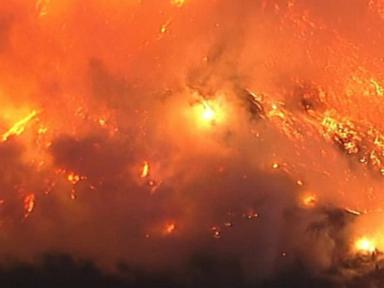
Most people watching the Palisades Fire retrial expected a battle of wildfire science. They got a digital autopsy instead.
On November 20, 2026, a federal jury in Los Angeles found 30-year-old Jonathan Rinderknecht guilty on two felony counts for igniting the fire that devastated Pacific Palisades in January 2025. The verdict landed on the third day of deliberations, closing a tense second act after his initial trial ended in a deadlocked mistrial. That catastrophic blaze killed 12 people and incinerated nearly 7,000 homes and businesses, making it the most destructive wildfire in Los Angeles history. You might also find this connected story insightful: The Operational Architecture of the Batavia ICE Detention Expansion.
If you only followed early headlines about him facing a retrial, you missed the dramatic shift in courtroom strategy. Prosecutors didn't just try the exact same case twice. They stripped away their weakest arguments, dropped a whole charge, and let Rinderknecht's own digital trail and courtroom testimony do the heavy lifting.
Why the First Palisades Fire Trial Failed
Wildfire arson cases are notoriously brutal to prove beyond a reasonable doubt. Unlike a house fire where a suspect pours gasoline on a living room rug, wildland blazes destroy their own physical evidence. As extensively documented in detailed coverage by BBC News, the results are notable.
During the first federal trial earlier in 2026, prosecutors tried to paint a broad psychological portrait. They argued Rinderknecht acted out of "societal revenge," leaning heavily on his alleged resentment toward wealthy coastal residents. They also charged him with three separate counts, including "timber set afire."
That approach backfired. Jurors got bogged down in character arguments and struggled with the scientific chain linking two separate blazes—the smaller Lachman Fire ignited on New Year's Eve and the massive Palisades Fire that erupted days later. The jury deadlocked. First Assistant U.S. Attorney Bill Essayli later noted that the original panel appeared to consider outside factors not presented as evidence.
Instead of giving up, the Department of Justice went back to the drawing board.
How Prosecutors Rebuilt the Case for the Retrial
When Rinderknecht walked back into the Felicitas and Gonzalo Mendez United States Courthouse in downtown Los Angeles, he faced a much sharper indictment. Federal prosecutors dropped the "timber set afire" count entirely. They narrowed the case to two hard-hitting charges: destruction of property by means of fire and arson affecting property used in interstate commerce.
They also ditched the "eat the rich" motive theory. Assistant U.S. Attorney Mark Williams and his team focused strictly on Rinderknecht's immediate state of mind and physical movements on the night of December 31, 2024.
- The timeline: Rinderknecht, a former Pacific Palisades resident working as an Uber driver, dropped off a passenger in the neighborhood on New Year's Eve.
- The mood: Testimony from his Uber riders and text messages sent to his girlfriend showed he wasn't executing a grand political manifesto. As Williams told the court, he was simply "mad at everything, and frustrated."
- The location: Photos placed his vehicle parked right at the base of a trail leading up to the ignition zone, while cellphone tower records tracked his movement up the hillside.
- The elimination: Fire detection cameras captured the exact ignition window, and investigators systematically ruled out New Year's Eve fireworks or electrical faults.
Even with this tighter narrative, the retrial hit major turbulence. On November 13, proceedings ground to a halt when prosecutors accused the defense of "bad faith discovery violations" over an expert witness. That defense expert claimed government investigators had misidentified the fire's true origin area.
The Digital Trail and Holdover Fire Science
Two massive pillars carried the government across the finish line. First was the forensic explanation of a "holdover fire"—a phenomenon that confuses almost everyone outside wildfire management.
People hear that a fire started on December 31 and assume it couldn't possibly cause an inferno on January 7. Fire scientists know better. Under specific conditions, embers can smolder undetected underground inside thick root systems or duff layers for days or even weeks. When Santa Ana winds roar through dry terrain, those hidden embers resurface and explode into a crown fire. Prosecutors walked the jury step by step through how the initial Lachman Fire smoldered and reignited into the Palisades Fire.
Second was Rinderknecht's own smartphone.
You honestly couldn't write a more damning digital sequence. After the flames started on the hill, Rinderknecht dialed 911 more than a dozen times as he walked back down. He even screen-recorded his phone while placing those emergency calls. While actively reporting the blaze, he typed a prompt into ChatGPT: "Are you at fault if a fire is lit because of your cigarettes?"
Prosecutors argued this wasn't panic. It was a clumsy, real-time attempt to manufacture an accidental alibi while covering his tracks.
The Turning Point Inside the Jury Room
Despite the ChatGPT query and cell tower pings, conviction wasn't automatic. When deliberations started, 10 jurors voted guilty, one was undecided, and Juror No. 3—a man identified only as Cameron—voted not guilty.
Cameron later spoke to reporters outside the courthouse, offering a rare look at what actually sways a modern federal jury. He initially hesitated because he felt there was a lack of clarity around the defense expert's technical review of the origin zone.
What changed his mind? Not the experts. Not the prosecutors. It was Rinderknecht taking the witness stand in his own defense.
Rinderknecht testified that he had been up on that hill on a clear, calm night, yet claimed he didn't smell smoke, didn't see any fireworks, and saw nobody else around. To Cameron, those statements collapsed under basic common sense. If nobody else was on the hill, and there were no fireworks, the math became impossible for the defense to escape. "Logically, things start pointing towards him," Cameron explained.
Defense attorneys rarely put criminal defendants on the stand for this exact reason. Once a defendant testifies, the jury stops grading the government's perfection and starts grading the defendant's credibility.
What Happens Next in the Palisades Fire Cases
Rinderknecht remains in federal custody, where he has been held since FBI agents arrested him in Florida in October 2025. United States District Judge Anne Hwang has scheduled his sentencing hearing for March 17, 2027, in Los Angeles. He faces a statutory maximum of up to 20 years in federal prison on each of the two counts.
His family maintains his innocence. Outside court, his father, Joel Rinderknecht, accused federal prosecutors of ignoring ethics just to pin the tragedy on a scapegoat. Los Angeles City Councilwoman Traci Park, who represents Pacific Palisades, offered a more sobering perspective—noting that while the guilty verdict delivers a degree of accountability, no courtroom outcome can ever undo the community's loss.
If you're tracking the broader fallout from the 2025 disaster, keep your eyes on two separate legal tracks over the coming months:
- Federal sentencing and restitution: Watch the March 17, 2027 hearing filings on the U.S. Attorney's Office Central District of California portal. Beyond prison time, federal judges routinely order massive criminal restitution in arson convictions, though collecting millions from an individual defendant is largely symbolic.
- Civil negligence lawsuits: A criminal arson conviction doesn't erase institutional accountability. Dozens of civil lawsuits filed by displaced homeowners against the City of Los Angeles, state agencies, fire departments, and utility companies are still grinding through state courts. Those plaintiffs are arguing that delayed emergency responses, water infrastructure failures, and brush management lapses turned a localized ignition into an unstoppable urban firestorm—and those battles will dictate who actually pays to rebuild Pacific Palisades.
For ongoing updates on the federal criminal trial, watch LiveNOW from FOX's coverage of the Palisades Fire verdict, which breaks down the charges Rinderknecht faced during his retrial.


