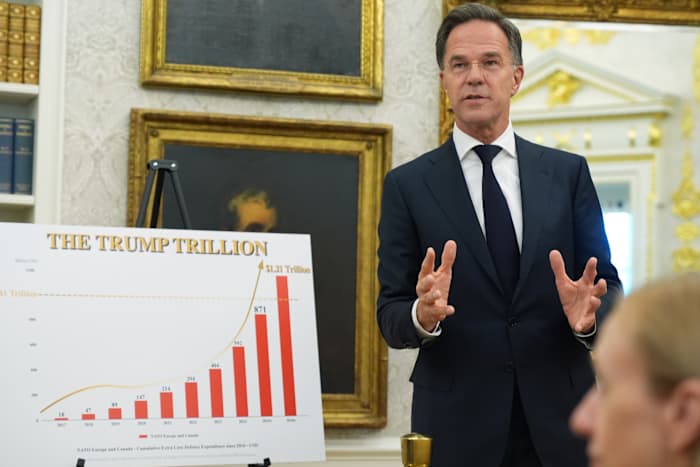
The transatlantic alliance is facing an existential shift that goes far beyond the long-running dispute over military spending. For years, the public debate around NATO has centered on a single metric: the requirement that member states spend at least 2% of their gross domestic product on defense. But the actual friction inside the alliance has shifted from ledger sheets to political alignment. Washington is signaling that financial contributions are no longer enough to guarantee the American security umbrella. The new price of admission is explicit political fealty, a shift that threatens to fracture the alliance from within.
The Mirage of the Two Percent Target
For decades, American presidents have complained about European free-riding. The 2% threshold, established at the Wales Summit in 2014, became the standard shorthand for burden-sharing. Most European capitals spent years dragging their feet, treating the target as an aspirational goal for the distant future rather than an immediate mandate.
That changed. The escalation of conflict in Eastern Europe forced a rapid reassessment of security priorities across the continent. Nations like Germany enacted massive defense funds, while frontline states in the Baltics and Poland pushed their spending well beyond the target.
Yet, the expected harmony between Washington and Europe failed to materialize.
The reality is that defense spending was always a convenient proxy for a deeper grievance. Washington is discovering that a well-armed Europe is not necessarily a compliant Europe. As European nations build up their domestic military-industrial capacities, they also gain the leverage to chart a more independent foreign policy. This independence is exactly what the current political current in the United States wants to curb. The demand has shifted from burden-sharing to ideological alignment.
The Price of Protection
The shift from financial metrics to political loyalty fundamentally alters the nature of the North Atlantic Treaty. Under Article 5, the core of the alliance is an unconditional commitment to collective defense. An attack on one is an attack on all.
By introducing political conditions to this guarantee, Washington is turning a treaty into a transaction. It resembles a protection racket more than a mutual defense pact.
Traditional NATO Model:
[Common Values & Security] ---> [Unconditional Article 5 Guarantee]

Transactional NATO Model:
[Financial Compliance + Political Loyalty] ---> [Conditional US Protection]
This transactional approach introduces massive volatility into European defense planning. European leaders now have to calculate whether their domestic political decisions will alienate a shifting administration in Washington. If a European government pursues trade policies with Beijing that displease the White House, or if it takes a different stance on Middle Eastern diplomacy, the American security guarantee could suddenly be called into question.
This is not a theoretical problem. It is a structural flaw that changes how deterrence works. Deterrence relies entirely on credibility. If America's adversaries believe that Washington's intervention depends on the personal relationship between leaders or the specific political alignment of the day, the deterrent effect evaporates.
The Subtext of the Procurement War
Beyond the rhetoric of loyalty lies a massive economic engine that rarely gets public scrutiny. When European nations increase their defense budgets, the immediate question is where that money gets spent.
Washington has long enjoyed a near-monopoly on high-end defense procurement in Europe. From fighter jets to missile defense systems, European taxpayers have routinely subsidized the American defense industry.
The European Autonomy Threat
France has long championed the concept of "strategic autonomy," arguing that Europe must possess the industrial capacity to defend itself without relying on the United States. For a long time, this was dismissed by other European capitals as a French boutique interest.
It is no longer a boutique interest. The realization that American political winds can shift overnight has energized defense procurement strategies across the continent.
- The German Pivot: Even Germany, traditionally the most pro-American purchaser of military hardware, is investing heavily in joint European projects.
- Air Combat Initiatives: Programs like the Future Combat Air System (FCAS) aim to build next-generation fighter capabilities entirely within Europe.
- Ammunition Independence: Continental production lines for standard artillery and armor are being expanded to reduce supply chain dependence on the Pentagon.
This shift infuriates Washington policymakers across the political spectrum. The American defense lobby exerts immense pressure on the US government to ensure that European defense spending flows back into American factories. When US leaders demand loyalty, they are often demanding that European capitals buy American hardware instead of developing their own. A self-sufficient Europe is a Europe that no longer needs to buy what Washington is selling, both literally and figuratively.
The Friction Over China
The divergence in priorities becomes starkest when looking toward Asia. Washington is locked in a long-term geopolitical confrontation with Beijing and views every global alliance through that specific prism. The United States wants NATO to expand its purview, turning its attention to the Indo-Pacific region and actively countering Chinese influence.
Europe sees things differently. While European capitals have grown increasingly wary of Chinese economic espionage and supply chain vulnerabilities, they do not view China as an existential military threat in the same way they view Russia.
| Geopolitical Actor | US Strategic Lens | European Strategic Lens |
|---|---|---|
| Russia | A regional menace that distracts from the primary theater in Asia. | An immediate, existential threat to continental borders and stability. |
| China | The primary global competitor requiring total economic and military containment. | A complex systemic rival, but also a vital trading partner that cannot be decoupled from. |
This divergence creates a friction point that no amount of defense spending can fix. A European nation could spend 4% of its GDP on defense, but if it refuses to join American freedom-of-navigation exercises in the South China Sea, or if it allows Chinese investment in its critical infrastructure, it fails the new American test of loyalty. The alliance is being pulled in two different geographic directions, and the center may not hold.
The Operational Reality of a Fractured Alliance
What does a conditional alliance look like on the ground? It looks like paralysis.
NATO operates on the principle of consensus. Every major decision, from deployment schedules to the appointment of the Secretary General, requires the unanimous consent of all member states. If Washington begins using its security guarantee as a cudgel to enforce political loyalty, the consensus mechanism breaks down entirely.
We are already seeing the early stages of this paralysis. Individual member states have begun playing their own transactional games, holding up the accession of new members or delaying joint statements to extract bilateral concessions from Washington or their European neighbors.
This political infighting has direct consequences for military readiness. NATO's strength has always been its seamless integration of command structures and doctrine. If individual nations begin to doubt whether their allies will actually show up in a crisis, they will stop sharing intelligence, stop integrating their command structures, and start hoarding resources for their own national defense. The alliance will hollow out from the inside, leaving behind an empty bureaucratic shell.
The Strategy for European Survival
European leaders are beginning to realize that the old status quo is gone forever, regardless of who occupies the White House in any given four-year cycle. The underlying political dynamics of the United States have shifted toward a more insular, transactional foreign policy.
To survive this new era, Europe has to move past the debate over the 2% target and focus on building a genuine, independent security architecture.
This does not mean abandoning NATO. It means building a European pillar within the alliance that is capable of operating autonomously if Washington decides to sit out a crisis. It requires the consolidation of European defense industries, the elimination of redundant national procurement programs, and the creation of a unified command structure that can function independently of American assets.
This will be incredibly difficult, expensive, and politically painful. It requires nations to surrender a degree of national sovereignty over their militaries that many are reluctant to yield. But the alternative is far worse: a continent dependent for its survival on the shifting political whims of a foreign superpower that views security as a commodity to be traded for political compliance. The era of unconditional American protection is over, and Europe must either learn to stand on its own feet or prepare to accept the terms of its vassalage.