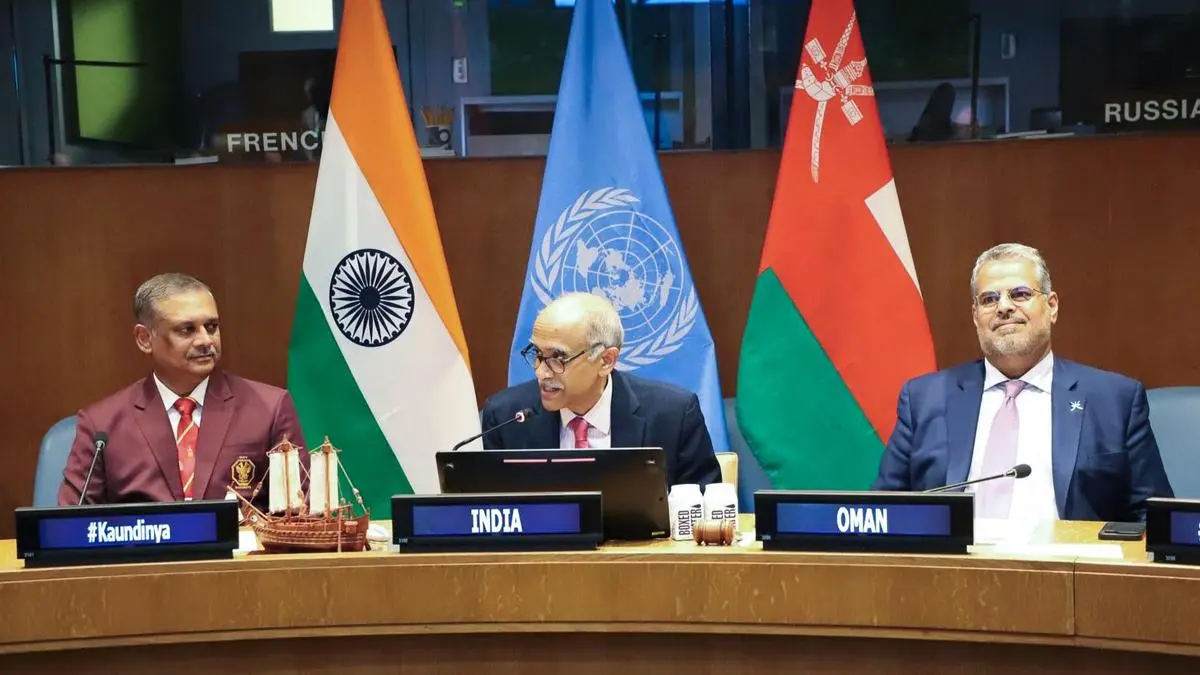
The United Nations Security Council is broken because it was designed to be a museum piece, not a functional executive body for the modern era. When India’s Permanent Representative to the UN, Ambassador Harish Parvathaneni, told a chamber chaired by China that running the current security architecture is like trying to deploy advanced artificial intelligence on a 1945 vacuum-tube computer, he exposed the core structural rot of global governance. The council is failing because its five permanent, veto-wielding members prioritize their own historical privileges over the prevention of global conflict. This architectural paralysis ensures that while geopolitical crises mutate at hyper-speed, the international mechanism meant to contain them remains frozen in the immediate aftermath of World War II.
To understand the depth of the current paralysis, one must look past the diplomatic theater in New York and examine the structural machinery. The Security Council operates on a foundational hypocrisy. Five nations—the United States, Russia, China, Britain, and France—hold the ultimate power to block any resolution, regardless of global consensus. This mechanism was devised in 1945 to keep the victorious Allied powers within a single multilateral tent. It was a pragmatic concession to raw power at the time.
Today, that concession has hardened into an unyielding barrier to global stability.
The Illusion of Collective Security
The original math of the council was simple. In 1945, the five permanent members (P5) balanced a rotating roster of six non-permanent members. That gave the veto holders an immense amount of leverage, but it still maintained a semblance of proportionality relative to the total UN membership at the time. When the non-permanent category expanded to ten seats in the 1960s, it looked like progress.
It was actually the opposite.
By expanding only the temporary, rotating seats while keeping the permanent category exclusive, the relative power of the veto-wielding core actually intensified. The ratio of permanent to non-permanent members shifted, leaving the real decision-making power even more concentrated in the hands of the original five. The hundreds of other nations joined an organization where their collective voice could be nullified by a single stroke of a pen from a permanent member.
Consider the baseline mechanics of how this plays out in real-time. When a localized conflict erupts or a major power violates territorial integrity, the Council meets. If a permanent member or one of its client states is involved, a veto is virtually guaranteed. The result is total legislative gridlock. This is not a bug in the system; it is the system working exactly as it was designed in 1945 to shield big powers from the consequences of their actions.
The High Cost of the Status Quo
The current fragmentation of global politics has brought this structural defect into sharp relief. The period of temporary diplomatic activism that followed the end of the Cold War has completely dissolved. We are back to a split council, where permanent members use the chamber primarily to score rhetorical points and block their adversaries.
The consequences of this paralysis are measured in human lives and systemic instability.
- Unchecked Conflicts: Major conflicts drag on indefinitely because the council cannot agree on enforceable enforcement mechanisms or peacekeeping mandates that displease any single P5 member.
- The Erosion of Multilateralism: When the primary global security body fails to act, regional coalitions and individual states bypass the UN entirely, leading to a fragmented international order where raw power dictates outcomes.
- Double Standards: The selective application of international law undermines the moral authority of the UN. Aggression is condemned in one region but ignored or shielded in another, depending entirely on the strategic alignments of the veto holders.
The arguments used to defend this status quo are increasingly detached from reality. Opponents of expansion often claim that adding new permanent members would paralyze decision-making even further. They argue that a larger council would become an unmanageable debating society.
This argument ignores the fact that the council is already paralyzed.
A body that cannot act during major global upheavals has already reached peak inefficiency. The fear of future deadlock is a smoke screen used by those who hold power to prevent anyone else from sharing it.
The G4 Strategy and the Veto Dilemma
The push for reform is led by the G4 nations—India, Brazil, Germany, and Japan—who represent a significant share of the world’s population, economic weight, and contribution to UN operations. Their proposal is straightforward: expand the council from 15 to 25 or 26 seats, adding six new permanent members and several new non-permanent seats to fix the severe under-representation of the Global South, particularly Africa.
But the real sticking point is the veto.
Proposed Reformed UNSC Structure (G4 Model)
┌────────────────────────────────────────────────────────┐
│             Total Council Seats: 25 - 26               │
├───────────────────────────┬────────────────────────────┤
│   Permanent Category      │   Non-Permanent Category   │
│   (Add 6 New Members)     │   (Add 4-5 New Members)    │
├───────────────────────────┴────────────────────────────┤
│ * Compromise: New permanent members defer veto power   │
│   for a 15-year period to break diplomatic deadlock.   │
└────────────────────────────────────────────────────────┘
To break the diplomatic logjam, India and its allies have floated a pragmatic compromise: the new permanent members would defer exercising their veto power for a 15-year period. It is a major concession designed to test the waters and prove that a larger permanent core can govern responsibly without instantly grinding operations to a halt.
Yet even this halfway measure faces fierce resistance from entrenched interests. Nations like Italy and Pakistan, operating through the Uniting for Consensus group, oppose any expansion of permanent seats, advocating instead for longer-term rotating seats. This alternative would simply perpetuate the two-tier class system of global diplomacy, keeping the ultimate authority exclusive to the 1945 victors.
Geography and Decolonization
The current composition of the permanent membership reads like a ledger of mid-20th-century colonial history. Entire continents are frozen out of permanent representation. Africa, with over 50 member states and more than a billion people, has no permanent seat on the council tasked with overseeing security on its own soil. Latin America is similarly excluded.
This is not merely an issue of fairness; it is a crisis of legitimacy.
During World War II, millions of soldiers from colonized nations fought and died under Allied commands. More than 2.5 million Indian soldiers served, yet the post-war diplomatic settlement ignored their contributions, cementing power within a select group of Western and Northern powers. Maintaining this exclusion in the current era means the UN is effectively preserving a colonial-era hierarchy.
A security architecture that refuses to adapt to the rise of major economic and demographic powers cannot expect those powers to indefinitely respect its dictates. When the rules of international order are set by a minority, the rest of the world will eventually find other ways to manage their affairs. The United Nations Security Council must either evolve into a living, representative instrument of modern geopolitics or accept its fate as a prestigious, yet ultimately powerless, historical artifact.
The transition away from an outdated system cannot be achieved by tinkering around the edges with rotating schedules. It requires changing the permanent composition of the council to reflect who actually holds stakes in the world today. If the nations holding the veto continue to block this evolution to protect their own monopoly, they will succeed only in guaranteeing the irrelevance of the very institution they claim to lead.