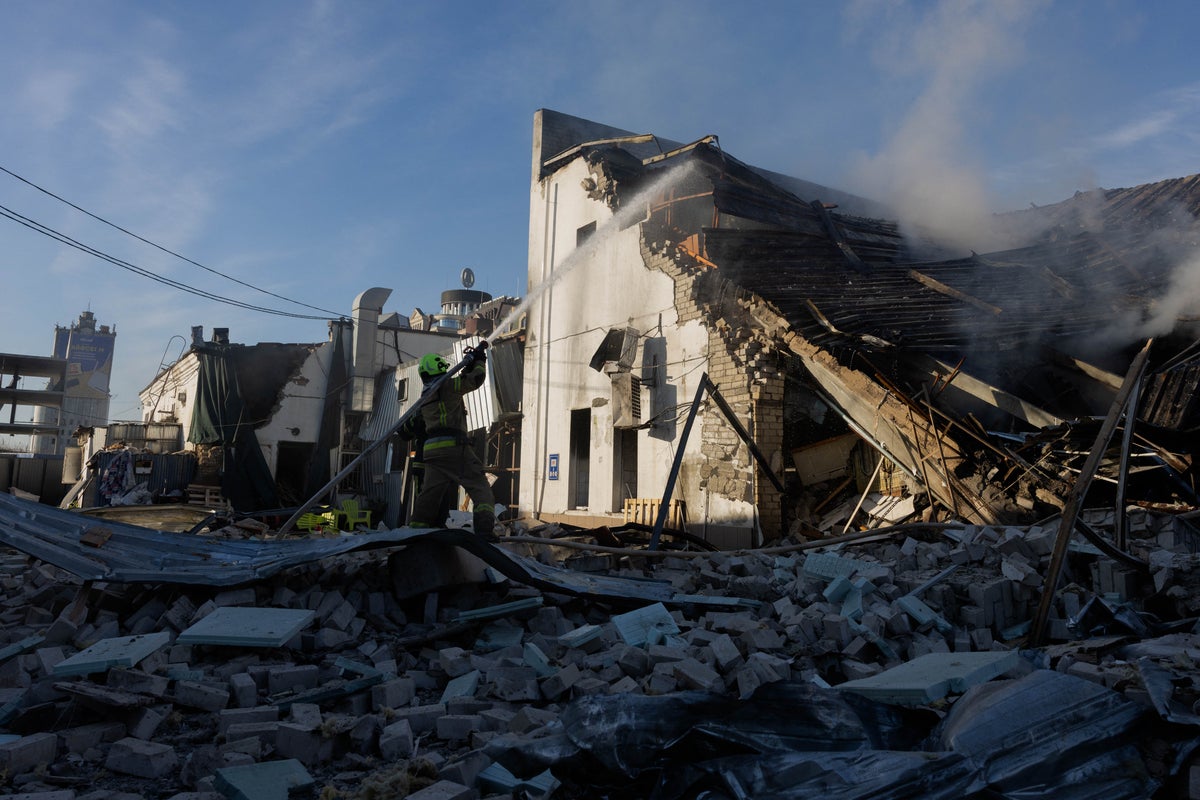
The United States House of Representatives just mounted a direct rebellion against both its own leadership and the White House, passing a new $9 billion Ukraine aid and Russian sanctions package through a rare and aggressive legislative maneuver.
By utilizing a discharge petition to bypass House Speaker Mike Johnson and the Republican leadership, a bipartisan coalition secured a 226-195 victory. The vote functions as a deliberate, structural break from the administration's current foreign policy agenda. While mainstream coverage frames this as a simple partisan squabble, the real story lies in how a fractured Congress engineered a systemic end-run around its own gatekeepers, exposing deep fissures over the limits of executive authority in modern warfare.
The Mechanics of Mutiny
For decades, the discharge petition was viewed by Capitol Hill insiders as a legislative unicorn: talked about constantly, but rarely seen in the wild. It requires 218 signatures to force a bill out of committee and onto the floor, effectively stripping the Speaker of the power to dictate what the chamber votes on. In a highly polarized Washington, gathering those signatures usually requires a level of cross-party alignment that party whips can easily crush.
Not this time.
A core group of 18 Republicans defied leadership pressure to join forces with Democrats, using the mechanism to advance the Ukraine Support Act sponsored by Representative Gregory Meeks. The legislation provides $1 billion in direct security and reconstruction aid and unlocks another $8 billion through military finance loans, while simultaneously extending the Ukraine Security Assistance Initiative through 2027.
This was not a spontaneous burst of bipartisanship. It was a calculated cold war within the Republican party.
National security hawks, including several members of the House Armed Services Committee, chose to align with their ideological opponents rather than submit to the administration's current negotiating posture. The rebellion signals that on matters of global security, a shadow majority is willing to burn down institutional norms to project American power abroad.
The Strategy of the Shadow Majority
The official line from Republican leadership was that the bill was premature and counterproductive. House Majority Leader Steve Scalise argued that the measure would undercut active, complex negotiations between Congress and the White House aimed at securing a different, theoretically stronger deal.
Opponents of the bill also attacked its substance. Representative French Hill criticized the text as an outdated framework that technically reduces funding for certain security initiatives compared to previous defense policy agreements. Others slammed it as an explicit political weapon designed to embarrass the administration.
But these arguments miss the underlying anxiety driving the mutiny.
Pro-defense institutionalists on the right are watching Ukrainian ammunition stockpiles deplete in real-time under relentless Russian air assaults. They have grown tired of waiting for executive branch disbursements, pointing to hundreds of millions in previously authorized aid that remains stalled in bureaucratic limbo. For these lawmakers, the vote was an act of raw policy preservation. They believe that waiting for a perfect deal negotiated by leadership would mean presiding over a collapse on the ground.
Institutional Decay and the Rise of Route-Around Governance
The success of this discharge petition is part of a broader, more disruptive trend in the current Congress. Lawmakers are increasingly using this exact mechanism to route around leadership roadblocks, having recently used it to force action on unrelated high-profile bills.
When the traditional committee system and the Speaker’s office stop functioning as places of compromise, the rank-and-file will inevitably find alternative plumbing.
| Legislative Factor | Traditional Process | The Discharge Petition Path |
|---|---|---|
| Gatekeeping | Speaker controls floor schedule. | Majority of members force the floor schedule. |
| Party Discipline | High; party leaders punish defectors. | Low; safe-seat rebels can insulate themselves. |
| Policy Outcomes | Carefully curated, highly partisan packages. | Sharp, focused, single-issue legislation. |
This shift shifts the power dynamics of Washington. If the Speaker can no longer guarantee what bills make it to the floor, their leverage over the caucus evaporates. The House becomes less like a disciplined corporate hierarchy and more like a fluid, unpredictable parliament where temporary coalitions form and dissolve on a case-by-case basis.
The Senate Reality Check
Despite the high-stakes drama in the House, the Ukraine Support Act now faces a steep uphill climb.
Supporters hope the momentum will pressure the upper chamber to take up the bill, but institutional realities remain unchanged. The legislation requires 60 votes to clear the Senate, a threshold it is highly unlikely to meet without an explicit endorsement from the administration—an endorsement that is not forthcoming.
Even proponents of the House bill, like Representative Brian Fitzpatrick, openly acknowledge that the measure is likely dead on arrival in the Senate.
Instead, the true value of the vote is symbolic and diagnostic. It acts as a stress test for American foreign policy, proving that while the executive branch handles the day-to-day execution of statecraft, the power of the purse remains a volatile, independent variable. The House has sent a clear message to international allies and adversaries alike: the American consensus on global leadership is fractured, but it is far from entirely broken.
The immediate consequence of this vote is not a sudden influx of weapons to the frontlines, but a permanent shift in how domestic political leverage is wielded. By proving that leadership can be completely bypassed on a major foreign policy issue, the shadow majority has altered the mechanics of legislative governance for the remainder of this term.