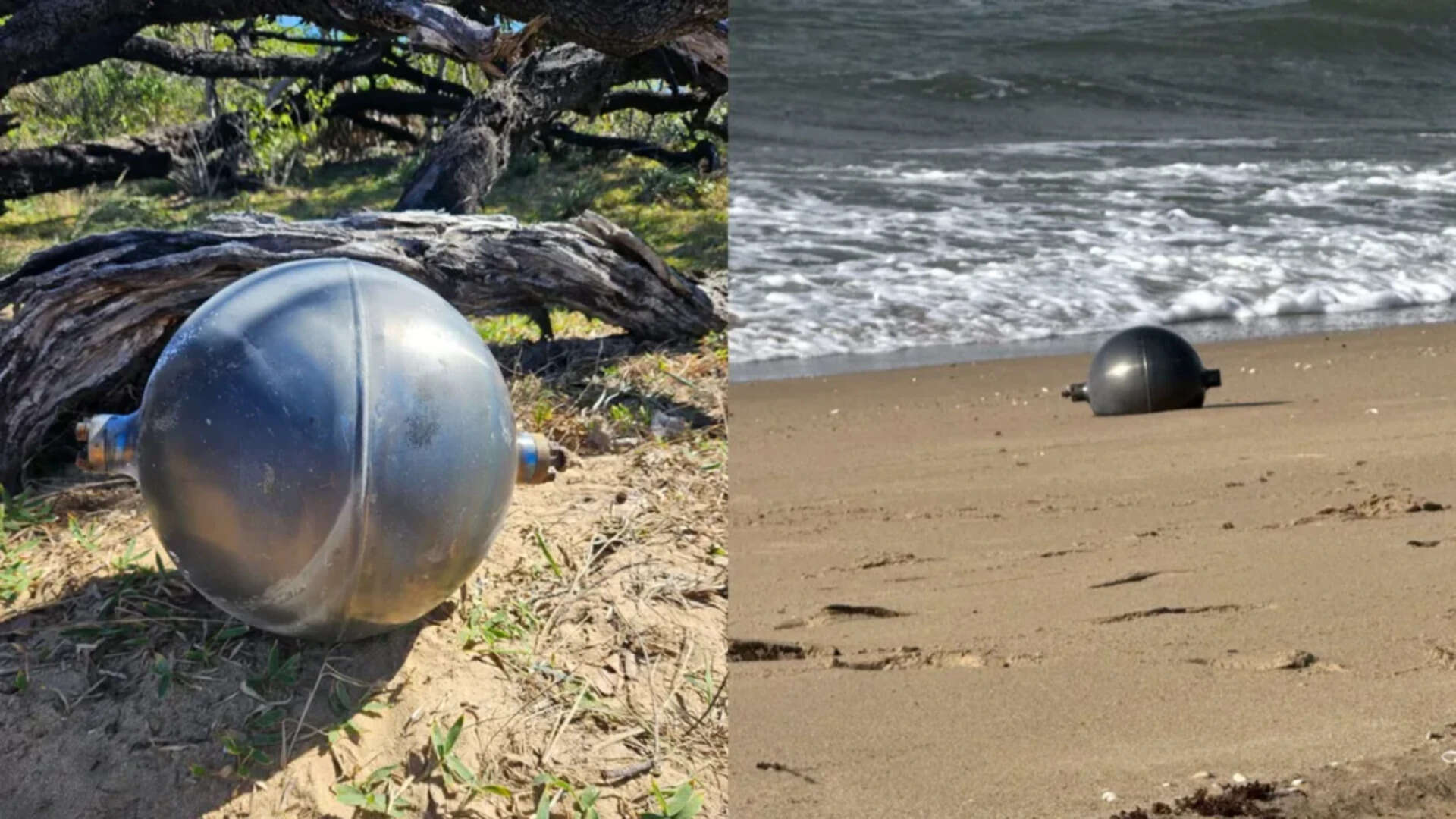
You are walking along a remote stretch of coastline, enjoying the salt air, when you spot something bizarre. It looks like a metallic sphere, twice the size of a basketball, partially buried in the sand. It is rusted, covered in barnacles, and looks like it dropped straight out of a science fiction movie. This isn't a hypothetical scenario. It keeps happening.
When mysterious space balls wash ashore on Australian beaches, the internet immediately goes wild with conspiracy theories. People talk about aliens, secret military weapons, or undiscovered deep-sea creatures. The reality is actually much more grounded, but it's arguably more terrifying. We have a massive space junk problem, and our oceans are becoming the ultimate dumping ground for cosmic debris.
Scientists will tell you that these discoveries are far more common than people think. Every single year, tons of space hardware re-enters Earth's atmosphere. Much of it burns up on the way down, but the heavy pieces survive the intense heat. Because oceans cover over seventy percent of our planet, most of these surviving fragments splash down unnoticed. Australia, with its massive coastline and positioning under various orbital paths, gets a front-row seat to this falling debris.
What These Strange Metallic Spheres Actually Are
They look otherworldly. They look dangerous. But if you talk to an aerospace engineer, they will recognize them instantly. These metallic spheres are almost always Carbon-Overwrapped Pressure Vessels or titanium fuel tanks.
Rockets require immense pressure to push fuel and oxidizers into their engines. To handle that pressure without adding massive amounts of weight, space agencies use high-strength spheres. Titanium survives the brutal heat of atmospheric re-entry incredibly well. While the main body of a rocket stage melts away into vapor as it plummets back to Earth, these tough little spheres drop right through the fire. They hit the ocean, float along the currents, and eventually ride the waves onto a beach.
We saw a massive example of this when a giant cylinder washed up on a beach near Green Head, Western Australia. Local residents found a huge, copper-colored cylinder that looked entirely alien. The Australian Space Agency jumped on the case quickly. They collaborated with international partners and confirmed the object was debris from a Polar Satellite Launch Vehicle operated by the Indian Space Research Organisation. It was a stark reminder that what goes up must come down.
The Hidden Danger of Touching Marine Space Junk
Your first instinct might be to run up and kick it. Don't do that. Finding space debris on a beach presents real, immediate dangers that have nothing to do with alien radiation.
Rocket propulsion relies on incredibly toxic chemicals. Hydrazine is a common rocket fuel, and it's absolutely lethal. It is highly corrosive, toxic to inhale, and can cause severe skin burns upon contact. Even if a tank has spent months floating in the Indian Ocean, there is always a chance that residual fuel remains trapped inside the valves or internal chambers.
Potential Hazards of Beachfront Space Debris:
- Residual toxic propellants like hydrazine or nitrogen tetroxide
- Jagged, torn carbon fiber strands that can pierce skin like glass shards
- Sharp metallic edges caused by structural tearing during re-entry
- High-pressure gases still trapped inside sealed chambers
If you ever encounter an unknown metallic object on the coast, keep your distance. Treat it like unexploded ordnance. Call the local authorities immediately so they can send a team with hazardous material gear to test the area.
Why Australia Attracts So Much Cosmic Trash
It feels like Australia gets hit by space junk more than other places. That isn't just your imagination. The geography and physics of orbital mechanics create a perfect storm for down-range debris drops.
Most space missions launch toward the east to take advantage of the Earth's natural rotation. When rockets lift off from various launch sites around the globe, their spent stages often get discarded over the vast, empty expanses of the Indian and Pacific Oceans. Ocean currents then take over. The Indian Ocean Gyre circulates water in a massive counter-clockwise circle, acting like a giant conveyor belt that naturally pushes floating debris right onto the western and southern coastlines of Australia.
Space tracking networks monitor thousands of pieces of orbital debris every day, but they can't predict exactly where a dying satellite or rocket body will fall. When an object undergoes an uncontrolled re-entry, a tiny change in atmospheric density can shift the impact zone by thousands of kilometers. Australia's sheer size makes it a massive target for these stray pieces of space history.
The Broken System of Space Traffic Control
International space law technically covers these incidents, but enforcing it is a nightmare. The Liability Convention of 1972 states that a launching country is absolutely liable to pay compensation for damage caused by its space objects on the surface of the Earth.
But what happens when an object just washes up on a beach without damaging anything? Usually, the country that launched it doesn't want to pay the massive logistical costs required to ship a rusted piece of junk back across the world. The local government ends up picking up the tab for cleanup and disposal.
The current system relies heavily on the honor system. Space agencies are supposed to design their rockets to burn up completely or ensure they perform controlled re-entries into a remote area of the Pacific Ocean known as Point Nemo. Point Nemo is the furthest place on Earth from any landmass, making it the ideal spaceship graveyard. Unfortunately, budget constraints and technical failures mean many rocket stages are simply left in orbits that decay naturally over time, leading to unpredictable crashes.
How to Handle a Coastal Space Find
If you are beachcombing and come across something that looks like a pressure sphere or a piece of a rocket panel, you need a clear action plan.
First, step back at least twenty meters. Take photos from a safe distance if you want, but do not touch the object or breathe in any fumes that might be escaping from it. Look for any visible serial numbers or markings without getting too close, as these can help experts identify the origin quickly.
Next, notify the police or the Australian Space Agency. Provide them with exact GPS coordinates. Local rangers will typically cordoning off the section of the beach to keep curious tourists and dogs away from the site until aerospace experts can verify that the object is safe to handle.
The frequency of these discoveries will only increase. We are launching more satellites now than at any other point in human history. Commercial space companies are putting up massive constellations of internet satellites, and nations are racing to establish new orbital infrastructure. More launches inevitably mean more spent stages, more failing hardware, and more metallic spheres washing up on the sand. Pay attention to the tides, keep your eyes open, and remember that the next strange object you see on the shore might have spent the last decade circling the earth at twenty-seven thousand kilometers per hour.